KDF Water Filter Replacement Timing and Contaminant Removal
October 23, 2026 · 16 min read

A KDF water filter is generally replaced about every 8 months to 1 year, depending on its application. That interval is a starting point, not a universal schedule. Water quality, usage, and the filter’s role in the system all affect when replacement makes sense.
It’s easy to assume a filter needs replacing only when the water tastes or smells different. But taste is not a reliable measure of how well a filter is working. This guide explains how KDF media works, what it may reduce, and how combining it with activated carbon can affect filtration.
You’ll also learn what to consider when choosing a replacement, why KDF cartridges don’t all follow the same schedule, and how to assess performance claims. The goal is a practical way to understand replacement timing and compatibility without treating every KDF filter as interchangeable.
Key Takeaways
- Use the cartridge’s recommended schedule as your starting point. Application, water quality, and usage all affect replacement timing.
- Before pairing KDF media with another filter, consider the system’s cartridge fit and how the stages work together.
- KDF uses a copper-zinc alloy and redox reactions to change certain contaminants. Understanding that process helps clarify what the media may do.
- Claims about KDF improving carbon adsorption need context. Learn why a staged system may affect the load on activated carbon.
- Compare the filtration purpose with the actual system design to decide whether an under-counter or inline option better fits your setup.
Can KDF filters be used with other types of filters?
Yes. A KDF stage can be combined with other media when the cartridge and housing are designed for that arrangement. What matters is each medium’s role, not simply the number of stages.
Combining KDF with Other Filter Media
KDF is a high-purity copper-zinc alloy that uses oxidation-reduction reactions, or redox, to change certain dissolved substances. In a staged cartridge, this process can work alongside activated carbon, which adsorbs some substances onto its surface. The design matters: layers, flow direction, and contact time determine how water meets each medium. Assess a combined filter as one system, not as a sum of generic media claims.
Combining media can involve practical trade-offs. Each stage takes up cartridge space and adds resistance to flow. A cartridge designed for one housing may not fit another, even if both contain KDF and carbon. Before treating two combinations as interchangeable, check the complete cartridge’s intended use, flow requirements, and documentation.
Comparing KDF with Other Filtration Types
KDF relies on redox reactions, while activated carbon works mainly through adsorption. Reverse osmosis uses membrane separation, and catalytic carbon is treated to support catalytic reactions. These mechanisms differ, so one material cannot stand in for another. A combined system may use several approaches, but its design and performance evidence determine what the stages accomplish.
For example, an under-sink cartridge containing KDF and carbon differs from a reverse-osmosis system with a membrane. The first combines media in a cartridge; the second uses membrane separation as part of its treatment process. Catalytic carbon also differs from standard activated carbon in its surface chemistry. Compare the exact system and stated treatment targets instead of assuming these categories deliver identical results.
Does NSF/ANSI certification apply to every KDF filter? No. A certification claim about KDF media does not establish certification of the finished cartridge or system. NSF/ANSI 61 is a standard buyers may encounter for drinking-water system components; check the certificate’s scope and model, and distinguish material-safety certification from evidence of contaminant reduction.
KDF media is described as durable, but the cartridge’s other materials still affect maintenance. Carbon, seals, and the housing each have their own requirements. Follow the instructions for the complete filtration system, including its specified replacement schedule. Changes in taste or flow can prompt attention, but neither observation alone shows how well the filter is treating water.
How to check the compatibility with filtration systems?
Check the cartridge, housing, and system instructions together. A KDF grade alone doesn’t tell you whether a replacement will fit or suit your water-treatment goal.
KDF media uses a copper-zinc alloy in redox reactions, transferring electrons to change certain contaminants. This describes the treatment mechanism, not a particular cartridge’s connections or capacity. Compatibility also depends on housing dimensions, connection type, flow direction, and the system’s intended operating conditions.
KDF-55 and KDF-85 are separate grade labels. The grade name alone doesn’t establish which one suits a particular system or what contaminants a finished cartridge reduces. Compare the product’s stated application and supporting performance information. KDF-55 media is also sold in a 1-pound quantity, but loose media requires a housing designed to contain it; it is not automatically a drop-in cartridge replacement.
Use these checks before choosing a grade or replacement:
- Identify the existing setup: Record the housing model and cartridge type. A loose-media vessel and a sealed cartridge housing take different formats.
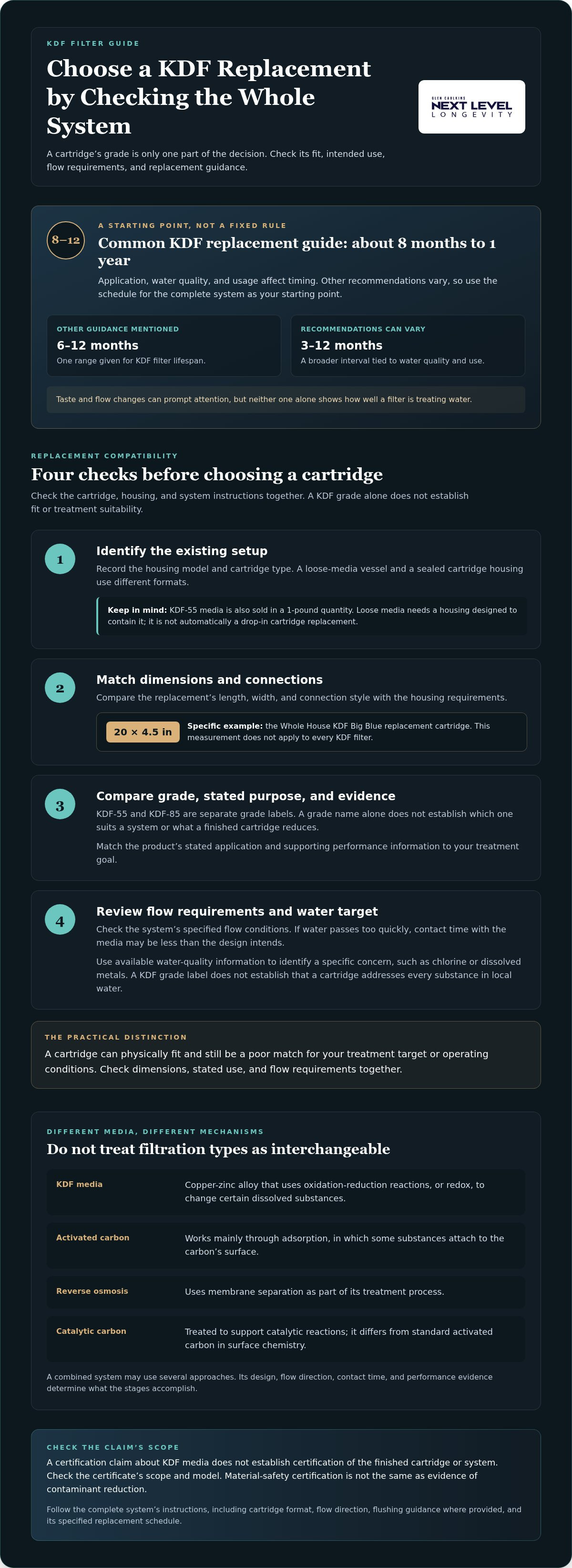
- Match the dimensions: Compare the replacement’s length, width, and connection style with the system requirements. The Whole House KDF Big Blue replacement cartridge is sized 20 x 4.5 inches; that measurement applies to that cartridge, not every KDF filter.
- Compare the grade and purpose: Match the media grade to the product’s stated application and treatment documentation, not just a similar-sounding label.
- Review flow requirements: Check the system’s specified flow conditions. Water that passes too quickly may have less contact with the media than the design intends.
Local water composition helps define your treatment target. Start with the water-quality information available for your supply, then identify the specific concern, such as chlorine or dissolved metals. A product’s KDF grade cannot replace this step: the grade label doesn’t establish that the cartridge addresses every substance in local water.
Install the cartridge according to the housing’s design. Follow its flow-direction markings, use the accepted cartridge format, and follow flushing instructions where provided. Don’t put loose media into a housing that wasn’t designed for it. In a multistage system, keep the intended stage order, since changing it alters the path water takes through the media.
These checks distinguish physical fit from treatment suitability. A cartridge may fit the housing yet still be a poor match for your target or operating conditions. Check three things together: compatible dimensions, an appropriate grade and stated use, and flow requirements that match the filtration system.
How often should I replace my KDF filters?
A common replacement guide is about 8 months to 1 year, depending on application. Other recommendations place KDF filters within a 6 to 12 month lifespan or suggest replacement every 3 to 12 months, based on water quality and use. These intervals differ because cartridges and operating conditions differ.
In the United States, KDF filters and replacement cartridges are priced according to the case, with pricing provided after a quote request. Cartridge format, media, and system compatibility affect the cost.
KDF Filter Replacement and Maintenance
Replace a cartridge or its media according to the instructions for that specific system. This distinction matters because a cartridge may contain several materials, each with different service needs. The expected lifespan of KDF alone may not reflect the replacement needs of the complete cartridge.
Keep the cartridge packaging or product record with the system’s model information. If your household has separate kitchen-faucet and shower filters, label each record with its location and model. This makes it easier to follow the right schedule when replacement parts look similar but serve different uses.
After replacing a cartridge, follow the system’s instructions for restarting and flushing. Record the date and maintenance performed. This history can help you assess later changes in flow or taste and distinguish routine replacement from an unexpected system issue. Don’t extend a replacement interval just because the water still looks clear.
Replacement Frequency and Intervals
Replacement guidance can span 3 to 12 months, 6 to 12 months, or about 8 months to 1 year. Treat those ranges as recommendations for different applications, not as competing promises about every cartridge. The product’s own schedule takes priority because its design, water conditions, and intended use shape the interval.
Usage affects how much water passes through the media, and water quality matters too. A system treating water with a different contaminant load faces different operating conditions. A cartridge in a high-use household shouldn’t automatically follow the same calendar schedule as one in a lightly used point-of-use filter.
Build a replacement record that captures the details you’ll need for the next change:
- System and cartridge: Write down the model and the location where it is installed.
- Installation date: Record when the current cartridge entered service.
- Maintenance notes: Add flushing or other care required by the system instructions.
- Next review: Use the cartridge’s stated interval to set a reminder, then account for actual use.
This record ties replacement decisions to the actual cartridge rather than a broad category estimate. It also preserves a clear maintenance history when different stages have different schedules. Use the complete system instructions to identify which part is due, and track each cartridge separately.
KDF's claimed effects on carbon adsorption
Combining KDF media with activated carbon brings two treatment processes into one filtration path. One claimed benefit is that KDF may change the workload or adsorption performance of the carbon stage. For drinking water, distinguish a proposed mechanism from measured performance for the complete cartridge.
Activated carbon adsorbs substances onto accessible surfaces in its porous structure. In a carbon block, water passes through the compressed material, where contact with those surfaces supports adsorption. KDF works differently. A system can place KDF before carbon so each stage has a defined role, rather than treating the materials as interchangeable.
One claim about this pairing is that KDF’s interaction with water molecules increases the carbon block’s effective surface area, allowing it to adsorb more impurities. “Effective surface area” means the carbon surface available to interact with water and dissolved substances. The claim alone doesn’t show that a particular cartridge removes more contaminants. That conclusion requires performance data for the complete design.
Another proposed advantage is reducing the load on downstream carbon. For example, if an upstream KDF stage changes or reduces chlorine, less chlorine may reach the carbon stage. Any resulting benefit depends on the media, cartridge layout, water conditions, and target contaminant. A general description of KDF and carbon cannot establish a specific cartridge’s service life or removal performance.
In a KDF carbon cartridge, media may be arranged in separate layers or in a combined design. Layer order affects the path water follows. A staged cartridge might direct incoming water through KDF first, then activated carbon. Another design may use a mixed bed. The system’s construction and documented test conditions determine what these arrangements demonstrate.
When reading a product claim, separate three questions:
- What is claimed? Look for a named contaminant, such as chlorine, rather than a broad phrase like “more impurities.”
- Which component was tested? Media-level results do not automatically describe a finished carbon block or cartridge.
- What does the evidence measure? A stated reduction under test conditions does not establish identical results in every home.
These distinctions matter because adsorption changes as carbon surfaces become occupied, while KDF works through a different redox process. A claim that KDF extends carbon performance needs evidence tied to the cartridge, its operating conditions, and its replacement schedule. Changes in taste alone cannot show that adsorption capacity has increased or contaminant removal remains effective.
Treat enhanced adsorption as a design claim to assess, not a guaranteed property of every KDF and carbon combination. The most useful comparison is between documented results for the complete filtration system and the specific contaminants it is designed to address.
Chlorine, lead, mercury, and heavy-metal removal
KDF media is used in water treatment to target chlorine and certain dissolved metals, including lead, mercury, copper, nickel, and chromium. Its redox process changes some contaminants through electron transfer. This mechanism differs from physical screening, and it doesn’t mean every cartridge performs identically.
Chlorine is often discussed because it can affect water’s taste and smell. KDF media is designed to reduce chlorine through a chemical reaction. In a combined cartridge, an upstream KDF stage may also reduce the chlorine reaching downstream activated carbon. Whether this improves a specific system’s performance depends on its complete design and test results.
Lead and mercury require a more specific distinction. KDF redox media is described as treating water-soluble forms of these metals, along with other dissolved metals. A removal claim should identify the metal and the form tested. “Heavy metals” is a broad category, not a single contaminant with one shared treatment outcome.
The same care applies to bacterial claims. KDF media is described as inhibiting microorganism growth inside a filter. That doesn’t mean a KDF cartridge disinfects water or removes every bacterium. Microbial control and contaminant reduction are separate performance questions. The filter’s intended use and test documentation should make that distinction clear.
To assess a product claim, look for details connecting the result to the system you plan to use:
- Named contaminant: Check whether documentation addresses chlorine, lead, mercury, or another specific substance.
- Tested configuration: Confirm whether results apply to KDF media alone or the complete cartridge, including any carbon stage.
- Operating conditions: Consider how the tested flow and water conditions relate to the intended setup.
- Claim wording: Distinguish reduction from complete removal, and note whether the statement applies to dissolved metals.
A percentage without those details can create false precision. Results from one tested sample and configuration don’t establish the same result for every installation. Household water composition, flow, cartridge design, and maintenance all affect what reaches the tap.
For a drinking-water decision, start with the contaminant you want to address. Then match that target to performance information for the complete filter instead of relying on a broad label such as “heavy-metal removal.” This keeps chlorine, metal, and bacterial claims in their proper scope.
Glen B. Caulkins’s research into water chemistry explores how treatment choices relate to the composition of finished drinking water.
Glen B. Caulkins: Under-Counter Water Revival System
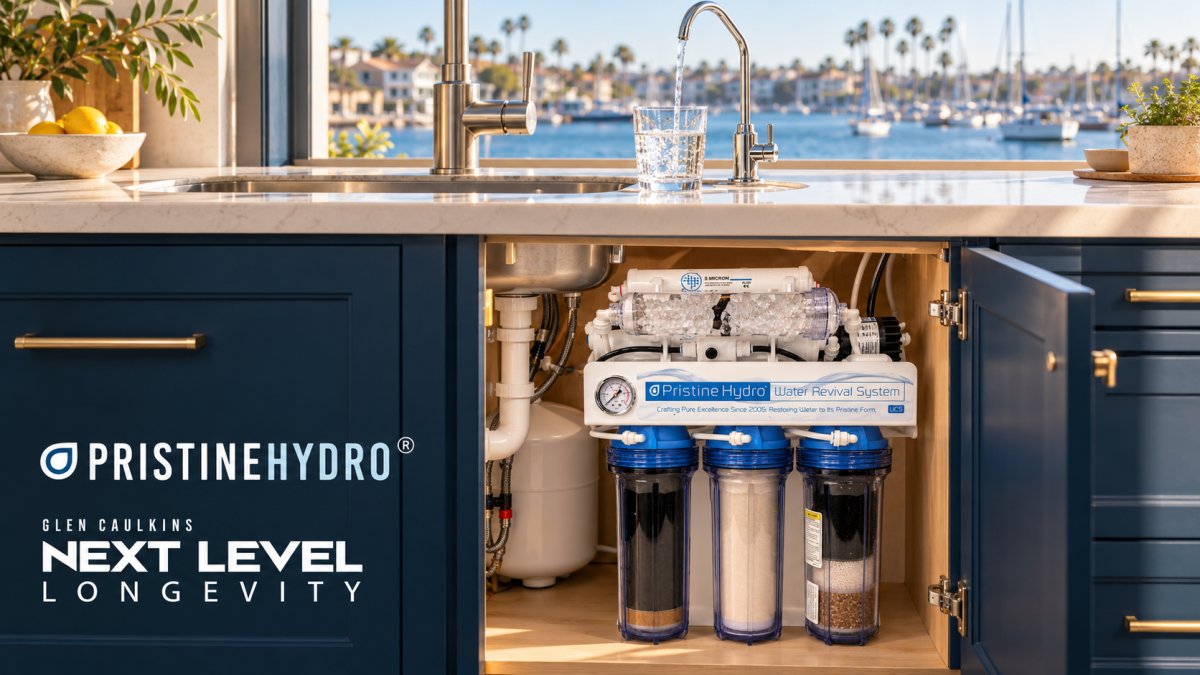
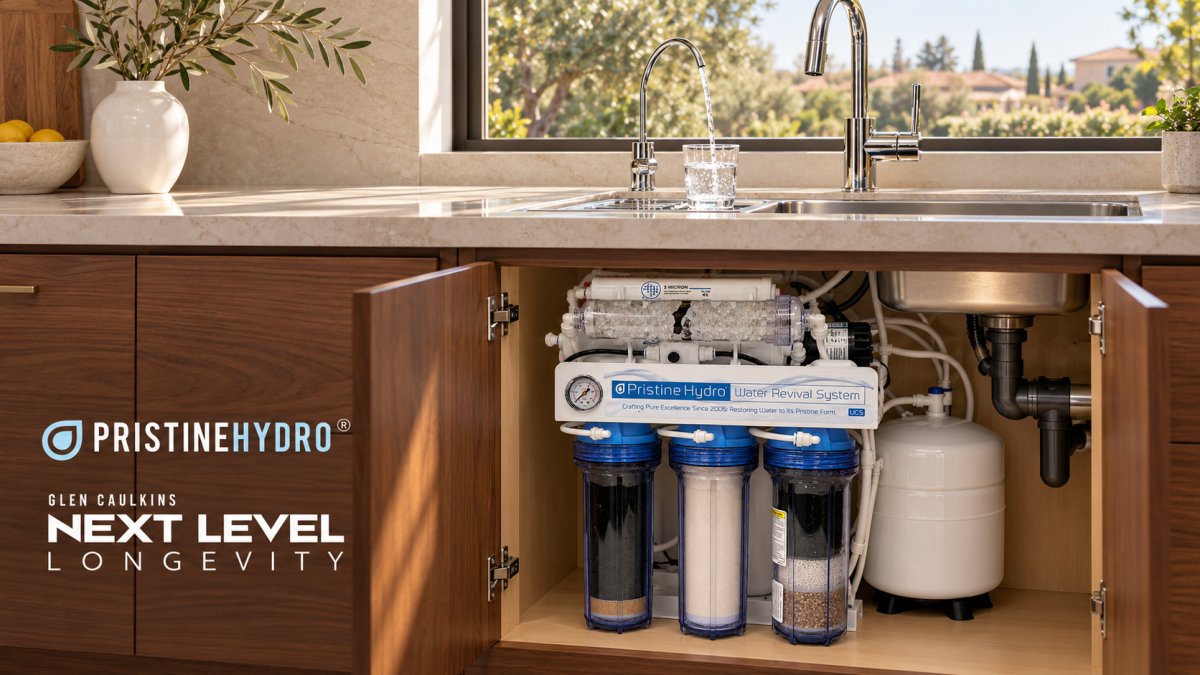
The Under-Counter Water Revival System is a practical option for readers considering home drinking-water filtration. It connects the questions in this guide, including treatment goals, system compatibility, and ongoing filter replacement, with a residential system designed around filtration and finished-water structure.
If your question is specifically about an inline KDF option, explore the Ultimate Dual KDF inline filter. The right choice depends on whether you want an under-counter system or an inline filter for a particular use.
For a closer look at the system and how it can fit into your water setup, visit Glen B. Caulkins’s product information.
Choose a Filtration Path That Fits Your Water
The next step is to connect your treatment goal with the system you use. A KDF water filter is one part of that decision, alongside cartridge design, other media, and a replacement plan. Focus on your water and setup rather than choosing by material name alone.
For a home drinking-water setup, consider Glen B. Caulkins’s Under-Counter Water Revival System. The Travel-Portable Water Revival System offers a different format, while the Aqualux filter with head is another option within the range. Each serves a distinct use, so the right comparison begins with where and how you want to treat water.
If you’d like to explore these options in the context of your filtration questions, contact Glen B. Caulkins. A thoughtful next step can make the system easier to understand and maintain.
Frequently Asked Questions
Can KDF filtration media help reduce scale buildup in plumbing systems?
No. KDF filtration media is generally used for contaminant treatment rather than as a dedicated approach to hard-water scale in plumbing or fixtures. Scale control and contaminant reduction are separate treatment goals. If mineral deposits are your concern, identify water hardness as the issue first, then choose a method designed for that purpose. KDF has a different role, even when included in a multistage filter.
Do KDF filters work?
Yes. KDF media uses redox chemistry to change certain contaminants, including chlorine and dissolved metals. What a complete filter reduces depends on its design, intended use, and supporting performance evidence. For example, evaluate a cartridge containing KDF and carbon as a complete unit, rather than assuming each stage delivers every result associated with its media. Match the documented treatment purpose to your water concern.
Are KDF filters safe?
KDF media is described as certified by NSF International to Standard 61 for drinking-water use. That statement applies to the media, not automatically to every finished cartridge or filtration system containing it. Check which component the certification covers and whether the full system has separate documentation. For a household in Laguna Woods, Newport Beach, Costa Mesa, Laguna Beach, Carlsbad, or Irvine, evaluate the specific product and local water needs.
How Does KDF Work to “Charge” a Carbon Bed?
The word “charge” can suggest that KDF electrically powers carbon, but their treatment processes are distinct. KDF uses redox reactions, while activated carbon adsorbs substances onto its surface. Some claims say KDF increases carbon’s effective surface area, but that doesn’t establish improved performance for every cartridge. Look for evidence measured on the complete KDF-and-carbon design instead of relying on the metaphor alone.
What Contaminants Does KDF Remove?
KDF media is used to reduce chlorine and certain dissolved metals, including lead, mercury, copper, nickel, and chromium. The specific result depends on the filter design and contaminant form. A broad “heavy metals” claim doesn’t show that every metal was tested. Documentation naming lead, for example, provides clearer guidance than a general metals claim. Review the tested substances and system configuration together.
What Is KDF and What Are Its Benefits for Water Filtration?
KDF is a high-purity copper-zinc alloy used as filter media. Its redox process changes some contaminants, and KDF can be paired with activated carbon in a staged system. Each medium then has a different treatment role, offering the option to address more than one target in one system. The cartridge’s documented performance, not the combination alone, defines its demonstrated use.
What Is KDF?
KDF stands for Kinetic Degradation Fluxion, the name used for copper-zinc alloy media in water filtration. The alloy transfers electrons during oxidation-reduction reactions, changing certain dissolved substances. It is a treatment medium, not a complete filtration system. When reading product descriptions, distinguish loose media from a cartridge or finished system, since the formats have different housing and installation requirements.
What is KDF media in a water filter and how does it work?
KDF media is the copper-zinc material inside a kdf water filter. Water passes through it, where redox reactions change certain contaminants rather than simply trapping them in a screen. The cartridge may also contain carbon or other media. Check the system’s treatment purpose and replacement instructions as a whole, since the media name alone doesn’t describe every stage or its service needs.
Frequently Asked Questions
Can KDF filtration media help reduce scale buildup in plumbing systems?
Do KDF filters work?
Are KDF filters safe?
How Does KDF Work to “Charge” a Carbon Bed?
What Contaminants Does KDF Remove?
What Is KDF and What Are Its Benefits for Water Filtration?
What Is KDF?
What is KDF media in a water filter and how does it work?
More articles