The Ultimate Guide to a Real Water Filter System
October 15, 2026 · 16 min read
What if the right RO Filter isn’t the one with the most stages, but the one that fits your system and needs replacing now? A filter can look nearly identical to another and still use different connections or serve a different stage. That makes it hard to know whether to replace one cartridge or the full set.
The answer starts with your system’s exact model, then with the role each filter plays. This guide explains how sediment, carbon, and membrane stages work, how to match a replacement to your unit, and why a general schedule or broad performance claim may not tell the whole story. You’ll learn which details to compare, what evidence can support a contaminant-reduction claim, and how maintenance affects the system over time.
That practical question connects to Glen B. Caulkins’s wider interest in finished-water chemistry. Glen founded PristineHydro, which sells water systems and replacement filters, so product discussions reflect a commercial interest as well as an educational purpose. The aim here is to give you a clear way to assess fit, timing, and evidence before choosing a filter set.
Key Takeaways
- Distinguish an RO filter cartridge from the complete system, and learn why different stages serve different roles.
- Assess an RO Filter performance claim by checking which contaminant was tested, under what conditions, and for which system.
- Start replacement shopping with your system’s model label, records, and existing cartridge markings to help identify a compatible part or set.
- Use the system’s current instructions and service history to guide replacement timing, since intervals vary by cartridge, water conditions, and use.
- See how Glen B. Caulkins’s interest in water chemistry connects with PristineHydro’s residential systems and replacement filters, without treating research as product-performance proof.
What Is an RO Filter, and What Does It Do?
An RO filter is a replaceable component used in a reverse-osmosis water treatment system. It isn’t the whole unit. Some people use “filter” to mean any cartridge in the system, while others mean the membrane itself. Those parts have different jobs, so the distinction matters when you’re identifying a replacement.
An RO Filter is a system-specific component that treats water as part of a reverse-osmosis setup, not a universal cartridge that fits every system. The membrane is one component, not a synonym for every filter. Other cartridges may sit before or after it, and their design and connections can differ between systems.
How is an RO filter different from an RO system?
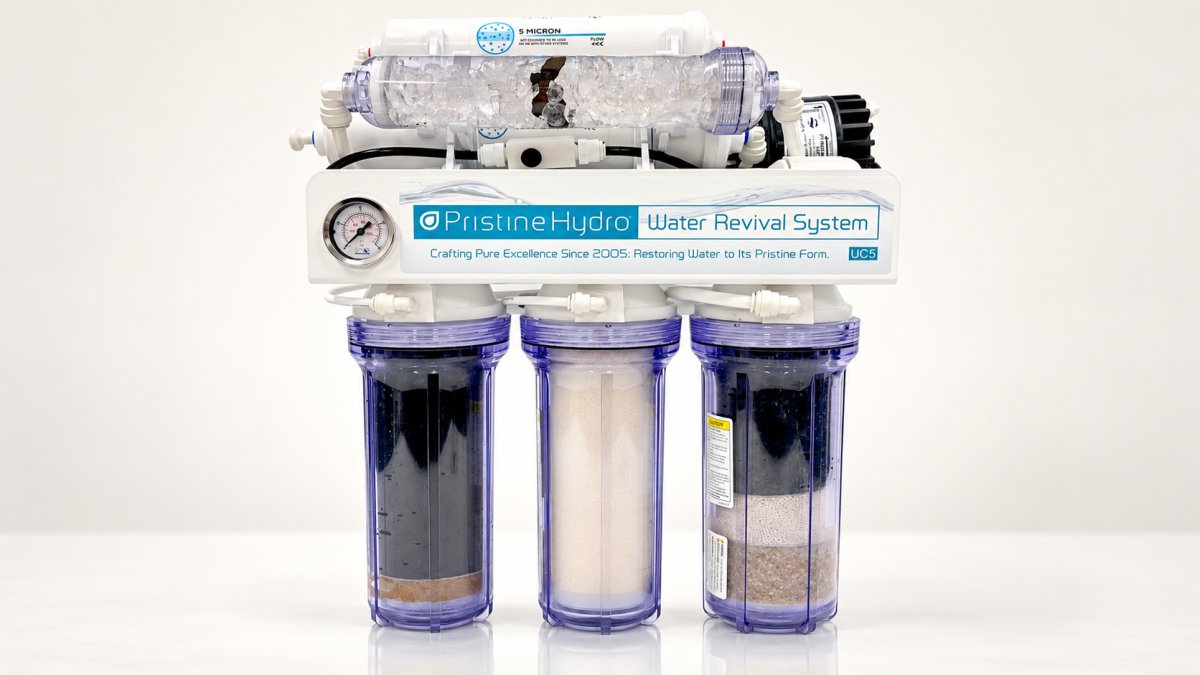
The system is the assembled equipment that moves water through its treatment stages. It may include housings, tubing, a storage tank, a faucet, and several cartridges, depending on its design. For example, one household under-sink setup might have a sediment cartridge, a carbon cartridge, a membrane, and a final polishing cartridge. Another system may use a different arrangement.
What can the filter stages do?
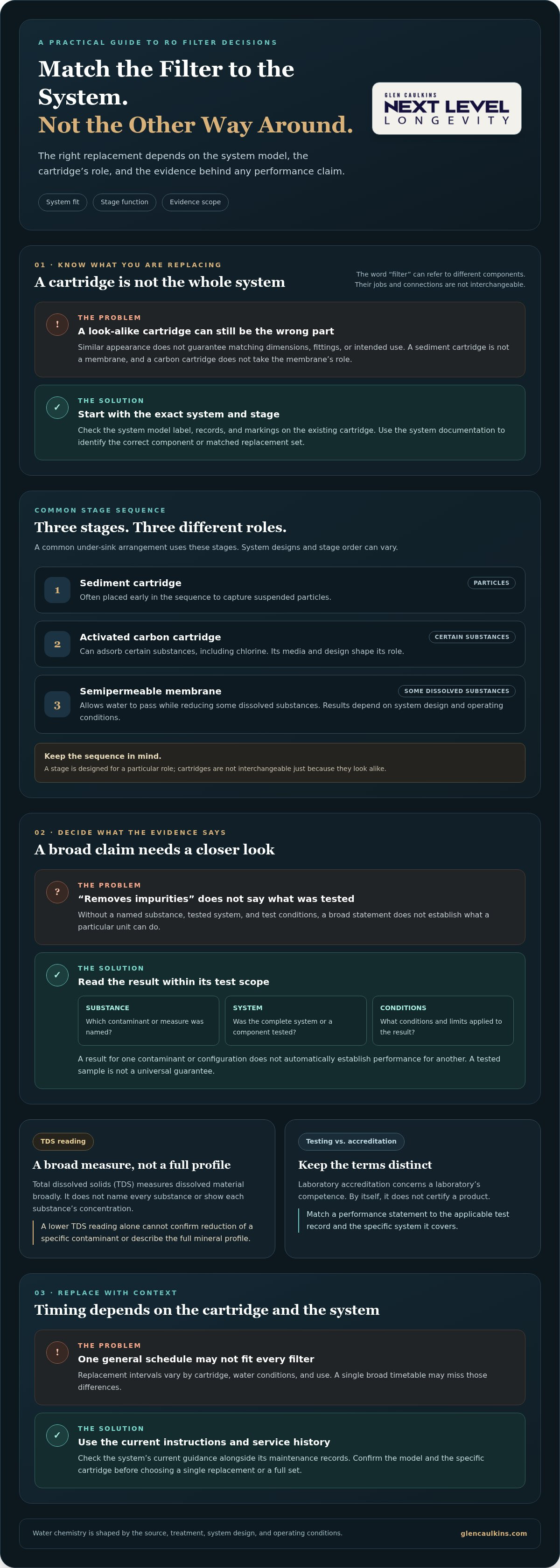
Each stage is designed for a particular role. In a common arrangement, sediment filtration catches particles; activated carbon can adsorb certain substances, including chlorine; and a semipermeable membrane allows water to pass while reducing some dissolved substances. The details depend on the media, system design, and operating condition. Reverse osmosis describes the membrane process and its wider uses.
Think of the stages as a sequence, not a row of interchangeable cartridges. A sediment cartridge is not a replacement membrane, and a carbon cartridge does not perform the membrane’s role. Even cartridges that look alike may have different dimensions, fittings, or intended uses. The label, model number, and system documentation help identify what belongs where.
These stage descriptions are general. They don’t establish what a particular system removes. Performance depends on the complete system, the cartridge condition, and the water being treated. A removal claim should identify the contaminant and the tested system, along with the relevant test conditions. A result for one tested sample doesn’t guarantee the same result for every unit in use.
- Sediment stage: Often placed early in the sequence to capture suspended particles.
- Carbon stage: Uses activated carbon to adsorb certain substances; the media and design shape its role.
- Membrane stage: Uses a semipermeable barrier to reduce some dissolved substances as water passes through.
Knowing the difference is a useful first step. Before choosing a replacement, identify the exact system and the stage you need. The next decision is whether that means one cartridge or a matched set.
What RO Filters Remove, and What Performance Claims Can Establish
A claim that a system “removes impurities” leaves important questions unanswered. Which substance was tested? Was the test performed on the complete system or on a component? What conditions applied? Without those details, a broad statement tells you little about what a particular unit can do.
A measured contaminant-specific result describes what was tested under stated conditions; it is not a blanket claim of complete water purity. The distinction helps keep laboratory evidence useful without stretching it beyond its scope.
How should you read an RO filter performance claim?
Start with the supporting record. Look for the named contaminant, the tested system configuration, and the conditions under which the test took place. Then note any stated limits, such as the test’s scope or the sample involved. A result for one contaminant doesn’t establish reduction of another, and a result for one configuration doesn’t automatically apply to every system.
Certification and testing also mean different things. Laboratory accreditation concerns the laboratory’s competence; it doesn’t, by itself, certify a product. The EPA WaterSense Labeled RO Systems resource explains the program’s criteria for point-of-use systems, including efficiency. Read a claim alongside the applicable record, not as a promise beyond it.
Does a lower TDS reading tell the whole story?
Total dissolved solids, or TDS, is a broad measure of dissolved material in water. A reading can help compare samples, but it doesn’t name every substance present or show each substance’s concentration. Two samples with similar TDS readings can have different chemical compositions.
So, a lower reading alone can’t confirm the reduction of a specific contaminant, describe the full mineral profile, or establish that water is safe or unsafe. Those conclusions require information suited to the question, such as contaminant-specific testing and relevant water-quality records.
For a careful comparison, separate three things: what a reading measures, what a performance report tested, and what the result can reasonably establish. Keep claims tied to the exact system and conditions in the supporting evidence. That approach makes it easier to compare documentation without treating one number as a complete account of water chemistry.
- Identify the substance: A stated result should name the contaminant or measure.
- Check the test scope: Match the result to the tested configuration and conditions.
- Keep conclusions narrow: Don’t turn one sample or reading into a universal guarantee.
These distinctions reflect a wider interest in how finished water is composed and measured. Explore Glen’s research on water chemistry for more context on that inquiry.
How to Choose Between an RO Filter Cartridge and a Replacement Set
Start with the system, not the product listing. Before choosing a single cartridge or a full set, identify the unit’s exact model and configuration. A familiar shape, a matching number of stages, or a label that says “RO” doesn’t establish that a replacement will fit or perform the intended role.
Use these sources to build a clear match:
- Model label: Record the model name or number on the system. Check the unit itself and any available purchase or service records.
- Existing cartridge: Note its printed name, part number, and stage position. These details can help distinguish cartridges that look similar.
- System instructions: Compare the documented replacement part and service schedule with the equipment you have.
If these details conflict, pause before ordering. A stage count alone doesn’t tell you which cartridges are present, and appearance alone doesn’t prove a match.
| Choice | Intended task | Compatibility evidence |
|---|---|---|
| Single cartridge | Replace one specified component when system instructions call for it. | Match the system model and the cartridge’s documented name or part number. |
| Full replacement set | Complete a multi-stage service when instructions specify replacing several components together. | Compare the set’s listed contents with the actual system model and installed stages. |
When might a single replacement cartridge make sense?
A single cartridge may be appropriate when the system’s instructions identify that component for individual replacement. Match the exact model and cartridge details, including its stated stage or part number. Don’t choose by shape alone: similar housings can conceal differences in fittings or intended use. If you can’t reconcile the label with the system record, gather the identifying details before selecting a part.
When might a complete filter set be the better fit?
A set may suit a scheduled service that calls for replacing multiple stages together. Compare every included cartridge with your system’s documented configuration. A set isn’t automatically suitable just because it’s labelled for reverse osmosis; the term describes a treatment method, not a universal fit standard. Confirm that the model and contents match before treating a set as the right replacement.
Practical rule: make the system model the anchor for every comparison. Then use cartridge markings and the current instructions to decide whether the task calls for one part or several. This keeps the decision tied to your equipment rather than a broad category label. If the evidence doesn’t establish a match, don’t infer compatibility from appearance, stage count, or general RO wording.
When Should You Replace an RO Filter?
There isn’t one calendar that fits every system. Replacement timing depends on the cartridge, the system’s instructions, source-water conditions, and how much water the household uses. A schedule for one unit may not apply to another, even if both use reverse osmosis.
Use this sequence to make the decision from system-specific information rather than guesswork:
- Identify the system. Find the model label and record the model name or number. Check your purchase or service records if the label is hard to read.
- Consult current instructions. Look up the guidance for that exact system and cartridge. Follow the stated interval or service conditions rather than a general rule for RO filters.
- Record service dates. Note when each cartridge was installed and replaced. Different stages may have different schedules, so record them separately.
- Review any changes. If flow, taste, or odor changes, consult the instructions and consider whether the system needs inspection. A change can prompt a closer look, but it doesn’t diagnose a worn filter by itself.
Which information should guide a replacement schedule?
Give the current instructions for your system and cartridge the most weight. Source-water conditions and household use can affect maintenance needs, so a neighbor’s schedule or a general online interval may not suit your setup. If the system has changed or you’re unsure which cartridge is installed, first establish the model and component identity. Don’t assume a membrane and other cartridges share the same replacement timing.
Performance claims also have limits. A change you notice isn’t a substitute for a system’s maintenance guidance or applicable test evidence. Water composition varies, and household observations alone can’t show whether a particular contaminant is being reduced as claimed.
What should you record during routine filter care?
A simple record keeps the maintenance history visible. Write down the system model, cartridge identity, installation date, and replacement date. Keep the system instructions with those notes, along with any relevant test documentation. If the system’s configuration changes, update the record so future decisions reflect the equipment that is actually in place.
Follow the manufacturer’s directions for any service work. This section doesn’t substitute for model-specific guidance on installation, flushing, or sanitizing. Avoid relying on taste, appearance, or an undated note as the sole basis for deciding whether to replace a cartridge.
PristineHydro offers residential systems and replacement filters, but fit depends on the specific system and cartridge. Use the model and component details to compare options in PristineHydro’s replacement-filter and product information.
How PristineHydro Fits Into a Thoughtful RO Filter Decision
Choosing a replacement is a practical question, but it also points to a larger one: what is in the finished water, and what can a treatment process tell us about it? Glen B. Caulkins, an author and independent researcher, explores water chemistry and minerals as part of that broader inquiry. His interest is in understanding composition and context, not turning a filter choice into a health promise.
That perspective sits alongside a commercial interest. Glen founded PristineHydro, which offers residential Water Revival Systems and replacement filters. Those products are part of the practical side of his work, but research interpretations and product-performance evidence are distinct. Claims about a specific cartridge or system need support from the applicable product records and test data.
Where does filter choice sit within Glen's water-first perspective?
Filtration is one part of finished-water composition. Treatment can change what is present in water, while source and system conditions also shape the final result. Minerals are one area Glen examines, but their presence or absence alone doesn’t demonstrate a health outcome. A research perspective can raise useful questions; it can’t substitute for product-specific performance evidence or establish that a particular filter fits a particular system.
That distinction helps keep the decision grounded. Match the replacement to the equipment first, then assess any performance statement by its stated scope. A broad idea about water chemistry doesn’t show what a particular cartridge reduces, and a product claim doesn’t resolve every question about water’s composition.
What is a useful next step for local readers?
PristineHydro’s residential systems and replacement filters give readers a place to explore practical water-system options. The product details should guide questions about the intended model, components, and maintenance. Use those specifics rather than assuming an RO Filter or replacement set will fit because the category name sounds familiar.
Readers near Laguna Woods, California, can also visit the local PristineHydro water store. For those comparing products from home, current product information is the more direct starting point. Review the model and filter details alongside your own system records, and keep any performance conclusion within the evidence provided.
View current PristineHydro product and filter information to explore the available details and make a system-specific comparison.
Make Your Next Filter Decision With Care
A clear maintenance record can make future decisions easier. Keep your system documents and service notes together, then add to them whenever a component is changed. Over time, that record gives you a practical reference for understanding your household’s routine and keeping your equipment history in one place.
Filter care also connects to a wider curiosity about water and the environment. Glen B. Caulkins’s work explores those questions as an author and independent researcher. His interest in water chemistry offers a broader context for considering how treatment choices fit into everyday life, while product performance remains a matter of specific evidence.
If you’re ready to compare your system details with current options, explore PristineHydro product information. Let your records guide the next step, and take it with confidence.
Frequently Asked Questions
Is an RO filter the same as a reverse osmosis system?
No. “RO filter” may be used loosely in product descriptions, while a system’s service documents may name the membrane, pre-treatment parts, or polishing cartridge separately. That difference matters when reading an old maintenance note: “filters replaced” may not identify which components were changed. Use the component names in the system’s records to make the service history useful for the next maintenance decision.
How do I know which RO filter fits my system?
Check whether the unit has a model variant or configuration detail in addition to its main model name. This can matter if the system was modified, moved, or bought secondhand. Compare what you find with the current instructions and the cartridge’s identifying marks. If the records and installed parts don’t seem to match, document the discrepancy before ordering instead of assuming the earlier replacement was correct.
Can I replace just one RO filter instead of the whole set?
Yes, if the system’s service plan treats that cartridge separately. Use the maintenance record to see which components were replaced and when, rather than assuming a previous full-set change reset every component’s schedule equally. Some instructions may group stages for service, so follow that guidance. Record the exact part changed; a note that simply says “filter replaced” may not help distinguish stages later.
How often should an RO filter be replaced?
Use the current schedule for your exact system, then keep notes if household use changes. For example, a change in occupancy can alter how often the system is used, which may be relevant to maintenance guidance. Don’t substitute a calendar reminder copied from another household or another model. A dated record helps you see whether your routine still reflects the system’s instructions and actual use.
What does an RO filter remove from water?
Its performance depends on the specific system and the substance named in the supporting evidence. When reviewing a report, check whether it describes the complete treatment unit or only one component, and whether the tested configuration matches the product being discussed. A claim about one substance shouldn’t be extended to others. This keeps a measured result tied to the evidence rather than a general impression of purity.
Does a TDS meter tell me when to change an RO filter?
Not by itself. A single reading is more useful as a point of comparison than as a maintenance verdict. If you track readings over time, use the same meter and follow its instructions so changes are easier to interpret. Even a consistent trend won’t identify which dissolved substances are present or pinpoint which component needs service. Treat the reading as one observation, not a replacement schedule.
Can I use any replacement filter labeled for reverse osmosis?
No. That label describes a broad treatment category, not a promise that the cartridge suits your unit. Read product descriptions for the exact system reference and component designation, and compare them with your own equipment records. Terms such as “universal” or “multi-stage” don’t replace a model-specific match. Keep the packaging or product details with your service notes so you can trace what was installed.
Frequently Asked Questions
How is an RO filter different from an RO system?
What can the filter stages do?
How should you read an RO filter performance claim?
Does a lower TDS reading tell the whole story?
When might a single replacement cartridge make sense?
When might a complete filter set be the better fit?
Which information should guide a replacement schedule?
What should you record during routine filter care?
Where does filter choice sit within Glen's water-first perspective?
What is a useful next step for local readers?
Is an RO filter the same as a reverse osmosis system?
How do I know which RO filter fits my system?
Can I replace just one RO filter instead of the whole set?
How often should an RO filter be replaced?
What does an RO filter remove from water?
Does a TDS meter tell me when to change an RO filter?
Can I use any replacement filter labeled for reverse osmosis?
More articles