What Is Structured Water? Meaning, Claims, and Evidence
October 16, 2026 · 16 min read

What if “structured water” describes several different ideas rather than one established kind of drinking water? That’s the difficulty behind the question “what is structured water”: the phrase can refer to claims about molecular arrangement, methods such as vortexing or magnetic treatment, or laboratory observations near certain surfaces. It can sound scientific while leaving the actual claim unclear.
It makes sense to ask whether this water is meaningfully different, and whether it offers benefits beyond ordinary hydration. Water molecules do form shifting connections with one another, but those arrangements change rapidly in liquid water. That fact alone doesn’t show that a device can create a lasting structure or improve health.
This article separates the main meanings of the term, explains what water chemistry can establish, and considers how well the health claims are supported. You’ll also see why findings from laboratory or animal studies aren’t the same as demonstrated benefits in people. The goal is a clear, grounded way to assess each claim without dismissing genuine questions about water or overstating what the evidence shows.
Key Takeaways
- Understand what is structured water can mean, and why the phrase doesn't point to one clearly defined type of drinking water.
- Learn to look beyond claims about vortexing, magnets, or light by asking what property was measured, under what conditions, and for how long.
- See how to interpret findings from an animal-focused review without treating them as proof of health benefits in people.
- Use a short set of questions to assess a structured-water claim and identify what evidence would make it more convincing.
- Explore how water structure fits within Glen B. Caulkins's wider interests in water chemistry and minerals, while distinguishing measured findings from proposed interpretations.
What does structured water mean?
“Structured water” is a broad label used for different claims about water’s molecular arrangement and how it might be changed. In ordinary chemistry, water has structure at the molecular scale: each molecule can form temporary attractions with nearby molecules. But that established behavior is not evidence that a treatment creates a lasting, meaningfully different kind of drinking water.
So, what is structured water in consumer discussions? It may mean water said to have been altered by a particular process, or water described as having a special arrangement. The meaning depends on the person making the claim. “Hexagonal water” and “magnetized water,” for example, can refer to different proposed structures or treatments. The shared label doesn’t make those claims equivalent.
What does “water structure” mean in chemistry?
A water molecule contains one oxygen atom bonded to two hydrogen atoms. Because its electrical charge is unevenly distributed, it can attract nearby molecules. These attractions, called hydrogen bonds, are weaker than the bonds within a molecule and continually form and break as liquid water moves.
Laage and Hynes’s 2006 paper in Science, “A molecular jump mechanism of water reorientation”, examines how water molecules change their orientation as hydrogen-bonding partners shift. It supports a description of molecular interactions as dynamic. It does not test consumer structuring devices or establish health effects. Observing molecular organization is not proof that a device creates a stable structure that persists in a glass.
Why do people use the phrase “structured water”?
Different proponents use the same phrase for different ideas. Some describe water as “hexagonal,” suggesting a particular arrangement. Others use “magnetized water” for water exposed to a magnetic field. The claims may refer to distinct treatments or proposed properties, so the label alone doesn’t tell you what was done or what changed.
Structured water is a catch-all term for water claimed to have a particular molecular arrangement or altered property, but its meaning varies across proponents and products. That variation makes precise language useful. Ask which property is being claimed, how it was measured, and whether the reported change lasts under ordinary storage and use. A description of a process is not, by itself, evidence of a lasting result.
The Wikipedia overview of hexagonal water discusses how that term is used and presents criticism of related claims. It can help clarify the terminology, but it is not a substitute for primary research. The next step is to look at what proposed treatments actually measure.
How is structured water created and measured?
Descriptions of a treatment don’t establish what changed in the water. Proponents report using magnetic fields, vortexing, or exposure to light, including ultraviolet or infrared light. These methods are claims to investigate, not proven ways to improve drinking water. A description such as “treated with a magnet” tells you what was done, but not whether a relevant property changed, how large the change was, or whether it lasted.
This is where a useful answer to “what is structured water” needs more than a list of devices. It needs a clearly stated claim and a measurement that tests it. A laboratory may detect a change under specific conditions. That result alone doesn’t show that the change persists in stored drinking water or affects health.
What methods do proponents describe?
Magnetic-field treatment, vortexing, and light exposure appear in accounts of structured-water methods. Each approach raises a different question. What part of the water is supposed to change? How was the treatment applied? Was the result measured in the treated sample, and was it compared with untreated water under the same conditions?
Those details matter because “light exposure” or “vortexing” can describe a range of conditions. A claimed effect from a controlled laboratory setup doesn’t establish that household sunlight, swirling water, or a commercial device reliably produces the same result. The method is a starting point for inquiry, not evidence of a lasting structure.
What would evidence of a measurable change need to show?
First, the study should define the property it calls “structured.” That might be a specific physical or chemical feature, rather than a general claim that the water has more energy or works better in the body. It should then use a measurement method suited to that property and explain the conditions, such as temperature and storage, that could affect the result.
A water measurement is meaningful only when the property, method, conditions, and time after treatment are clearly defined. Without that context, a reported number or instrument reading is difficult to interpret or reproduce.
Look for a comparison with untreated water, appropriate controls, and repeat measurements. Timing matters: a reading taken immediately after treatment can’t establish that the same property remains hours later or after storage. Independent repetition also helps show whether the finding reflects the treatment rather than an uncontrolled difference or measurement variation.
Finally, keep two questions separate. Did a study detect a physical or chemical change? And did that change produce a health benefit in people? The first requires reliable measurement; the second requires relevant human evidence. One cannot stand in for the other. Glen B. Caulkins’s broader research on water and related subjects offers a path to explore how water chemistry fits into wider questions about minerals and environmental exposure.
What does the research say about structured water and health?
Health claims should be judged by the kind of evidence behind them. A 2021 review in the Journal of Animal Science examined structured-water research involving animals. It was not a human clinical trial. The review’s reported animal findings therefore can’t establish that people who drink treated water will experience the same outcomes.
The paper can be located through this PubMed search for the 2021 Journal of Animal Science review. Its scope matters: a review discusses prior studies, but neither the review format nor the animal research it examines proves a health effect in people.
What did the animal research review examine?
The review considered studies in which animals consumed water described as structured or treated to alter its properties. It reported outcomes including changes in growth, blood lipid profiles, and oxidative stress. These observations belong to the particular animal studies reviewed. They aren’t established human benefits, and they don’t show that every treatment sold as structured water produces the same results.
The studies also varied in species, methods, and design. A finding in one animal group under particular conditions may not apply to another species or treatment. Differences in how researchers prepared and characterized the water can also complicate comparisons. The findings may help frame questions for further research, but they don’t settle those questions.
What can animal findings tell us about people?
Animal research can help researchers investigate possible effects and mechanisms. But a proposed mechanism is not proof that an outcome occurs in humans. An association between a treatment and a measured change also doesn’t establish that the treatment caused a meaningful health benefit.
Testing a specific claim in people requires a well-designed human study. Researchers would need to describe the treatment, choose an appropriate comparison, measure a relevant health outcome, and report the study’s limitations. Results would also need to be repeatable. Animal findings can inform what researchers test, but they can’t replace evidence from people.
Keep the evidence categories distinct: a proposed mechanism is an explanation to test; an animal study reports an outcome in animals; a human study examines outcomes in people. The evidence discussed here doesn’t justify promising health benefits from structured water. Nor does it show that properly treated drinking water is inherently harmful. Questions about water treatment and composition should be assessed on their own evidence.
Glen B. Caulkins’s interest in water sits within broader questions about chemistry, minerals, and biological resilience. Readers can explore that wider context through Glen’s research and writing, while distinguishing empirical findings from interpretations and proposed frameworks.
How can you evaluate a structured-water claim?
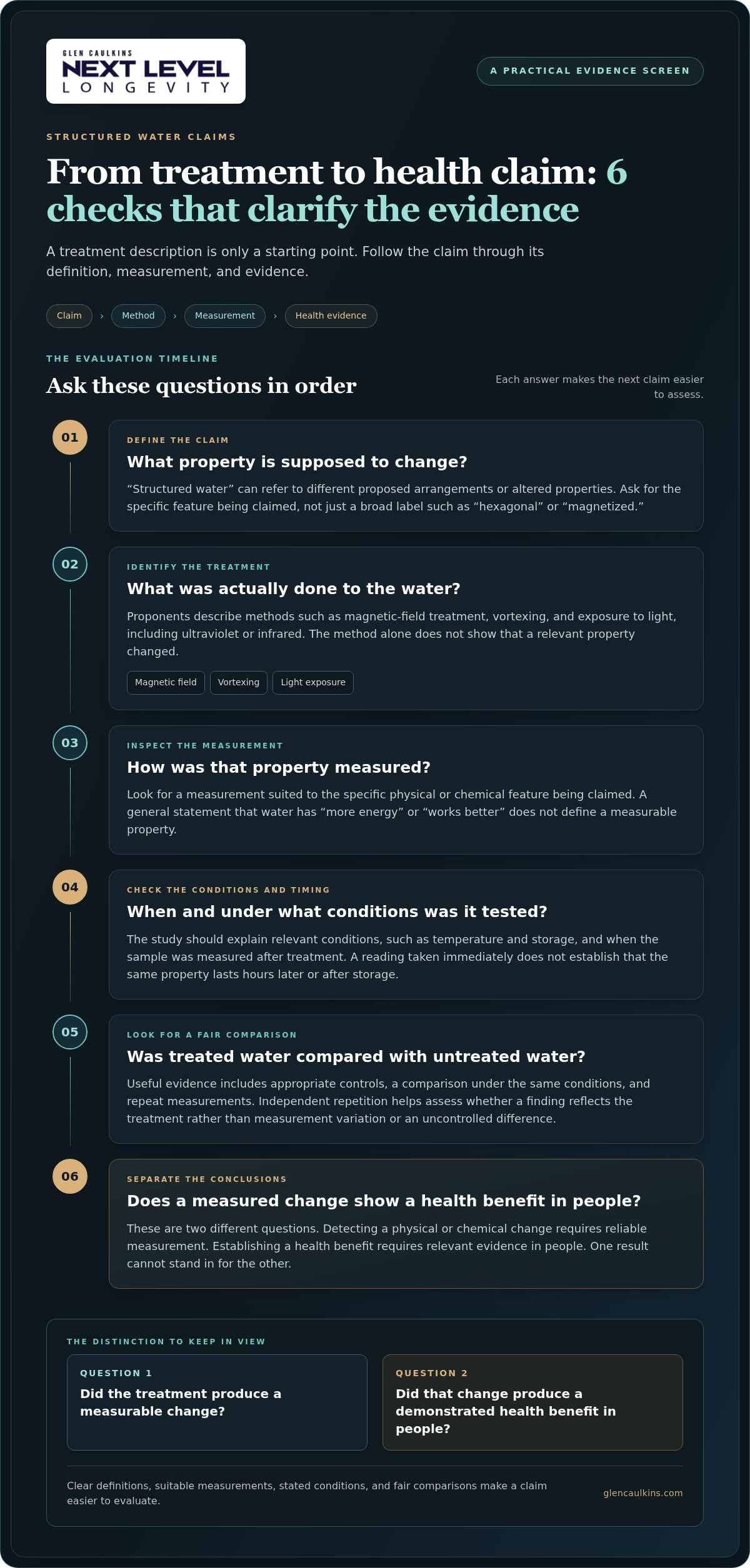
A useful claim should tell you what changed and show evidence that matches the claim. The label alone can’t do that. To understand what is structured water in a product description, look past the name and follow the evidence from the treatment to the measured result, then to any health conclusion.
Which questions clarify a product or process claim?
Use this checklist when you encounter a claim about a device, treatment, or bottle of water:
- What exact property is claimed? Look for a defined physical or chemical feature, not only broad wording such as “energized” or “more natural.”
- How was it measured? The method should suit the claimed property. A reading is hard to interpret without knowing what the instrument measures and how the result was calculated.
- What was the comparison? A treated sample should be compared with an appropriate untreated control under similar conditions. This helps separate an effect of treatment from other differences.
- When was the result measured? A measurement taken just after treatment doesn’t establish that the change remains after storage or at the time the water is consumed.
- Does the evidence match this specific product? A result from a different treatment or laboratory setup doesn’t automatically show what a particular device does.
These questions make a claim easier to assess. If a description identifies a treatment but not the property, measurement, comparison, or timing, the evidence may not support a clear conclusion about the water people drink.
How should you read health claims carefully?
Next, identify what kind of evidence supports the promised outcome. A laboratory finding may show a change in a sample. A proposed mechanism offers an explanation that still needs testing. Animal research reports results in animals. Human studies test outcomes in people. These forms of evidence are related, but they are not interchangeable.
A measured change in water does not, by itself, prove a health benefit in the people who drink it. For that, the research must connect the specific treatment to a relevant human outcome. Check whether studies use an appropriate comparison, report limitations, and distinguish association from causation. An association means two things occur together; it doesn’t establish that one caused the other.
Be especially careful when a broad promise rests on a narrow finding. A change in one laboratory measurement cannot establish claims about energy, cellular function, or other health outcomes unless those outcomes have been tested directly. A careful source makes the boundary clear rather than extending a result beyond the study.
Glen B. Caulkins approaches water as part of a wider inquiry into chemistry, minerals, and biological resilience. Explore Glen’s research and writing to see how these questions fit into that broader investigation.
How does structured water fit into Glen Caulkins's water research?
The question of what is structured water sits within a larger inquiry: how do water chemistry, minerals, and environmental conditions shape the water people encounter? For Glen B. Caulkins, water structure is one question among many. It belongs beside practical questions about what is dissolved in finished water and how that composition differs across sources and treatment processes.
Those questions need separate evidence. A claim about molecular arrangement is not the same as a measurement of minerals in a water sample. Chemistry can identify and quantify dissolved constituents. Claims that a treatment creates a special structure or improves health require their own definitions, measurements, and evidence. Keeping these subjects distinct helps readers see where a measured finding ends and an interpretation begins.
How do water chemistry and mineral context broaden the question?
Finished-water composition describes characteristics such as dissolved minerals and other measurable constituents after treatment. That information can help explain what is in a sample, but it does not establish that the water has a lasting molecular structure or a particular biological effect. Water structure and water composition are related to the broad subject of water, but they are not interchangeable claims.
Minerals add useful context because the water people drink is not only a collection of water molecules. Its composition depends on its source and treatment. Understanding that chemistry can make a discussion of water more precise, while still requiring care not to infer health outcomes from composition alone.
This distinction also reflects the range of Glen B. Caulkins's writing. Dire Straits Volume I: The Chemistry We Inherited examines environmental chemistry through industrialization. Dire Straits Volume II: The Biology We Depend On explores finished-water composition, minerals, and biological regulation. Both books are forthcoming. The topics connect water to wider environmental and biological questions, but they do not turn interpretations or proposed frameworks into established scientific findings.
Where can readers continue exploring Glen B. Caulkins's work?
A useful next step is to follow the question outward. Water chemistry leads to questions about minerals and environmental exposure; questions about biological regulation require evidence suited to the specific outcome being discussed. Glen B. Caulkins's research considers these connections while distinguishing documented chemistry from broader interpretations. That boundary matters: an idea may guide further inquiry without yet being a demonstrated scientific conclusion.
Readers interested in this wider perspective can explore Glen B. Caulkins's research and writing. It offers a grounded path from a focused question about water toward related subjects, without treating every proposed explanation as settled fact.
Let the next question guide your research
Asking “what is structured water” can lead to a broader habit of inquiry: define the claim, find out how it was tested, and keep the conclusion within the limits of the evidence. That approach applies well beyond water. It can help you examine claims about minerals, food, and the environmental conditions that shape everyday life.
Glen B. Caulkins is an independent researcher and author whose work connects water chemistry, minerals, and environmental exposure. His writing follows these subjects into wider questions about the systems people depend on, while distinguishing measured findings from interpretation. There is always another useful connection to explore, provided each step stays grounded in what the evidence can show.
Explore Glen’s research and continue following the questions that matter to you. A careful inquiry doesn’t need to end with certainty. It can begin with a clearer next question.
Frequently Asked Questions
Does ordinary liquid water have a structure?
Yes. A glass of water has molecular structure without any special treatment: its molecules attract and reorient as they move. A useful answer to “what is structured water” distinguishes this ordinary behavior from a specific claim about a stable arrangement created by treatment. If a product description uses “structure,” ask whether it means water’s normal molecular interactions or a proposed added property. Those are different statements and call for different evidence.
Is structured water the same as alkaline water?
No. Alkalinity and pH describe different chemical properties: pH indicates how acidic or basic a sample is, while alkalinity describes its capacity to neutralize added acid. Structured-water claims usually concern proposed molecular arrangements or other physical changes. If you live in Laguna Woods, Newport Beach, Costa Mesa, Laguna Beach, Carlsbad, or Irvine, consider the water relevant to your own household rather than assuming nearby supplies have identical chemistry. A pH reading doesn’t measure structure.
Can magnets permanently change drinking water?
Exposure to a magnetic field alone doesn’t show that a change lasts. To assess a permanence claim, look for measurements taken after treatment and again after storage, with untreated water tested for comparison. The key question is whether the claimed property remains in the water people actually drink, not simply whether a magnet was used. A reported change under one set of conditions shouldn’t be treated as proof of a lasting effect.
What does hexagonal water mean?
“Hexagonal water” is a label used in some claims to suggest a particular arrangement of water molecules. The term isn’t a complete scientific description. A useful explanation would define the proposed arrangement and show how a sample was tested for it. A drawing or the word “hexagonal” alone doesn’t establish that stable units exist in drinking water. Nor does the label itself demonstrate a health benefit.
Does structured water occur naturally in the human body?
Water in the body interacts with proteins, membranes, and dissolved substances, creating local environments that differ from a glass of water. That observation doesn’t show that a marketed product creates the same conditions after drinking it. Be cautious of claims that move directly from water’s presence in the body to a promised biological effect. The proposed process and the specific outcome need evidence that tests them directly.
How can I tell whether a structured-water study is relevant to people?
Check what the researchers studied: people, animals, or water samples in a laboratory. Then compare the treatment and outcome with the claim being made. A study of one process doesn’t automatically support a different product’s claims. Look for methods, stated limitations, and disclosures of funding or commercial interests. If a study reports only a laboratory measurement or animal result, it doesn’t establish that people experience the same effect.
Frequently Asked Questions
What does “water structure” mean in chemistry?
Why do people use the phrase “structured water”?
What methods do proponents describe?
What would evidence of a measurable change need to show?
What did the animal research review examine?
What can animal findings tell us about people?
Which questions clarify a product or process claim?
How should you read health claims carefully?
How do water chemistry and mineral context broaden the question?
Where can readers continue exploring Glen’s work?
Does ordinary liquid water have a structure?
Is structured water the same as alkaline water?
Can magnets permanently change drinking water?
What does hexagonal water mean?
Does structured water occur naturally in the human body?
How can I tell whether a structured-water study is relevant to people?
More articles