Reverse Osmosis System Installation and Placement in Irvine
October 22, 2026 · 17 min read
Irvine tap water has a published annual water quality report, and the Environmental Working Group identifies 19 contaminants above its recommended guidelines. That finding is useful context, but it does not mean every home has the same water or establish that tap water is unsafe to drink. A reverse osmosis system in Irvine is one option for people who want additional treatment at a kitchen faucet.
Installing an under-sink system yourself may suit you if you’re comfortable making plumbing connections and following the system’s instructions. Cabinet access, the drain connection, and whether the countertop needs a faucet hole all affect the work. A tight cabinet or challenging countertop material can make installation more difficult.
This guide helps you assess Irvine water information, understand how filtration stages work, and plan system placement. It also covers what to consider before choosing DIY installation, including maintenance access and space beneath your sink. The goal is to help you make a practical decision based on your household’s water priorities and kitchen setup.
Key Takeaways
- Use Irvine’s annual water quality information as context, then consider what matters for your household’s drinking water.
- Learn how sediment, carbon, a semipermeable membrane and post-carbon filtration work together in an under-sink system.
- Assess whether a DIY installation suits your plumbing skills, sink setup and the system’s installation requirements.
- Plan placement around cabinet space, water connections and the location of a dedicated faucet before drilling a countertop.
- Explore how the Under-Counter Water Revival System may fit a kitchen drinking-water setup.
Is Irvine Tap Water Safe To Drink?
Irvine tap water cannot be summed up with one measurement. Irvine Ranch Water District publishes an annual report, while household concerns may involve hardness, chlorine, taste, or a specific contaminant. These are distinct aspects of water quality. A report or home water test can clarify a particular concern, but each result answers only the question it measures.
Local Water Hardness and Chlorine
Irvine water hardness is reported at 10 to 15 grains per gallon, and the listed chlorine level is 2.1 mg/L. The most recent water quality report referenced for Irvine measured fluoride at 0.6 ppm. These measurements describe separate properties, so don’t treat a hardness reading as a contaminant screen or a chlorine result as a complete water analysis.
Hardness reflects mineral content and can leave scale on faucets, kettles, and other surfaces. Water above 120 PPM is considered hard. Compare that threshold with the unit and method used by a test; grains per gallon and parts per million are different units. Chlorine, by contrast, is associated with treatment and may influence the taste or smell of tap water.
Water Sources and Possible Contaminants
Irvine Ranch Water District’s drinking-water sources include rivers, lakes, streams, ponds, reservoirs, springs, and wells. Groundwater and surface water can involve different treatment considerations, and hard water is commonly associated with groundwater. Because water composition can vary by source and treatment, there is no single profile that applies to every home.
According to the Environmental Working Group, 19 contaminants in Irvine tap water were detected above its recommended guidelines. Its list includes arsenic, chromium-6, HAA5, nitrates, PFAS, and uranium. Possible trace contaminants in district drinking water also include microbial, pesticide and herbicide, radioactive, inorganic, and organic categories. A listing identifies a reported concern; it doesn’t show that every household has the same levels.
Testing and Hard-Water Effects
A home water test is useful when you know what it measures. A screening test for hardness or chlorine cannot establish whether every other contaminant is present. Read the test’s stated scope, note where the sample came from, and compare relevant results with the district’s annual report. A laboratory analysis for a specific substance answers a narrower question than a general screening.
Hard-water minerals can build up as scale on plumbing fixtures and inside appliances that heat water. A home water test can show whether hardness is a concern, while visible deposits offer a practical clue about where scale forms. Neither observation identifies every water-quality issue. Distinguish a scale problem from a drinking-water concern, then choose filtration based on the substance or property you want to address.
What is an Under Sink Reverse Osmosis System?
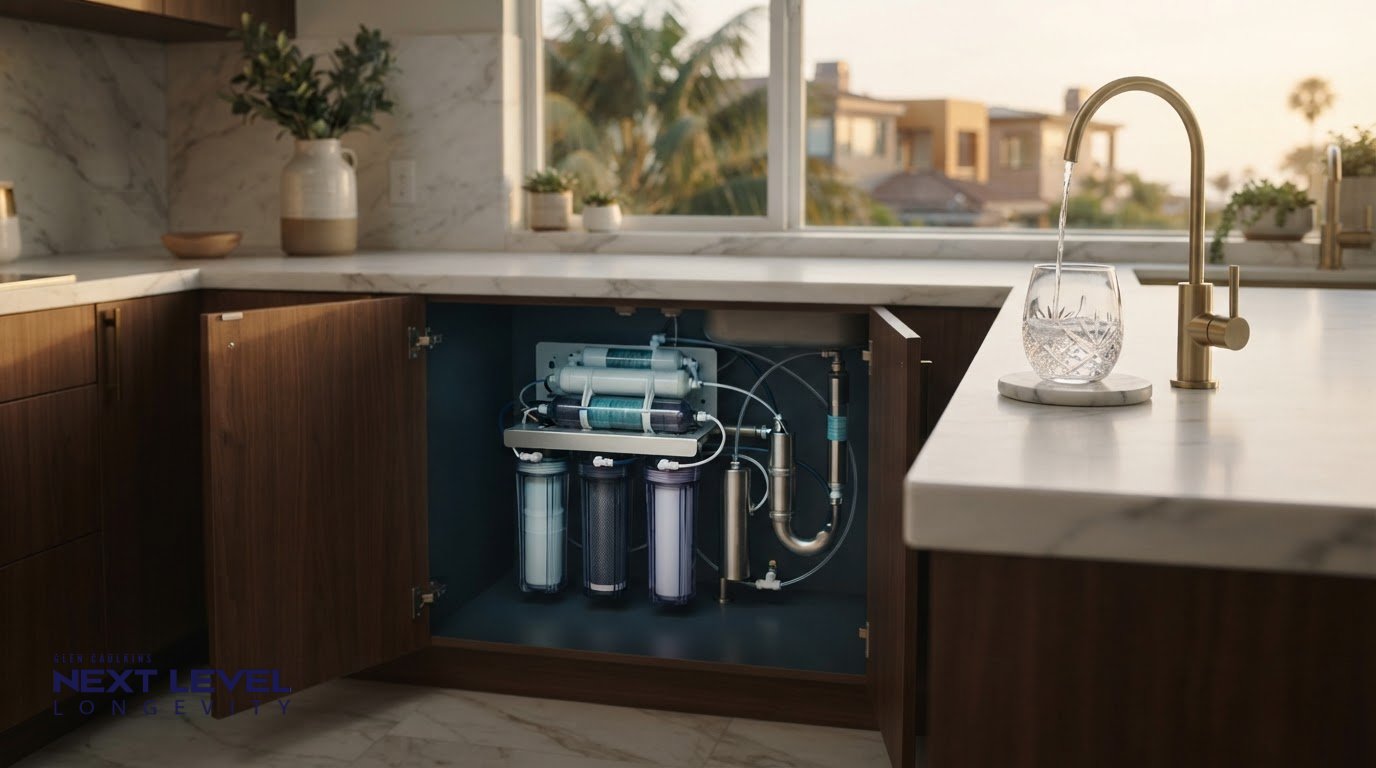
An under-sink reverse osmosis system treats water beneath the kitchen sink and delivers it through a dedicated faucet. Its usefulness depends on the treatment stages, household demand, and whether you can keep up with maintenance.
Filter Stages and Media
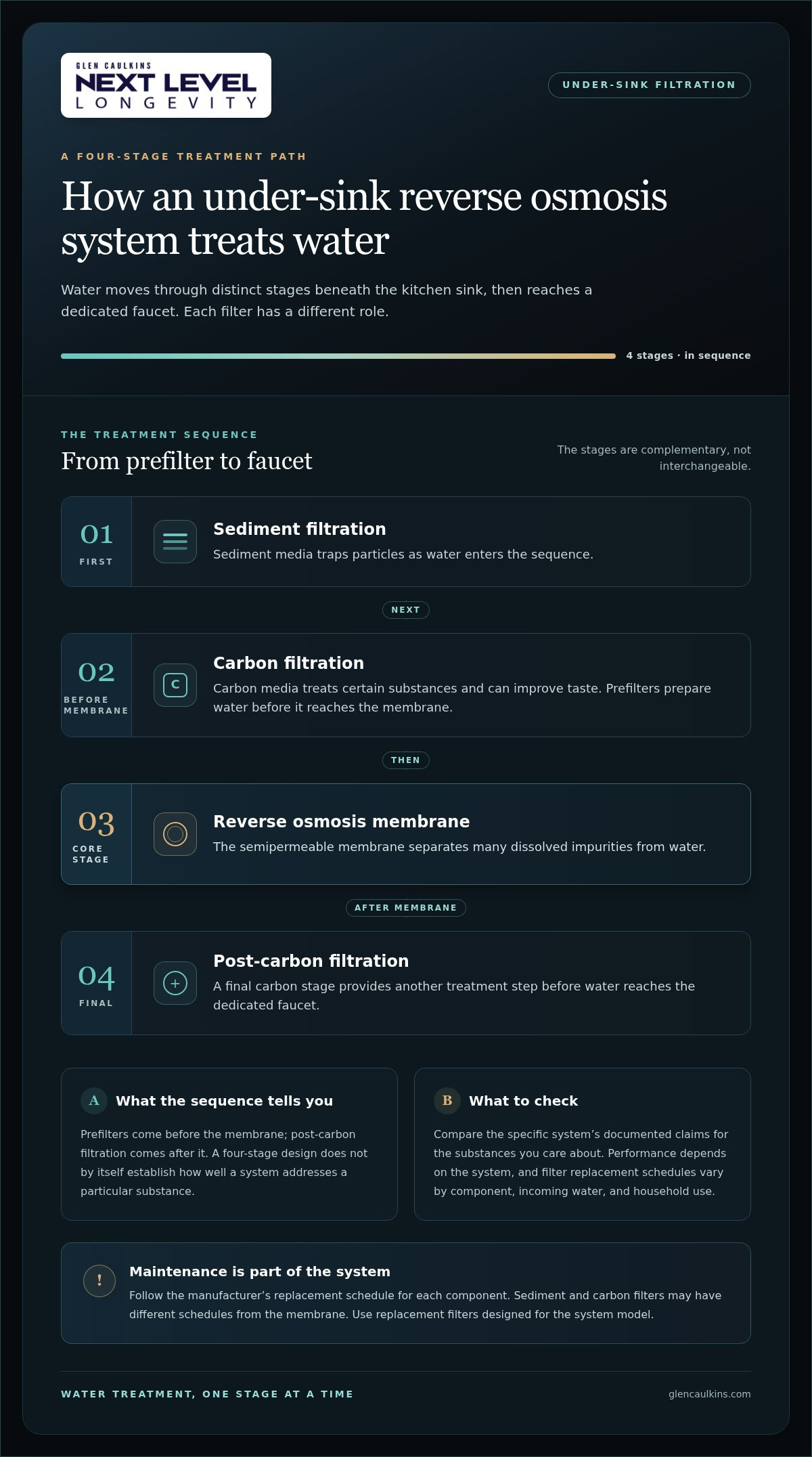
A four-stage system may combine sediment, carbon, a reverse osmosis membrane, and post-carbon filtration. Sediment media traps particles, while carbon media treats certain substances and can improve taste. The semipermeable membrane separates many dissolved impurities from water. Post-carbon filtration adds another treatment step before water reaches the faucet.
These stages work in sequence, not as interchangeable parts. Prefilters prepare water before it reaches the membrane, and the final filter treats water after membrane processing. Performance depends on the specific system and its documented claims. Check which contaminants it addresses rather than assuming all four-stage designs perform alike.
Filter Replacement and Upkeep
Filter life varies with incoming water, household use, and each cartridge’s role. Follow the manufacturer’s replacement schedule for every component. Sediment and carbon filters may have different schedules from the membrane. Record the model and installation date, then use replacement filters designed for that system.
Replacement costs depend on which components are due, their compatibility, and whether filters are sold individually or together. A replacement promotion can be useful when it clearly identifies the included media and compatible systems. Compare the parts in the offer with your maintenance needs. Don’t choose based only on the number of cartridges in a package.
Household System Selection
Match flow rate, storage capacity, and stage design to your household’s water use. A household filling several bottles or cooking pots in quick succession needs more water on hand than one drawing occasional glasses. A storage tank supplies water at the faucet while the membrane produces treated water. Compare the system’s stated output and storage specifications with your peak demand.
Choose filtration stages based on your treatment goals and the system’s evidence for specific substances. A larger household may prioritize available water and recovery time, while a smaller one may focus on cabinet space. No single flow rate or tank size suits every Irvine home. Consider demand, available space, and the system’s performance information.
Water Waste and Maintenance Drawbacks
Reverse osmosis sends a reject stream down the drain as the membrane separates impurities. The amount depends on system design and operating conditions, so compare the water-use information published for the specific system. More efficient designs are available, but judge efficiency by stated recovery or reject-water data, not a general label.
Maintenance is a practical trade-off. Clogged filters can restrict flow, overdue replacements can affect treatment, and loose fittings can leak beneath the sink. The membrane also needs upkeep according to the system’s schedule. Consider whether you can track replacements and inspect connections. If installation or regular maintenance is likely to be neglected, this may not be the right system for you.
Reverse osmosis system installation in Southern California
Installation connects the filtration system to the water supply, drain, and drinking-water faucet. The work depends on your home’s plumbing, cabinet space, and treatment goals.
Professional Installation and Pressure Settings
Professional reverse osmosis installation in Southern California can take a few hours. The work includes connecting the system, routing its drain line, and checking the faucet and fittings. Even a compact under-sink unit needs enough room for filter changes and access to shutoff valves.
Pressure settings affect how the membrane operates. Correct settings can extend filter life and reduce replacement costs. Follow the system’s pressure requirements rather than making a generic adjustment. After setup, check the connections for leaks and confirm that the faucet delivers water as intended.
Under-Sink and Whole-House Options
An under-sink system treats water for a dedicated kitchen faucet. Its compact placement focuses filtration on drinking and cooking water, rather than every household fixture. It suits residents whose priority is the kitchen tap and who have usable cabinet space.
A whole-house system treats water where it enters the home and serves multiple fixtures. It has a broader scope and different space and plumbing requirements. Choose based on whether you need drinking-water treatment at one faucet or treatment throughout the home. Compare the intended use before considering equipment size.
Installation Requirements and Costs
In Irvine, permit and plumbing requirements depend on the work and applicable local rules. Connecting to existing plumbing differs from changing supply or drain lines. Faucet placement, drain access, and countertop material also shape the installation plan. These details affect the work involved, not the filtration method itself.
The purchase and installation price depends on the system, plumbing changes, cabinet access, and labor. An installer can provide a project price after a quote request; there is no single total for every Irvine kitchen. A clear scope separates equipment costs from installation work and identifies plumbing changes before the job begins.
Local Installation and Service Companies
In Irvine, water-treatment businesses and plumbing companies are the relevant provider categories for installation or servicing. The work may include system connections, drain routing, pressure adjustment, leak checks, and maintenance. The task depends on whether the system is new, has reduced flow, or needs replacement filters.
Service needs also vary by system design. A membrane issue differs from a loose fitting or overdue filter. For example, reduced faucet flow may point to a pressure or filter concern, while moisture inside the cabinet calls for attention to the connections. Identifying the symptom helps define the work involved.
System placement and countertop drilling
Good placement keeps the system accessible and connects it neatly to the kitchen faucet, water supply, and drain. Before installation, map those points and inspect the cabinet and countertop. Even a small change in faucet position can affect tubing routes, usable counter space, and access for future filter changes.
Start beneath the sink. Look for a clear area near the cold-water supply and drain connection, and keep stored items away from the filter housings. Leave enough room to reach shutoff valves and remove cartridges without emptying or dismantling the cabinet. A disposal, pull-out bin, or cleaning supplies may require a different layout.
Trace the planned tubing route from the supply connection to the unit, then to the faucet and drain. Keep hoses clear of sharp edges, moving disposal parts, and hot plumbing. A kinked tube can restrict flow, and a loose connection can leak into the cabinet. Make sure the drain connection remains accessible for inspection.
The drinking-water faucet needs a stable mounting point. Some sinks have an unused accessory opening, which can avoid drilling. If the countertop needs a new hole, identify its material first. Stainless steel, laminate, stone, and engineered surfaces require different tools and handling. Using an unsuitable method or location can damage a finished countertop.
Before choosing a spot, check underneath for braces, sink clips, and drawer clearance. Above the counter, consider the faucet’s reach, nearby backsplash, and how you fill a glass or cooking pot. A location beside the main faucet may be convenient, while a crowded corner can make everyday use awkward.
Plan for the unit’s size and service space, not just whether it fits today. Position it where filter housings can turn or lower during replacement. Keep labels visible when possible. These details make it easier to identify the correct cartridge and follow maintenance instructions later.
A home water test can help define your treatment goal, but it does not determine the best cabinet layout. Keep the decisions separate: water quality informs filtration, while plumbing access and countertop construction guide placement. “Free water” from a dedicated faucet means filtered water is available at that tap. You still need to plan for the drain, supply connection, and maintenance access.
Reverse osmosis systems
Reverse osmosis systems use a semipermeable membrane to separate impurities from water. Irvine households comparing these systems can consider under-sink designs for drinking water and whole-house systems intended to treat water throughout the home. The practical choice depends on where treatment is needed and what the system can document.
An under-sink system sends water through treatment stages before it reaches a dedicated faucet. A typical sequence may include sediment filtration, carbon media, a reverse osmosis membrane, and post-carbon filtration. Each stage has a distinct role. The membrane is central to reducing dissolved substances, while prefilters prepare water for that step.
Reverse osmosis can reduce or remove substances such as lead, arsenic, fluoride, nitrates, bacteria, and viruses. Actual performance depends on the system and the specific contaminant. A broad phrase such as “advanced filtration” does not establish how well a system handles a particular substance. Look for performance documentation that names the substance, test conditions, and exact system configuration.
That distinction matters because water concerns can vary by source and household. A system designed for a kitchen faucet treats drinking and cooking water at that point. It does not automatically treat water at showers, laundry taps, or other fixtures. Whole-house treatment covers more locations but also requires different equipment and installation. Match the treatment location to your actual need.
Compare systems by more than their number of filters. Check which stages are included, what the manufacturer says each stage reduces, and which replacement filters fit. Then consider how water reaches the faucet, how the system handles reject water, and what maintenance it requires. If a system lists a contaminant without evidence for that specific model, an important question remains unanswered.
For Irvine homes, the right reverse osmosis system depends on a clear goal: improving kitchen drinking water, addressing a measured concern, or treating water throughout the house. Compare documented performance with that goal. A water test can help identify properties worth investigating, but it cannot replace contaminant-specific performance evidence.
Glen B. Caulkins’s water research and educational articles explore how filtration relates to finished-water composition. This perspective encourages readers to look beyond a product’s stage count and consider what the treatment is designed to change and how its claims are supported.
Glen B. Caulkins: Under-Counter Water Revival System
Glen B. Caulkins’s Under-Counter Water Revival System is an option for Irvine households seeking a dedicated kitchen drinking-water setup. It follows the under-counter approach described above, where cabinet space, plumbing access, and faucet placement shape the installation plan.
Glen is the founder of PristineHydro, and this system is part of his commercial work as well as his wider interest in water chemistry and finished drinking water. Consider it if you want an under-counter system rather than whole-house treatment. For water away from home, the Travel-Portable Water Revival System serves a different need.
Visit Glen’s water system offerings to learn more, or contact Glen B. Caulkins with your questions.
Choose the Next Step That Fits Your Home
Choosing a reverse osmosis system for an Irvine home starts with your intended use, not a product label. Decide whether you want treated water at a kitchen faucet, a portable option for travel, or another type of filtration for a different part of daily life. Then compare the system’s documented purpose with your needs and installation space.
Glen B. Caulkins offers the Under-Counter Water Revival System and Travel-Portable Water Revival System. The Aqualux filter with head serves a separate shower-filtration purpose; it does not replace a kitchen drinking-water system. These offerings serve distinct needs, so compare them based on where you want filtration and what you want it to do. Glen’s interest in water chemistry also informs his broader research, alongside his commercial work.
If you’re weighing those options or have a question about your next step, contact Glen B. Caulkins. Take time to choose the approach that makes sense for your home.
Frequently Asked Questions
Can I install the system myself?
Yes, DIY installation can suit a homeowner comfortable with basic plumbing connections and careful leak checks. First, compare the kit instructions with your sink’s supply valve, drain connection, and faucet opening. A crowded cabinet, drilling a stone countertop, or unfamiliar plumbing can make the work more demanding. Photograph existing connections before disconnecting anything, and keep the shutoff accessible afterward.
Do you serve neighborhoods like Woodbridge, Northwood, and Quail Hill in Irvine?
Glen B. Caulkins serves Irvine, including residents in neighborhoods such as Woodbridge, Northwood, and Quail Hill who are looking for water systems. The local service area also includes Laguna Woods, Newport Beach, Costa Mesa, Laguna Beach, and Carlsbad. For an Irvine household, the key first distinction is whether you need a kitchen drinking-water system or a portable option for travel.
How Does It Work?
Water enters the system from the cold-water line and passes through treatment media before reaching the reverse osmosis membrane. The membrane separates treated water from a reject stream, and a storage tank can hold treated water for faucet use. Opening the dedicated faucet, for example, draws from that stored supply. Flow and output depend on system design and operating conditions.
How often do I need to replace filters?
Follow the replacement schedule for your exact system and cartridge type, since sediment, carbon, and membrane components have different roles. Record the installation date and each replacement. If faucet flow or water taste changes, review maintenance, but don’t assume that one specific filter has failed. Use compatible replacement filters.
What contaminants would an RO system address in Irvine?
Reverse osmosis systems can reduce or remove substances including lead, arsenic, fluoride, nitrates, bacteria, and viruses. The result depends on the system’s documented performance for each substance. If you are concerned about a specific contaminant, compare the system’s evidence for it rather than relying on broad claims such as “advanced filtration.” Irvine water conditions and treatment goals can vary between households.
Why the 4-Stage Process?
A four-stage process assigns different tasks to successive filters, rather than asking one component to do everything. Sediment filtration captures particles, carbon media helps treat certain substances, the membrane separates dissolved impurities, and post-carbon filtration provides a final treatment step. This sequence can support membrane operation and finished-water quality. However, stage count alone does not establish performance; check the system’s claims for specific contaminants.
Does Irvine tap water need reverse osmosis, and what contaminants are commonly reported?
Reverse osmosis isn’t automatically necessary for every Irvine household; the choice depends on your water goals and concerns. The Environmental Working Group reports 19 contaminants above its recommended guidelines, including arsenic, chromium-6, HAA5, nitrates, PFAS, and uranium. Irvine Ranch Water District publishes an annual water quality report. Those sources provide context, but a contaminant listing doesn’t establish that every home has the same water composition.
How often should reverse osmosis filters and membranes be replaced, and what do replacements cost?
Replacement timing varies by component, system instructions, water conditions, and household use. Follow the schedule for the specific filters and membrane, and choose replacements that match the system model. Cost depends on which compatible parts are due and what replacement set is required; the price is provided after a quote request. Tracking each change helps you plan maintenance rather than guess when a component was installed.
Frequently Asked Questions
Can I install the system myself?
Do you serve neighborhoods like Woodbridge, Northwood, and Quail Hill in Irvine?
How Does It Work?
How often do I need to replace filters?
What contaminants would an RO system address in Irvine?
Why the 4-Stage Process?
Does Irvine tap water need reverse osmosis, and what contaminants are commonly reported?
How often should reverse osmosis filters and membranes be replaced, and what do replacements cost?
More articles