Travel Water Filter for Hotels: A Practical Buying Guide
October 20, 2026 · 15 min read
The smallest filter in your bag may not be the right one for a hotel stay. A travel water filter for hotels should match the water you’ll encounter and the concern you want to address, not just promise convenience. Hotel tap water may come from a treated public supply, but conditions vary by destination, and building plumbing can affect water at the faucet. Before choosing a device, check current local guidance and identify what you need the system to do.
This guide explains how to compare portable treatment methods, evaluate product claims, and choose a format that fits your itinerary and hotel routine. The goal isn’t to carry the most equipment. It’s to choose a system with a clearly stated purpose, evidence relevant to that purpose, and instructions you can follow on your trip.
Key Takeaways
- Start with the destination’s water guidance and the specific concern you want to address. Conditions can vary by supply and building.
- Match the treatment method to that concern. A broad product label does not establish performance against a particular contaminant.
- Choose a travel water filter for hotels based on documented treatment scope and a routine you can follow throughout your trip.
- Read the product instructions and use the system only with the water sources and conditions those instructions allow.
- PristineHydro’s Travel-Portable Water Revival System is designed to purify and remineralize drinking water. Compare its purpose and instructions with your travel needs.
Hotel drinking water: what should you check before choosing a travel water filter?
Assess the water guidance and your particular concern before choosing a filter. In Irvine, Laguna Woods, or another destination, water conditions can vary with the local supply and the building’s plumbing. A filter that affects taste may not address a named contaminant, so start with the question you want to answer rather than choosing by size or a broad marketing claim.
Check current guidance from public-health agencies and the local water utility. If an advisory applies, follow its instructions. A utility’s information can help explain the public supply, while a building’s plumbing is a separate part of the picture. Use available information to distinguish a general concern about the destination from one that relates to the property.
Is hotel tap water safe to drink?
There isn’t a universal yes or no. Conditions differ by location and water supply, and plumbing can affect water after it enters a building. Consult current public-health guidance and the relevant water utility for information about your destination. If a boil-water notice applies, follow it rather than treating a filter as a substitute.
Identify the concern before choosing a filter
A change in taste or smell can be unpleasant, but it doesn’t by itself confirm a health or safety problem. Clear water, on the other hand, doesn’t prove that every possible concern has been addressed. Name the issue first: taste, odor, visible particles, or a specific contaminant identified in official guidance or a water report. Then compare it with evidence for the exact filter model you’re considering.
“Travel filter” is a broad product category, not a treatment guarantee. Different water purification methods work in different ways, and a product’s general label doesn’t establish performance against every contaminant. Look for claims that identify the treatment target and the specific model, and make sure the instructions fit the water source you intend to use.
- Taste or odor: Look for documentation showing that the specific model is designed to address the issue you notice.
- Particles: Check what the product is designed to reduce and the conditions under which it is used.
- A named contaminant or advisory: Compare the exact concern with applicable performance documentation, and follow official guidance.
This source-first approach makes the decision more practical. A travel water filter for hotels should address the question you’re trying to answer, not simply feel reassuring to carry. If current guidance advises against drinking the water, follow the recommended alternative. If taste is your main concern, choose accordingly without assuming taste reveals the full water chemistry.
How travel water filters work: understand the treatment method behind the claim
Filtration is a treatment process, not a single capability. What a device can reduce depends on its technology, design, and tested conditions. A compact bottle, straw, or multi-stage system may use different treatment methods, so the product category alone doesn’t tell you what happens to the water. When comparing a travel water filter for hotels, ask a more precise question: what is this model designed to treat, and what evidence supports the claim?
International guidance can help put water safety in context. The WHO drinking water guidelines describe health-related considerations for drinking water, but they don’t establish the performance of an individual filter. For that, look for product evidence that applies to the model and treatment claim you’re evaluating.
Membranes, carbon, and other treatment approaches
Membranes separate some substances from water as it passes through a barrier. Activated carbon works differently: its surface can adsorb certain compounds, meaning substances attach to the carbon. Other devices may use additional treatment stages. A multi-stage design can combine approaches, but the number of stages alone doesn’t show what each stage reduces or how the complete system performs.
Keep different claims separate. Reducing a named contaminant is not the same claim as improving taste or odor. Remineralization means adding minerals to treated water; it does not, by itself, establish contaminant reduction. One claim doesn’t prove another. Read each statement as a separate part of the product’s intended function.
What a test report can and cannot establish
Read a test report for its boundaries, not just its headline. Check the exact model, the substance tested, the conditions, and the report’s conclusion. A result for one substance doesn’t demonstrate performance against others. Results from a tested sample also don’t guarantee identical outcomes for every unit or water source.
Pay attention to the relationship between the document and the product claim. A laboratory certificate of analysis reports testing within its stated scope. Laboratory accreditation concerns a laboratory’s competence for specified work; it doesn’t certify an entire filter product. Product certification is separate and shouldn’t be inferred from a laboratory report.
A test result is useful when its model, target substance, and test conditions match the claim you plan to rely on. This helps separate specific evidence from broad marketing language. Glen B. Caulkins’s interest in water chemistry informs the questions raised here, and he founded PristineHydro, which sells water-treatment products. Readers can keep that commercial connection in mind while exploring Glen’s wider research and writing on water and environmental chemistry.
Compare hotel water filter options by fit, evidence, and everyday use
Portable products differ in how you fill a container, drink, and fit the system into a hotel-room routine. They also differ in what their documentation says they treat. A bottle or straw isn’t automatically suited to the same concerns as another device with a similar travel label. Compare the format and evidence separately, then set aside any option whose instructions don’t match your source water or intended use.
| Format | Typical use | What the evidence needs to show | Practical trade-off |
|---|---|---|---|
| Bottle-style filter or purifier | Drink from the vessel or use it to carry water, depending on the product design. | Which substances or organisms the exact model is tested to reduce or treat. | Combines drinking and carrying in one item, but capacity, care, and use instructions vary. |
| Straw-style device | Drink through the device from a compatible vessel or source, as its instructions allow. | The model’s stated treatment scope and the water conditions it can handle. | Can suit direct drinking, but may not serve a routine based on filling bottles for later. |
| Other portable filter | Use according to the specific device, which may be designed around a container or another setup. | Claims tied to that model, rather than assumptions based on its format. | Setup and handling differ. Check what the trip requires you to carry and maintain. |
| Travel water system | Treat drinking water through the system’s specified process. | Product information and applicable reports that define the tested model and scope. | May suit a consistent room-based routine, depending on the system’s setup and instructions. |
Bottle, straw, and other portable formats
A bottle format can make sense if you want to drink from one vessel; a straw format may fit direct drinking better. Those are convenience distinctions, not proof of treatment performance. A familiar form can still be unsuitable for a particular concern. Before relying on a device during a stay, review the instructions for compatible source water, use conditions, cleaning, and care.
When does a travel water system make sense for hotels?
Think about the length of your trip, the room setup, your daily drinking routine, and what the available evidence supports. A short stay with frequent outings may call for a different format from a longer stay where you expect to prepare drinking water in your room. Include carrying and maintenance in the decision. Don’t assume every portable system has the same setup or service life.
For any system, compare its stated purpose with your intended routine and read the relevant instructions and performance documentation. That keeps two practical questions distinct: whether the system fits your trip, and what its evidence says it can do.
The right format depends on both evidence and routine. Choose a travel water filter for hotels that suits the way you plan to use it, while keeping its documented treatment scope distinct from convenience.
A hotel-trip checklist for using a travel water filter thoughtfully
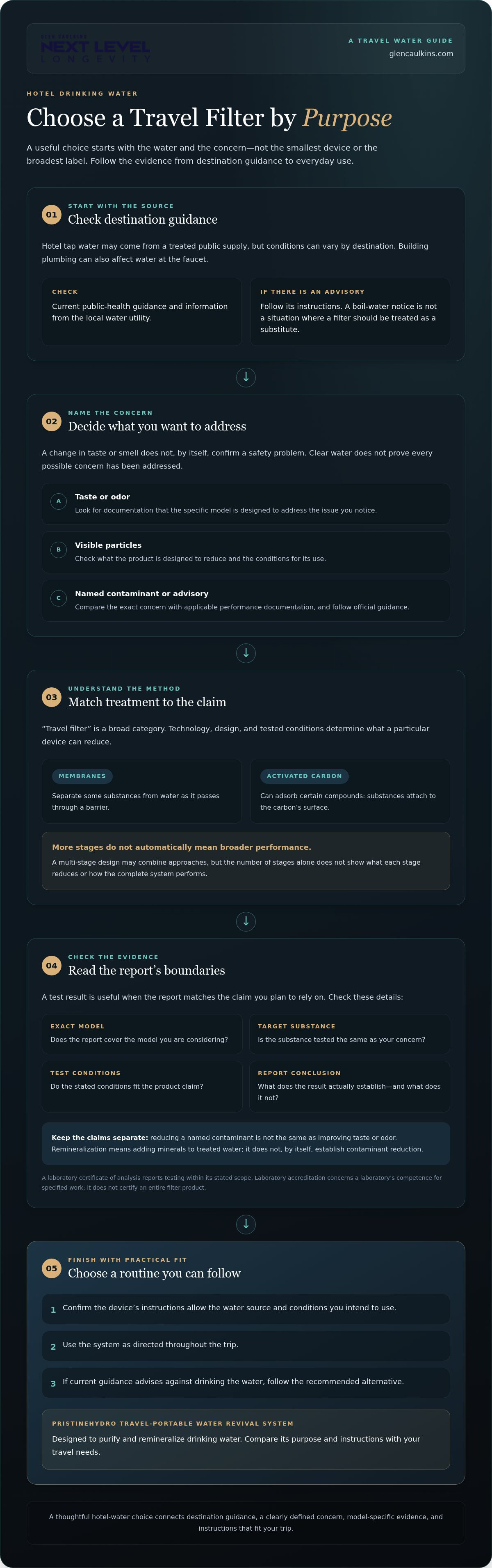
A dependable routine starts before you reach the hotel. Check destination guidance, read the exact product instructions, and plan only for uses those instructions allow. A travel device is designed for particular conditions; it shouldn’t be treated as a universal solution for every faucet, temperature, or water source you encounter.
- Check destination guidance. Review current official drinking-water advice and any local notices that apply to your destination.
- Review the product instructions. Confirm the permitted source water, operating conditions, setup, and care requirements.
- Pack for the intended use. Bring the components and replacement parts specified for that model and your planned routine.
Before departure: check the destination and product instructions
Read the instructions for the exact model, not just general travel-filter advice. Note any limits on source water, temperature, setup, cleaning, or storage. If the manufacturer specifies replacement components for your travel plan, prepare them as directed. Don’t assume that products with similar shapes or labels share compatible parts or operating rules.
Keep destination guidance separate from product claims. A filter’s documented scope doesn’t override an official advisory. If guidance calls for a specific action, follow it rather than assuming the device changes the recommendation.
In the hotel room: follow a consistent routine
Use the system only with the source water and conditions allowed by its instructions. Hotel sinks, faucets, and water temperatures differ. Don’t assume a fixture will connect to a device or that hot tap water is suitable. If the instructions don’t allow a particular source or condition, choose another option consistent with current official guidance.
Consider ice and room-service water separately. Ice may come from a different point in the hotel’s water and handling process than the tap in your room. Room-service water may also come from a source or container your device isn’t designed to treat. A filter’s stated performance for one use doesn’t automatically extend to ice, hot water, or water served elsewhere on the property.
- At the sink: Follow the model’s setup and use directions, including any limits on faucet or water conditions.
- With hot water: Don’t process it unless the product instructions expressly allow that temperature and use.
- With ice or served water: Don’t assume the device applies to it. Check the source and the product’s permitted use.
- If an advisory changes: Stop relying on the device if official guidance calls for another action, and follow that guidance.
Care is part of the routine, too. Follow the product’s cleaning, storage, and replacement directions rather than improvising during a trip. A travel water filter for hotels is useful when its intended conditions fit the stay and you can follow its instructions consistently.
Is PristineHydro's Travel-Portable Water Revival System a fit for hotel stays?
PristineHydro’s Travel-Portable Water Revival System is designed to purify and remineralize drinking water. To decide whether it fits a hotel stay, compare that purpose with your intended water source, travel routine, and the system’s instructions. A product name or category alone can’t establish suitability for every water concern or setup.
What the Travel-Portable Water Revival System is designed to do
The system’s design combines water purification and remineralization. Those functions are distinct: purification addresses treatment, while remineralization adds minerals to treated water. For a specific contaminant concern, look for applicable documentation that identifies the model and the scope of any performance claim. A stated design purpose and a demonstrated result are different kinds of information, so assess each on its own terms.
Hotel conditions matter as well. Consider where you plan to access water, whether the room routine suits the system’s instructions, and whether you can follow its care requirements during the stay. Use it only with sources and conditions permitted by those instructions.
Choose a next step that matches your trip
Think through the length and rhythm of your stay. A brief visit with frequent outings may call for a different approach from a longer stay where you expect to prepare drinking water in your room. Include the effort of carrying, setting up, and caring for the system in your decision. These practical considerations help clarify fit without making assumptions about performance.
Glen’s wider work considers how water composition and treatment connect to environmental chemistry. Explore Glen’s water research for that perspective, or review PristineHydro’s current product information to compare the Travel-Portable Water Revival System with your travel needs. PristineHydro serves customers through its online store and a retail storefront in Laguna Woods, California, relevant for readers in Laguna Woods, Newport Beach, Costa Mesa, Laguna Beach, Carlsbad, and Irvine.
Make your next water choice with confidence
A hotel stay doesn’t require a complicated routine. Let current destination guidance and your travel plans shape what you bring. If the evidence and instructions don’t fit the water or situation, choose another option rather than relying on assumptions. That’s the practical standard for a travel water filter for hotels: a clear purpose, a suitable routine, and claims you can evaluate.
PristineHydro’s Travel-Portable Water Revival System is designed to purify and remineralize drinking water. Glen B. Caulkins is an independent researcher and PristineHydro’s founder, so that commercial connection is relevant as you weigh product information alongside broader questions about water chemistry.
Explore PristineHydro’s current water systems and compare the options with your travel routine. Explore PristineHydro’s current water systems.
Frequently Asked Questions
Can I use a travel water filter with a hotel sink?
Some travel products are made for portable use, but that doesn’t mean they attach to a faucet. Check the exact device instructions for its permitted source, setup, and operating conditions. A bottle designed to be filled with water has a different routine from a system designed to connect to a sink. In Irvine or elsewhere, don’t force a connection or improvise an adapter.
Does a travel water filter remove viruses from hotel tap water?
Only product-specific evidence can answer that. The words “filter” and “purifier” don’t establish virus reduction for every model. Look for a current test report that names the exact device, the relevant performance claim, and the conditions tested. If official guidance raises a pathogen concern during a stay in Irvine or another destination, follow that guidance rather than relying on an unsupported assumption about a filter.
Can a hotel water filter improve the taste of tap water?
Some devices are designed to affect taste or odor, but the result depends on the product and the water. A different taste after treatment doesn’t prove that a health-related contaminant has been reduced. If taste is your main concern during a hotel stay in Irvine, check the model’s documented claims for that purpose. Use official local guidance to assess safety, not taste alone.
Should I filter hotel ice or hot water?
Don’t assume ice, hot tap water, and cold drinking water share the same source, handling, or suitability for a device. A filter intended for cold water, for example, may not be designed to process hot water. Follow the product instructions on temperature and permitted water, and use current local guidance if you’re uncertain about safety.
How often should I replace a travel water filter cartridge?
There’s no universal replacement interval. Follow the current instructions for the exact cartridge and model, including any stated capacity or care limits. A schedule for one brand or device may not apply to another. Before a trip from Laguna Woods, Irvine, or elsewhere, review the product’s replacement guidance and replace the cartridge according to its instructions. Don’t estimate its remaining life from appearance alone.
Frequently Asked Questions
Is hotel tap water safe to drink?
When does a travel water system make sense for hotels?
Can I use a travel water filter with a hotel sink?
Does a travel water filter remove viruses from hotel tap water?
Can a hotel water filter improve the taste of tap water?
Should I filter hotel ice or hot water?
How often should I replace a travel water filter cartridge?
More articles