Under-Sink Water Filter in Laguna Woods: Start with Water Quality Testing
October 20, 2026 · 17 min read
What if choosing an under sink water filter Laguna Woods starts with a different question: what do you want to know about your water? A change in taste or mineral scale can raise reasonable concerns, but neither one identifies a specific contaminant.
Laguna Woods is served by El Toro Water District, whose 2026 Water Quality Report covers testing from 2025. That report offers useful context about district water, but it doesn’t describe every home’s tap or answer every household question. This article explains how to find the report for your service area, when a sample from your own tap may add useful detail, and why a lab test should be chosen to answer a specific question.
From there, you can match any treatment decision to the measured condition rather than to a broad filter claim. The Water Revival System™ is one drinking-water option discussed here. Glen B. Caulkins founded PristineHydro, so that product discussion carries a commercial interest that’s important to understand alongside the evidence.
Key Takeaways
- Start with the water supplier serving your address, then locate its latest consumer confidence report and check the period it covers.
- Define the concern you want to investigate before choosing a screening method or laboratory analysis; different tests answer different questions.
- Read a test result alongside its analyte, unit, method, sample location, and applicable guidance before deciding what it means.
- Use the evidence to guide an under sink water filter Laguna Woods choice, and distinguish a drinking-water system from whole-house treatment.
Laguna Woods tap water quality: what should you find out first?
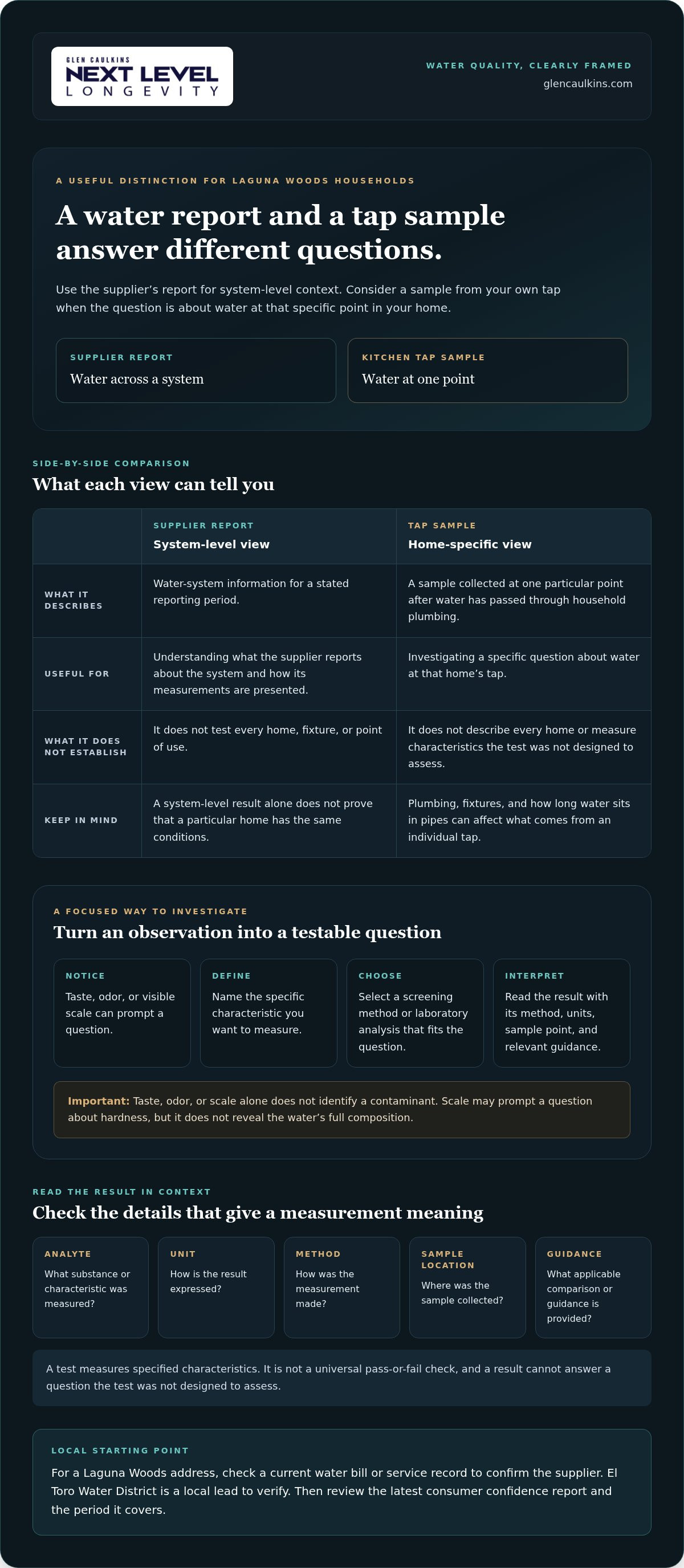
A water-quality report describes water across a supplier’s system. A sample from your kitchen tap reflects water at one particular point, after it has passed through that home’s plumbing. These are related views, but they answer different questions.
Water-quality testing measures specified characteristics, such as a substance’s concentration or a physical property. It isn’t one universal pass-or-fail check. Drinking-water standards apply to defined substances and purposes. The U.S. Environmental Protection Agency’s overview of drinking water regulations and contaminants helps show why a result needs to be read in relation to the substance measured and the relevant standard.
A water-quality test can establish whether specified characteristics were detected or measured in a particular sample; by itself, it cannot describe every home’s water or identify a concern it wasn’t designed to measure.
Taste, odor, and visible scale can help you form a question, but they don’t identify a contaminant. Scale, for example, may prompt a question about hardness; it doesn’t tell you the water’s full composition. Water chemistry can vary with supply conditions, while household plumbing, fixtures, and how long water sits in pipes can affect what comes from an individual tap. Avoid assuming every Laguna Woods home has identical water or the same issue.
Start with the water provider for your Laguna Woods address
Check a current water bill or service record to identify the supplier for your address. El Toro Water District is a local lead to verify against your account. Once you’ve identified the supplier, find its latest consumer confidence report, also called a water-quality report, and note which reporting period it covers.
Regional descriptions of water sources can provide background, but they don’t replace the current report for the supplier serving your address. Nor does a report for the wider system describe the plumbing inside your home. That distinction matters if you’re comparing report information with a sample collected from a kitchen tap.
Separate a water concern from a testable question
Turn an observation into a question that a specific measurement could address. For example, recurring scale might lead you to ask about hardness. A new or unusual taste or odor might prompt you to check the supplier’s report and consider whether a targeted measurement is relevant. An observation alone cannot tell you which substance, if any, is responsible.
Keep the question narrow. Ask what characteristic you want to measure, where the sample should come from, and whether a result would change your next step. A screening method may provide limited information; a laboratory analysis may measure selected substances under specified conditions. Neither approach automatically answers every water-quality question.
Household experiences are clues, not proof of a health effect. If you’re considering an under sink water filter Laguna Woods homeowners might use, first establish the question the filter is meant to address. That keeps the decision tied to evidence rather than to taste, scale, or broad claims alone.
How to review a Laguna Woods water-quality report before testing
A report becomes useful when you read it as a record of a defined water system over a defined period, not as a snapshot of every kitchen tap. For a home in Laguna Woods, first match the document to the supplier on your current bill or service records. Then check its publication date and reporting period before interpreting any result.
- Confirm the supplier. El Toro Water District is a local lead to verify against your address. Service records help ensure you’re reading the right utility’s information.
- Find the latest consumer confidence report. Look for the report on the confirmed supplier’s official website or in its customer communications.
- Note the reporting period. The latest available report is the 2026 Water Quality Report, released in June 2026, covering testing from the 2025 calendar year.
- Identify relevant measures. Find the entries related to your question, then note the units, definitions, and any comparison values provided in the report.
What a consumer confidence report can tell you
A consumer confidence report summarizes water-system information for a stated reporting period. It can help you understand what the supplier reports about the system and how its measurements are presented. Start with the supplier name and report date, then read the report’s own notes before drawing conclusions. A value without its unit or definition is difficult to interpret, and one measure cannot answer every water-quality question.
Pay attention to how a result is described. A reported concentration, for example, is a measurement expressed in a unit. A comparison value has its own meaning and scope. Don’t assume two figures are directly comparable just because they appear in the same table. The University of Georgia Extension’s guide to interpreting water test results offers useful background on reading measurements and understanding testing methods.
What a public report cannot tell you about one home
A utility report describes system-level information. It does not test every home, fixture, or point of use. Water may change as it travels through household plumbing, so a sample collected from one tap can differ from general supply data. The report’s broad findings alone don’t prove that a particular home’s water is unsafe, nor do they establish that every household concern has been ruled out.
If you’re weighing an under sink water filter Laguna Woods option, use the report to sharpen the question, not to make a household diagnosis. A system report may guide what you look into next, while a household sample addresses conditions at its collection point. For a broader look at how water chemistry fits into Glen’s research, explore Glen’s research on water and the environment.
When does home water testing in Laguna Woods add useful evidence?
Testing adds value when you have a defined question and the result could inform a decision. Before choosing a kit or requesting laboratory analysis, name the characteristic you want measured. A concern about mineral scale, for instance, calls for a different measurement than a question about a particular chemical. A broad “water test” may not include the parameter you care about.
Think of the method as part of the question. A quick screen may help indicate whether a specific parameter deserves further attention. Laboratory analysis can measure selected characteristics with a stated method. Neither automatically produces a complete account of water quality. The useful choice depends on the concern, the method’s limits, and what you plan to do with the result.
Match the test method to the question
Screening tools can be a practical first look, but their scope varies. Check what the method measures, how it displays a result, and whether it gives a numerical value or only an indication. Don’t treat a screen as a substitute for laboratory analysis if you need a more specific measurement.
Laboratory analysis also has boundaries. It measures the parameters requested or included in the selected service, not every possible characteristic. Before relying on a result, review the lab’s method description, units, detection or reporting limits, and sample requirements. A result below a stated limit means the method did not report a value at that level; it doesn’t answer questions outside that method’s scope.
Keep the purpose practical. If the result would not change what you investigate or how you compare treatment options, testing may not add much. If you’re unsure which measurement fits your question, consult the lab’s published test descriptions or relevant official guidance before selecting an analysis. Avoid choosing a broad panel simply because it sounds comprehensive.
Choose a sample point that reflects the concern
Decide where the sample should come from based on what you’re trying to learn. A question about a particular faucet calls for a sample from that point. A question about water before it enters a treatment device requires a different collection point than a question about water after treatment. The sampling location defines what the result represents.
Timing can matter too. Water that has remained in a fixture or plumbing line may not represent the same conditions as water collected at another time. Don’t improvise collection steps. Follow the laboratory’s current instructions for the specific analysis, including any directions about the container, timing, storage, and delivery. Record where and when the sample was taken so you can interpret the result in context.
A test result alone doesn’t establish health risk or prove that a filtration product performs as claimed. Those are separate questions that require appropriate guidance and product-specific evidence. For an under sink water filter Laguna Woods decision, testing is most useful when the measurement, collection point, and intended treatment question all line up.
How to interpret a home water test before choosing an under-sink filter
A test result is a starting point for a decision, not a filter recommendation by itself. Before acting on a number, read the details that give it meaning: what was measured, how the lab measured it, where the sample came from, and when it was collected. Without that context, a result can be easy to misread.
Check the analyte, the substance or characteristic measured, and the unit used to report it. Then note the method, sample location, and reporting context. A result from one kitchen tap may not describe every fixture or the water entering the property. A number also needs comparison with current authoritative guidance that applies to that specific analyte and purpose. Such guidance has a defined scope; it isn’t a universal verdict on every aspect of water quality.
Connect a result to a specific filtration objective
Ask one direct question: which measured parameter do you want treatment to address? Then compare that objective with product documentation. Performance claims and supporting test materials should identify the relevant parameter and apply to the system configuration under consideration. A broad phrase such as “purifies water” doesn’t show which substances were tested, under what conditions, or how the system performed for a particular parameter.
This keeps the decision proportionate. If a result raises a question about one characteristic, evidence about an unrelated characteristic doesn’t answer it. If no clear concern emerges, a test result may not point to a specific treatment need. Avoid assuming that one filter addresses every parameter simply because it has multiple stages or broad claims.
Know what filtration and remineralization mean
Filtration is a treatment process that passes water through materials or stages intended to affect specified characteristics. Its performance depends on the system’s design and the evidence available for that system. Remineralization is a separate design choice: it adds minerals to treated water. It doesn’t, by itself, establish a health outcome or prove performance against a contaminant.
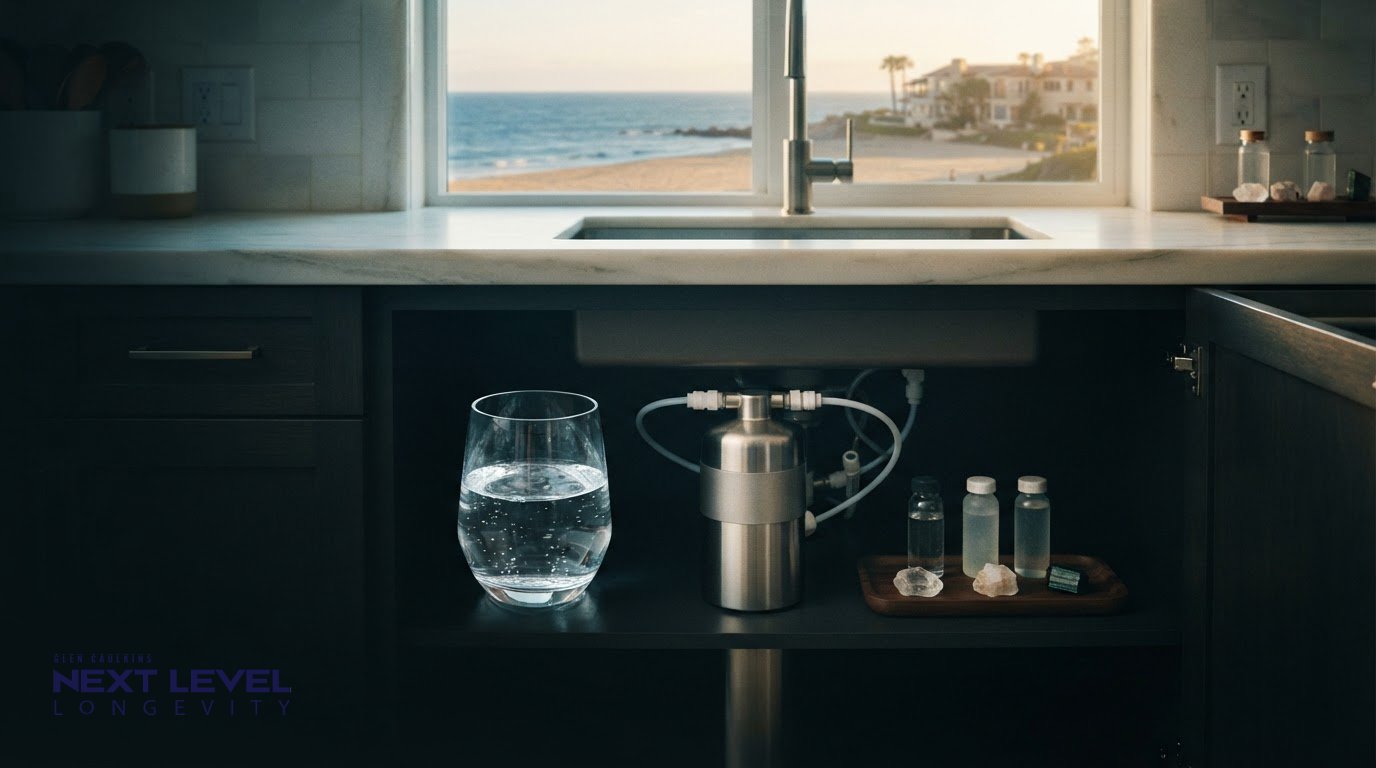
PristineHydro’s Under-Counter Water Revival System is a multi-stage drinking-water system designed to purify and remineralize water, including replenishing minerals such as magnesium bicarbonate. Those design aims shouldn’t be mistaken for a result against every possible analyte. Glen B. Caulkins founded PristineHydro and has a commercial interest in its water-treatment products, so consider that alongside the distinction between design claims and parameter-specific performance evidence.
Keep the treatment boundary clear. An under-sink drinking-water system treats water at a point of use, such as the kitchen supply. Whole-house treatment addresses water entering or moving through the home more broadly. They serve different purposes, so a tap-specific question doesn’t automatically call for whole-house treatment.
Use the evidence to define the treatment objective, then compare it with the system’s documented scope. Explore under-counter drinking-water options as one next step in evaluating an under sink water filter Laguna Woods household needs.
A local next step: explore under-sink water filtration in Laguna Woods
A measured choice follows a simple path: identify the supplier for your address, review its current report, define the concern you want to address, and test your tap only if a specific question remains. Each step narrows the decision. You may find that a public report gives enough context, or that a particular household question calls for a sample from a specific tap.
Then match the treatment to the intended use. An under-sink drinking-water system treats water at a point of use. It is not whole-house treatment, and it should not be expected to address every water-quality concern throughout a home. The result you want should guide the comparison, not the other way around.
Consider a drinking-water system when the goal is clear
A general wish for better-tasting water is different from a defined treatment objective. Taste may help you describe what you notice, but it doesn’t identify a substance or establish what a filter should address. If a report or household test points to a specific parameter, use that information to identify the relevant performance evidence for a system’s intended configuration.
PristineHydro’s Under-Counter Water Revival System is a residential drinking-water option built around multi-stage filtration and remineralization. Glen B. Caulkins founded PristineHydro and has a commercial interest in its water-treatment products. Product design and performance claims should be understood in that context, and specific claims should be compared with current product records and applicable test documentation. Avoid treating a general phrase such as “purifies water” as proof of a particular removal rate, certification, or health outcome.
For someone comparing an under sink water filter Laguna Woods homes can use, the practical question is whether the system’s documented purpose matches the water concern and kitchen use. If the concern is broader than drinking water at one fixture, a point-of-use system may not match the scope of the question.
Choose a relevant next step in Laguna Woods
Before choosing, keep your notes together: the report’s supplier and period, the concern you identified, and any test result with its method and sample location. This makes it easier to compare the question you want answered with the intended use of a drinking-water system. It also helps keep product descriptions distinct from evidence about performance.
If you want to explore the local in-person option, PristineHydro’s Laguna Woods store is a separate next step from water testing. A visit can help you learn about the local offering, while the evidence for a household concern still comes from the relevant report or test. Plan a visit to the Laguna Woods store.
Let the evidence shape your next water choice
A useful water decision begins with a clear priority. Consider which qualities matter most in your daily drinking water, and keep that purpose in view as you compare options. This gives your under sink water filter Laguna Woods search a practical direction without turning every observation into a reason to test or buy.
If you’re ready to explore systems with that priority in mind, compare PristineHydro water systems. Take the next step when it feels useful, and let a well-defined question guide the choice.
Frequently Asked Questions
Does Laguna Woods tap water come from El Toro Water District?
Yes. El Toro Water District provides drinking water service to the City of Laguna Woods. Check a current water bill or service record to confirm the supplier for your specific address, especially if you’re comparing information across nearby communities such as Irvine or Laguna Beach. Once you’ve identified the supplier, use its latest water-quality report rather than relying on a regional description of water sources.
Is Laguna Woods tap water safe to drink?
El Toro Water District reports that its water meets or exceeds applicable federal and state drinking-water standards. Its 2026 Water Quality Report covers testing from 2025. The report also distinguishes legal limits from health-based goals: a result can be above a goal while remaining within a legal limit. That distinction needs context and does not, by itself, determine conditions at every household tap.
Can a home water test tell me whether I need an under-sink filter?
A home test can help identify whether a specific measured characteristic deserves attention, but it can’t make the whole decision for you. For example, a test aimed at hardness may help investigate mineral scale, but it won’t answer unrelated questions about other substances. If you’re considering an under sink water filter Laguna Woods residents can use, compare the result with evidence for the exact parameter the system is intended to address.
How often should I test the water in my Laguna Woods home?
There isn’t one testing interval that suits every home or concern. The useful timing depends on what you’re measuring and why. A change in taste, odor, plumbing, or a specific household concern may lead you to seek new information, but the observation alone doesn’t dictate a test schedule. Use current guidance from the water supplier, relevant public-health authorities, or the laboratory for the question you want answered.
Can a water-quality report tell me what is coming from my kitchen faucet?
No. A supplier’s report describes its water system, not a sample from your particular kitchen faucet. The plumbing and fixture in a home can affect what a tap sample represents. If the question is specifically about water at that faucet, a sample collected there and analyzed for the relevant characteristic provides more direct information than a system-wide report. Follow the laboratory’s collection instructions so the sample suits your question.
Do I need a water test before using an under-sink water filter?
No. A test isn’t always necessary before choosing a drinking-water filter, particularly if you’re evaluating a general preference rather than a measured concern. Testing can be useful when you need evidence about a specific characteristic. In either case, read product information for its intended use and supporting performance evidence. PristineHydro’s Under-Counter Water Revival System is a residential drinking-water option, not a whole-house treatment system.
Frequently Asked Questions
Does Laguna Woods tap water come from El Toro Water District?
Is Laguna Woods tap water safe to drink?
Can a home water test tell me whether I need an under-sink filter?
How often should I test the water in my Laguna Woods home?
Can a water-quality report tell me what is coming from my kitchen faucet?
Do I need a water test before using an under-sink water filter?
More articles