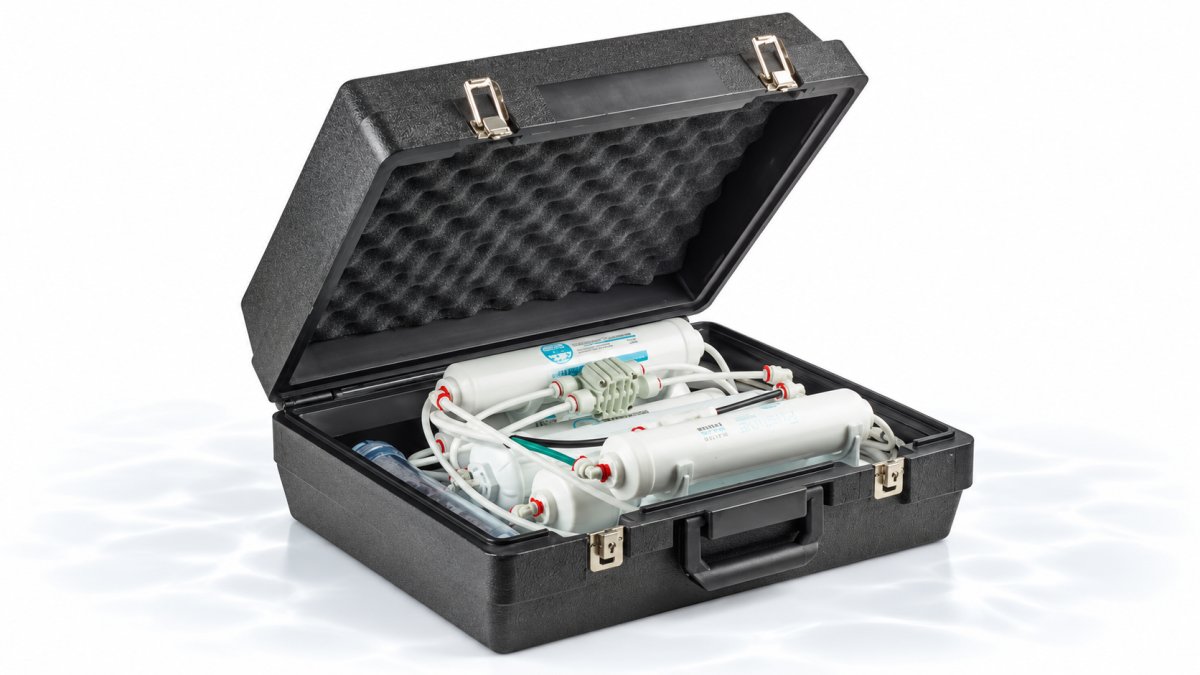
Under-Sink Water Filter in Newport Beach: Test Your Water and Choose Thoughtfully
October 18, 2026 · 16 min read
Choosing an under sink water filter Newport Beach homeowners can feel confident about starts with a practical question: what do you want to change about your drinking water? Local water conditions aren’t identical at every address. Begin by identifying the utility that serves your home and reading its latest Consumer Confidence Report. If your concern is about household plumbing, treat that as a separate question.
This guide explains how to find local water information, what home tests can and can’t tell you, and when a more specific test may help. Then you can compare filtration and remineralization based on your priorities, rather than assumptions about every Newport Beach home. Glen B. Caulkins founded PristineHydro, which sells an under-counter filtration and remineralization system. That commercial interest is relevant context when considering product options. The goal is a measured choice: define what matters, review the evidence, and compare systems against your actual needs.
Key Takeaways
- Start with the water utility serving your address. Its report describes system-level water, while a home’s plumbing can affect what reaches the kitchen tap.
- Define the question before testing. A screening kit and laboratory analysis can differ in what they measure and how specifically they answer it.
- Compare filter claims with evidence for the substance in question. Check the scope and conditions of any supporting test or certification, and note what remains unanswered.
- When choosing an under sink water filter Newport Beach, distinguish filtration from remineralization and decide whether you want one function or both.
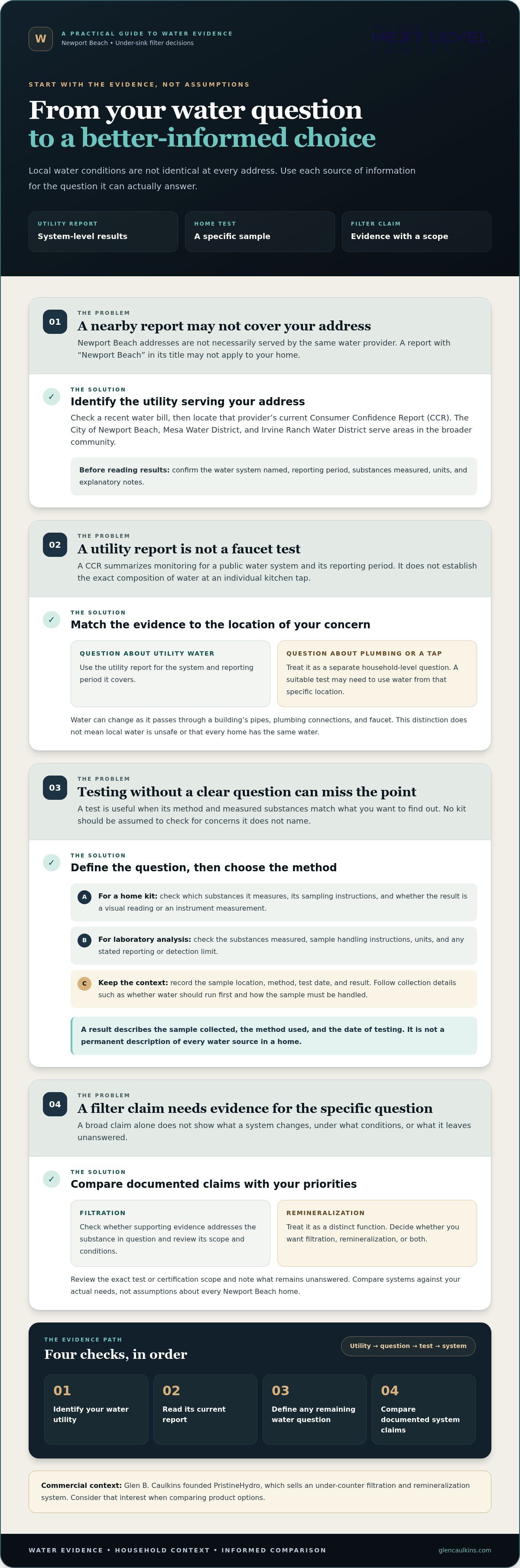
- Follow a simple sequence: identify your utility, read its current report, define any remaining water-quality question, then compare documented system claims.
Before choosing an under-sink water filter in Newport Beach, identify your water source
A utility report describes water across a public water system. It is not a test of every home’s kitchen faucet. That distinction is a useful starting point when researching an under sink water filter Newport Beach homeowners might choose. Water composition can vary with its source and treatment, service area, and conditions inside a building, including its plumbing and fixtures.
Check a recent water bill to identify the utility serving your address. Then find that utility’s current Consumer Confidence Report, also called a water-quality report. Newport Beach addresses aren’t all necessarily served by one provider. The City of Newport Beach, Mesa Water District, and Irvine Ranch Water District each serve areas in the broader community, so don’t assume a report applies to your home just because it includes “Newport Beach” in its title.
How to find the right Newport Beach water-quality report
Use the utility name on your bill to locate its official report. Before relying on a table, check the water system named and the reporting period. Then review the results, substances measured, units, and explanatory notes. The City of Newport Beach’s Consumer Confidence Report applies to addresses served by its water system; it is not a citywide household test. The U.S. Environmental Protection Agency’s Consumer Confidence Reports guidance explains the purpose of these reports.
A Consumer Confidence Report summarizes a water utility’s monitoring results for its system and reporting period. It does not test the water at an individual home’s faucet. That distinction helps you use the report for the question it can answer. The EPA describes CCRs as annual reports on public water systems. Read the utility’s current report and confirm its stated coverage before applying its findings to your address.
What a utility report can and cannot tell you
A report can help you understand the utility’s monitoring and the water it manages. It can’t establish the exact composition of water at a particular tap. Water may change as it passes through a building’s pipes, plumbing connections, and faucet. A result collected for the utility system doesn’t account for every household fixture or plumbing condition.
This doesn’t mean local water is unsafe or that every Newport Beach home has the same water. It means the evidence has a boundary. If your question concerns water as delivered by the utility, start with the utility’s report. If you’re concerned about a particular faucet or building plumbing, that is a separate household-level question and may call for a suitable test of water from that location. Keep these evidence sources distinct as you decide what, if anything, you want a kitchen filter to change.
How to assess Newport Beach tap water: reports, home test kits, and lab testing
After finding the report for your utility, decide what you still need to know. Testing for “everything” without a clear purpose can leave you with results that don’t answer your concern. A test is useful when its method and measured substances match a specific question about your water.
- Review the current utility report. Note its reporting period and the substances it covers. The EPA Safe Drinking Water Act provides context for national drinking-water standards and public water-system monitoring, but a utility report and a household test answer different questions.
- Define the question. Are you investigating a particular substance, a mineral characteristic, or water from a specific faucet? A clear question helps narrow down which test could provide relevant information.
- Select a method that fits. Compare the test’s analytes, meaning the substances it measures, and its sampling instructions with the question you’ve identified.
A test result is meaningful only in relation to the sample collected, the method used, and the date of testing. Keep those details together. A result from one tap or one day shouldn’t be treated as a permanent description of every water source in a home.
When a home water test kit may be useful
A home kit can be an initial screening step, but it isn’t a universal assessment of water quality. Kits differ in what they measure and how they produce a result. Before choosing one, check whether it covers the substance in your question, what sampling steps it requires, and whether the result is a visual reading or an instrument measurement. Don’t assume a kit checks for concerns it doesn’t name.
Follow the kit’s instructions closely. Collection details may matter, including the sample location, whether water should run first, the container used, and the time between collection and testing. Record the kit name, method, date, sample location, and result. If the instructions don’t explain whether the kit can answer your question, its result may not resolve the uncertainty.
When a more specific test may be needed
Some questions call for a method designed for a particular substance or type of sample. Laboratory analysis may provide a more specific measurement than a basic screening kit, but “laboratory test” alone doesn’t describe its scope. Review which substances the lab measures, how it asks you to collect and handle the sample, and the units used in its report. If it lists a reporting or detection limit, keep that information with the result.
Compare findings cautiously. A result applies to the sample and method used, not automatically to another faucet, another date, or all Newport Beach homes. That distinction matters when comparing a result with an article on water chemistry or evaluating an under sink water filter Newport Beach homeowners may consider. Glen B. Caulkins’s research and PristineHydro’s filtration products reflect a commercial interest, so assess product performance through documentation specific to the relevant claim.
How to compare water-test results with under-sink filter claims
A test result and a filter claim answer different questions. The result describes what a particular method found in a particular sample. The claim describes what a product is documented to do under stated conditions. Compare the substance, method, and scope instead of relying on a broad phrase such as “reduces impurities.”
Use this table to organize the evidence. The examples are questions to consider, not claims about any Newport Beach home or filter.
| Test finding | Product claim | Supporting method | Remaining question |
|---|---|---|---|
| A test reports a result for a named substance in a faucet sample. | Does the documentation name that same substance? | Look for a relevant test report or certification, including its stated scope and conditions. | Does the evidence apply to this product and the water-use conditions described? |
| A test measures a general characteristic, such as mineral content. | Does the product claim address that characteristic, or a different substance? | Compare the measured property with the product’s stated performance endpoint. | Would the treatment change the specific property you care about? |
| A kit gives a screening result for its listed analytes. | The product makes a broader filtration claim. | Review the test method and product documentation separately. | Does the screening result provide enough detail to assess that claim? |
Match the finding to the treatment claim
Start with the substance named in your result. Then look for the corresponding product claim and its supporting documentation. If the test reports one substance but the product materials discuss another, the two don’t establish a match. A general measure of water quality also can’t substitute for substance-specific evidence.
Read the conditions closely. A report may apply to a particular sample, setup, or operating condition. A certification, where applicable, has a defined scope; it doesn’t establish that a product addresses every substance or concern. Don’t extend a limited test into a universal promise or assume the same performance in every home.
Separate measured concerns from personal preferences
A documented finding differs from a preference about taste, convenience, or the mineral character of finished water. A preference can be a valid reason to compare options, but it doesn’t by itself establish a health risk or a need for filtration. Keep those reasons distinct when considering an under sink water filter Newport Beach households might choose.
A practical decision depends on the match: consider treatment when its documented scope addresses a defined concern, or when it fits a preference you’ve identified. If the evidence doesn’t line up, pause before treating a broad claim as an answer.
What under-sink filtration and remineralization change, and what they do not
An under-sink filter is a point-of-use system. It treats water dispensed at a particular kitchen tap, rather than treating water throughout the home. That makes it a focused option for drinking and cooking water, but not a substitute for whole-house treatment. Its value depends on what you want to change and whether the system’s documented purpose fits that goal.
Filtration is not the same as remineralization
Filtration describes treating water to reduce or remove substances, according to the system’s design and supporting evidence. Remineralization describes adding minerals to finished water. These are separate functions: one concerns treatment, the other concerns the composition after treatment. Neither is automatically necessary for every household or water source.
PristineHydro’s Under-Counter Water Revival System is a multi-stage system designed to purify and remineralize drinking water. Its stated design purpose includes magnesium bicarbonate. That description doesn’t establish a health outcome, a change in blood pH, or improved mineral absorption. Those are separate claims and require evidence of their own. Properly treated reverse-osmosis water shouldn’t be treated as inherently dangerous. The practical question is whether a system’s treatment and finished-water design suit your priorities.
Glen B. Caulkins’s interest in water chemistry and mineral composition informs his work, and he founded PristineHydro, which sells this system. That commercial relationship is relevant context when considering his perspectives alongside the product. Judge product performance by current official documentation and the scope of any applicable test report, not by broader interpretations of water or mineral chemistry.
Questions to answer before selecting an under-sink system
Before choosing an under sink water filter Newport Beach homeowners might install, name your goal. Are you responding to a specific test finding, seeking a different taste, or looking for a convenient dedicated tap for drinking water? Those aims call for different evidence. A taste preference may guide a personal choice, while a measured concern calls for documentation that addresses the relevant substance.
Then compare the system’s current official materials with that goal. Look for the treatment function described, the specific substances addressed, and the scope and conditions of supporting test results or certifications. Don’t assume that a multi-stage label means every possible concern is covered. If the documentation doesn’t address your question, it may not support that particular choice.
Keep the boundary clear: an under-sink system serves its designated kitchen tap. It doesn’t treat water at showers, bathroom sinks, or other household outlets. If you’re considering filtration and remineralization together, the Under-Counter Water Revival System is one option to assess against those priorities.
A Newport Beach reader’s next step: review the water evidence and explore PristineHydro
A useful decision starts with a clear goal. Identify whether you’re responding to a particular finding, seeking a different taste, or looking for a convenient drinking-water setup. That distinction helps you judge whether a treatment option fits, without assuming every home needs the same approach.
- Identify your water utility. Use a recent bill to find the provider for your address.
- Read its current report. Check the reporting period and findings related to your question.
- Define what remains unclear. If you still have a specific household concern, consider whether a test designed for it could help.
- Compare documented claims. Match the system’s stated purpose and supporting documentation to your goal.
A simple decision path after reviewing a water report
If the report answers your question, you may not need another test or a filter. If a distinct question remains, identify what you want to understand before selecting a test method. Then use the result, if you obtain one, to assess whether a system’s documented scope aligns with your concern. A product claim that addresses a different question won’t resolve yours.
Explore a system designed for filtration and remineralization
The Under-Counter Water Revival System is a multi-stage system designed to purify and remineralize drinking water. It brings those functions together for readers considering both, while the right fit still depends on your priorities and the system’s documented scope. Glen B. Caulkins’s broader research explores water chemistry and mineral composition, with interpretations kept distinct from demonstrated outcomes.
PristineHydro’s storefront is in Laguna Woods, a local option for readers in Newport Beach, Costa Mesa, Laguna Beach, Carlsbad, and Irvine. Find store visit details on the Plan Your Visit page.
If you’d like to explore the system in person, plan a visit to the PristineHydro storefront in Laguna Woods.
Make your next step fit the question you’re asking
A thoughtful choice doesn’t need to become a search for a perfect filter. Begin with one clear aim: address a documented concern, adjust the taste of water at the kitchen tap, or make drinking water more convenient. Keeping that aim in view helps you assess an under sink water filter Newport Beach residents are considering without treating every product claim as relevant to every home.
Glen B. Caulkins’s work explores connections between water chemistry and mineral composition, while distinguishing research interpretations from demonstrated outcomes. PristineHydro has a commercial interest in the products discussed here, so read product information with that context in mind and weigh claims against their supporting documentation.
If you want to learn more about the Under-Counter Water Revival System, visit the PristineHydro storefront in Laguna Woods. Plan your visit.
Frequently Asked Questions
Is Newport Beach tap water safe to drink?
Start with the current report for the utility serving your address and consider any circumstances specific to your home. Check a recent bill, then read that utility’s latest Consumer Confidence Report and its reporting period. The report reflects utility monitoring, not a sample from your particular faucet. If your concern involves a fixture or household plumbing, that distinction can help you decide what evidence you need next.
How can I find a water-quality report for my Newport Beach address?
Check a recent water bill to identify the utility serving your address, then find its current Consumer Confidence Report on the utility’s official website. Confirm that the report names the right water system and covers the relevant service area. Check the reporting period as well. Use its findings as context about the utility’s system, not as a measurement of water from your own kitchen tap.
Can a home water test kit tell me everything about my tap water?
No. Home kits differ in method and in the substances they measure, so a kit can only speak to its stated scope. A kit that measures one set of analytes won’t answer a separate question about an unlisted substance. Compare the kit’s analytes with your specific concern, follow its sampling directions, and keep the instructions with the result for context.
When should I use a laboratory water test instead of a home test kit?
Consider laboratory analysis when your question calls for a method suited to a particular substance or sample. Lab testing isn’t necessary for every home. Before collecting a sample, review the lab’s method, container and handling instructions, and the units used in its report. These details help you understand what the result describes.
Do I need an under-sink water filter if my utility report meets requirements?
Not automatically. A utility report describes system monitoring, while a household filter decision may reflect a particular faucet, plumbing question, taste preference, or convenience. For example, someone may want a different taste without having a specific test finding. Another person may have a question about water after it passes through home plumbing. An under sink water filter Newport Beach residents consider should fit their reason, not an assumption that every household needs one.
Does an under-sink reverse-osmosis system add minerals back to water?
Some systems are designed to remineralize water, while others may not be; filtration and remineralization are distinct functions. The Under-Counter Water Revival System is a multi-stage system designed to purify and remineralize drinking water. That description doesn’t establish a health effect, and it shouldn’t be generalized to every reverse-osmosis system. For system-specific details, use current official product information.
What should I compare before choosing an under-sink water filter?
Compare the system’s intended use, the substances its current documentation addresses, and the scope of supporting tests or certifications. Review installation requirements and maintenance information as well. Match those details to your concern rather than relying on broad claims. For readers in Newport Beach, Costa Mesa, Laguna Beach, Carlsbad, and Irvine, PristineHydro’s storefront is in Laguna Woods, a separate consideration from a system’s fit for your home.
Frequently Asked Questions
Is Newport Beach tap water safe to drink?
How can I find a water-quality report for my Newport Beach address?
Can a home water test kit tell me everything about my tap water?
When should I use a laboratory water test instead of a home test kit?
Do I need an under-sink water filter if my utility report meets requirements?
Does an under-sink reverse-osmosis system add minerals back to water?
What should I compare before choosing an under-sink water filter?
More articles