Drinking Water Systems in Costa Mesa: Which Filter Type Fits
November 6, 2026 · 15 min read

A whole-house filter isn’t automatically the right answer for Costa Mesa water. A drinking water system in Costa Mesa can be a better fit when your goal is to treat water used for drinking and cooking; reported local water measures 5.8 grains per gallon of hardness and 371 parts per million of total dissolved solids. Those figures describe mineral content, not by themselves whether the water is safe or which filter you need.
It makes sense to want a clear picture of what comes through the tap and what a filter can change. Start with the goal: reducing a specific substance, changing taste, or addressing mineral scale throughout the home. This guide explains how hardness and TDS differ from contaminant concerns, why whole-house systems and drinking-water filters serve different purposes, and where reverse osmosis fits. The result is a practical way to compare options without treating one system as the answer to every water question.
Key Takeaways
- Separate hardness and TDS from questions about specific contaminants; each describes a different aspect of water.
- Choose whole-house treatment when the concern affects water throughout the home, and a drinking-water filter when the priority is water at the tap.
- Consider reverse osmosis when you want a drinking-water treatment approach aimed at reducing dissolved substances.
- Understand that water-system reliability depends on the source, treatment process, and ongoing system maintenance.
- Start with the water concern you want to address, then match the treatment scope to where that water is used.
Should You Filter Your Costa Mesa Water?
Whether to filter depends on the water district serving your address, the substances of concern, and your treatment goal. Costa Mesa water data includes detections and regulatory results, but those describe different things.
Tap Water Safety Guidelines
Health guidelines help interpret measured contaminants by comparing results with health-based benchmarks. A detection alone doesn’t show whether a level exceeds a limit or indicates a regulatory violation.
For Costa Mesa, EPA compliance monitoring data from 2012-2019 recorded eight regulated contaminants, and one contaminant’s average was reported above a federal limit. Mesa Water District has had no health-based EPA maximum contaminant level violations on record since 2010. These figures describe different measures, so they should not be collapsed into a single claim that all local tap water is unsafe.
Detection, concentration, and legal status each answer a different question. For example, a reported average above a federal limit is not the same as a documented health-based violation by a water district. The district serving your address matters too: Costa Mesa includes areas associated with Mesa Water District and Irvine Ranch Water District.
Water Safety and Legal Limits
Legal limits are regulatory thresholds for contaminants, while health goals offer a separate, health-focused point of comparison. Exceeding a health goal does not automatically mean a legal limit was violated.
For Irvine Ranch Water District, the supplied local records report zero health-based violations since 2020, while also listing two contaminants above EPA maximum contaminant level goals. Those statements can coexist because a goal and an enforceable maximum contaminant level are not interchangeable. Looking at the exact contaminant and measurement prevents a broad label from obscuring what the result means.
For example, the reported average arsenic level in Costa Mesa water was 2.22 parts per billion in 2012-2019, compared with a listed federal limit of 10 parts per billion. That comparison gives context for arsenic specifically; it does not describe every contaminant, every home, or every water district. A drinking-water system should therefore match a defined concern rather than a general label.
Testing and Reporting Water Quality Concerns
Water testing measures a sample for selected substances, while a utility report summarizes monitoring across its service area. Both matter: a district-wide result and a concern about your home’s plumbing address different parts of the water journey.
The U.S. Environmental Protection Agency says residents can contact their water utility to ask about testing and lead levels. This is useful when the concern is lead, since water can contact household plumbing before it reaches the tap. A district report and a sample from the home can help distinguish these possibilities.
For a specific concern, identify the water district serving your address, then describe the issue clearly to the utility. A change in taste, color, or odor is worth reporting, but appearance alone cannot identify a contaminant. If your concern is lead, ask about testing and lead levels, as the U.S. Environmental Protection Agency advises.
Filtering is a treatment choice, not a substitute for understanding test results. In Costa Mesa, compare the water district’s monitoring information with your specific concern, such as lead or a named regulated contaminant. This can help clarify whether the next step is utility testing, a drinking-water filter, or no additional treatment for that particular issue.
Costa Mesa water hardness and TDS
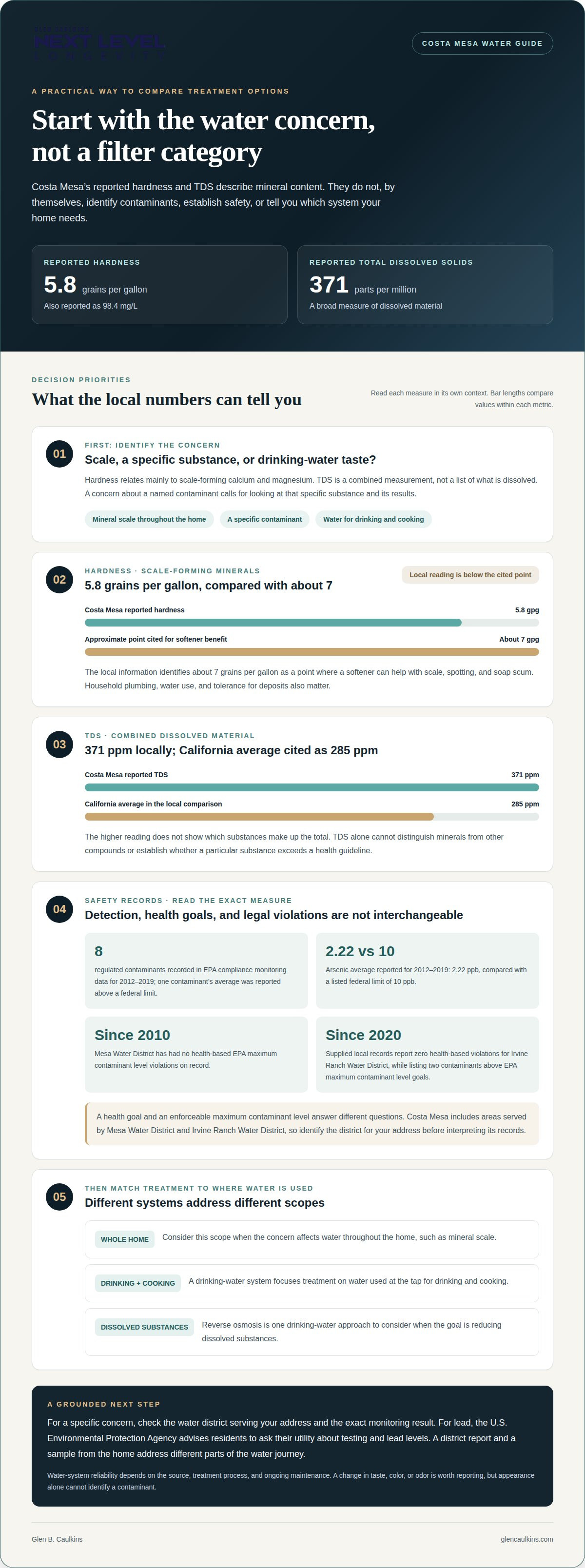
Costa Mesa tap water is reported at 5.8 grains per gallon of hardness, equivalent to 98.4 milligrams per liter. Its reported total dissolved solids, or TDS, measure 371 parts per million. These figures describe mineral content in different ways. Neither one identifies every substance in the water or, by itself, decides what treatment a household needs.
Hardness describes scale-forming minerals
Water hardness mainly reflects dissolved calcium and magnesium. When water heats or evaporates, these minerals can leave scale on surfaces. Pale deposits in a kettle or spots on dishes are familiar examples. Hardness can also affect how soap performs and leave residue on fixtures.
The reported 5.8 grains per gallon for Costa Mesa sits below the point identified in the local information where a softener can help address scale, spotting, and soap scum: about 7 grains per gallon. That comparison provides context, not a complete diagnosis for every home. Plumbing, water use, and tolerance for visible deposits also shape whether hardness feels like a problem. A drinking water system in Costa Mesa should fit the household’s specific concern, rather than treating every mineral reading as a reason for the same equipment.
Hardness and contaminant questions are separate. A hardness reading doesn’t reveal whether a specific contaminant is present, and a softener doesn’t serve the same purpose as a drinking-water filter. First determine whether the concern is mineral scale around the home or a substance in water used for drinking and cooking.
TDS is a broad measurement, not a contaminant list
Total dissolved solids, or TDS, represent the combined amount of dissolved material in water. This broad measure can include minerals and other substances. A TDS result doesn’t identify each component, distinguish beneficial minerals from unwanted compounds, or establish whether a particular substance exceeds a health guideline.
Costa Mesa’s reported TDS is 371 parts per million. The local comparison gives California’s average as 285 parts per million. The difference shows that the Costa Mesa reading is higher than that stated average, but it doesn’t mean each dissolved substance is higher or that the water is unsafe. TDS is a summary number, not a chemical profile.
Two water samples can have similar TDS readings but different mixtures of dissolved material. Someone focused on taste may interpret the number differently from someone investigating a named substance. TDS describes overall dissolved content, not the specific composition behind the reading. That distinction matters when deciding what a filter should do.
Match treatment to the household concern
If scale on a water heater, faucet, or kettle is the concern, consider hardness and where buildup appears. If the concern is drinking or cooking water, focus on the substances the treatment is designed to address. Whole-house treatment and a kitchen drinking-water filter serve different points of use.
The Mesa Water District figure provides local context, but it doesn’t measure water at every household tap. Plumbing and household equipment can affect what you observe. Separate the questions: is the issue mineral hardness, overall dissolved solids, taste, or a specific substance? This makes treatment comparisons more useful than treating one measurement as a complete verdict.
Reverse osmosis for drinking water
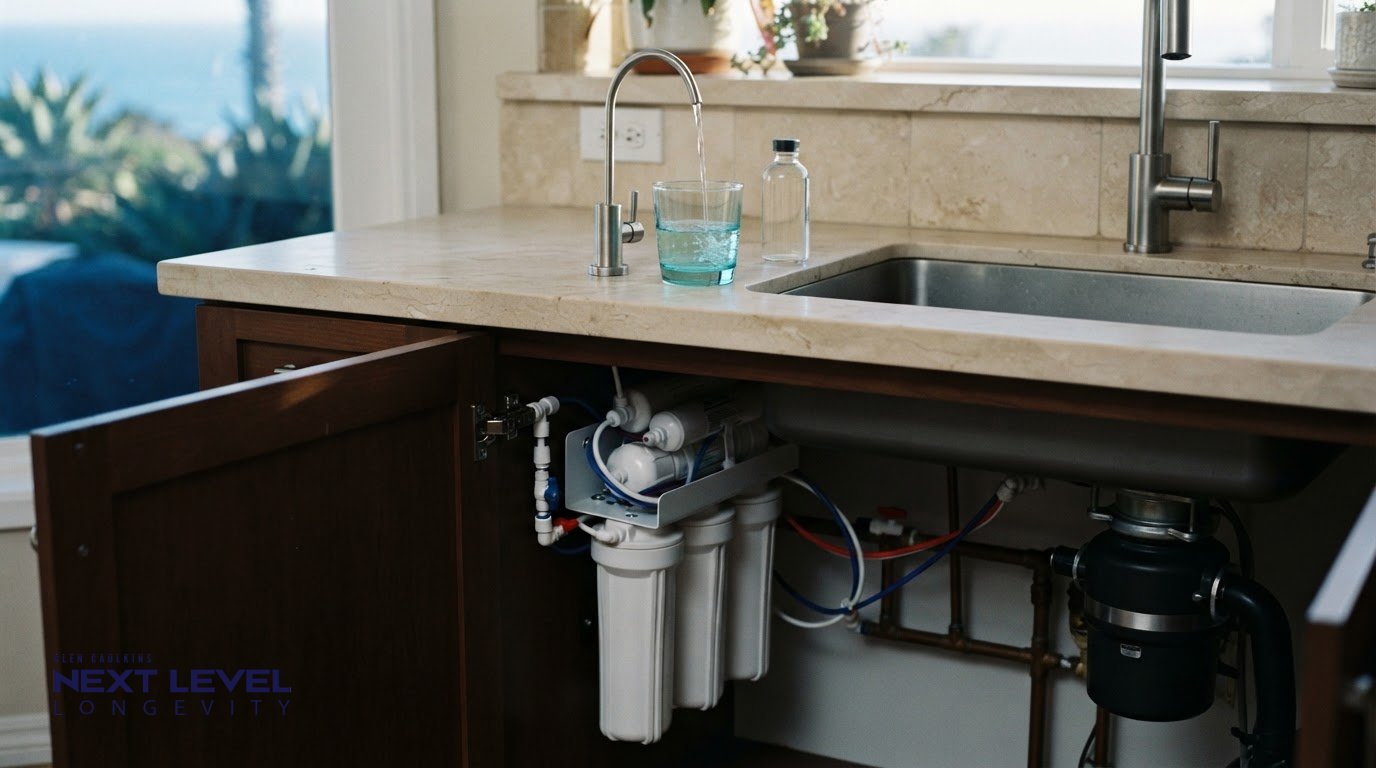
Reverse osmosis, often shortened to RO, treats water at a drinking-water tap. It pushes water through a selective membrane that separates water molecules from many dissolved substances. In Costa Mesa, the local recommendation identifies under-sink RO for drinking water concerns involving nitrate, arsenic, and chromium-6. The right choice depends on the substance you want to reduce and the system’s documented performance for it.
How reverse osmosis works
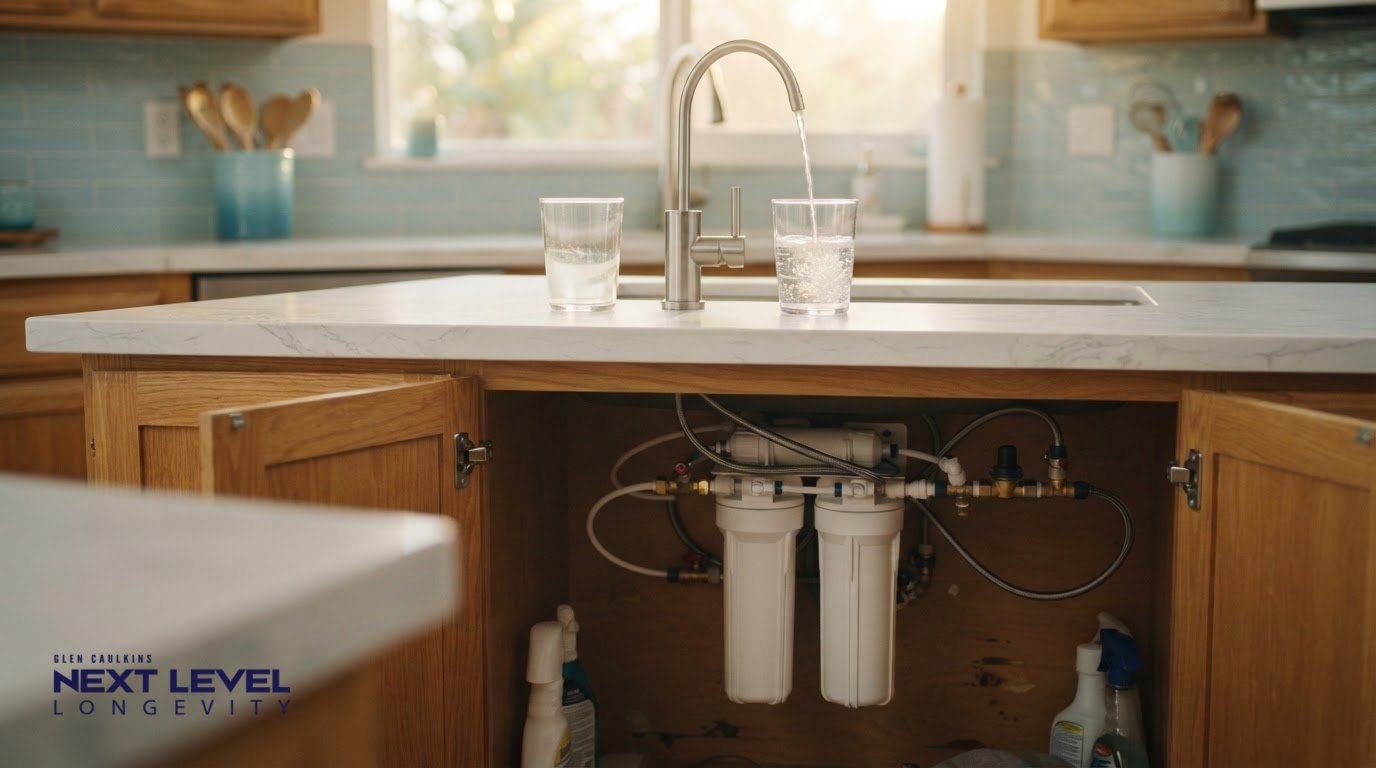
An RO unit uses pressure to move water through a membrane. The membrane allows water to pass while limiting many dissolved substances. Systems often include additional filtration stages, but their purpose and performance vary by model. An RO label alone doesn’t show how well a particular system treats a specific contaminant.
Think of a kitchen tap as a point of use. An under-sink system treats water there for drinking or cooking, rather than treating every tap in the home. Its purpose differs from whole-house treatment, which addresses water entering multiple fixtures. RO is a focused option when the treatment goal concerns drinking water.
Match the system to the contaminant
Start with the substance of concern. Costa Mesa’s local information points to nitrate, arsenic, and chromium-6 as examples for which under-sink RO may be considered. Those are distinct contaminants, so performance evidence for one does not establish performance for the others. The relevant question is whether the system’s test documentation covers the specific substance and conditions of use.
A broad TDS reading can’t answer which specific substance is present. TDS summarizes dissolved material without naming its components. If you’re focused on nitrate, for example, a lower TDS reading alone doesn’t demonstrate nitrate reduction. Choose treatment based on contaminant-specific evidence, not a single general measurement.
What to consider in daily use
RO changes the composition of water passing through its membrane, including its dissolved minerals. This can affect taste, and you may notice a difference between RO water and your usual tap water. Properly treated RO water isn’t inherently dangerous. Rather, RO is a treatment choice with a defined purpose and operating requirements.
Maintenance matters because a membrane and its supporting filters work as a system. Follow the product’s replacement schedule and operating instructions, since overdue components can affect performance. Consider the space beneath the sink, the drinking-water tap arrangement, and whether household members will use the treated water consistently. These practical details help determine how well an RO setup fits daily routines.
When RO may not be the first choice
If the main issue is scale on a water heater or spots on dishes, an under-sink RO unit doesn’t address the whole home. If the goal is only to change taste, a different drinking-water filter may suit that narrower aim. For a named concern such as arsenic, nitrate, or chromium-6, compare system-specific test evidence with that target before deciding.
Reverse osmosis is one option, not a universal answer. In Costa Mesa, consider it as a point-of-use treatment when it suits your goal, and keep its scope clear: one treated drinking-water outlet is not whole-house filtration.
The recommendation is specific in both placement and purpose: under the kitchen sink, for drinking water. Its examples are nitrate, arsenic, and chromium-6. Keep those details together when weighing the option, so the system being considered matches the drinking-water use and the contaminant concern named. This keeps the decision aligned with the recommendation rather than extending it beyond its stated scope.
Water system reliability
Reliable drinking water depends on both the public supply and any household treatment. In Costa Mesa, the serving water district provides important context, while a home filter has its own operating needs. The two systems work at different points: a district report describes monitored supply, but not every tap or whether a household filter is maintained correctly.
Public supply and monitoring
Water service in Costa Mesa may vary by address. The utility serving an address matters because service boundaries and water sources can differ. The same principle applies in Laguna Woods, Newport Beach, Laguna Beach, Carlsbad, and Irvine. A city name alone doesn’t identify the water provider, so connect local monitoring information to the specific address.
For Irvine Ranch Water District, the reported 90th-percentile lead result was 0 parts per billion for the monitoring period from January 1, 2023, through December 31, 2025. The cited EPA action level is 15 parts per billion. That district result describes its monitoring data, not a sample taken from every home’s plumbing or tap.
This distinction matters in practice. Public water passes through a distribution system before reaching a building, and indoor plumbing is another part of its route. A utility-wide result and a sample from one household can therefore answer different questions. If you’re concerned about lead at a particular tap, utility testing and information about lead levels can help clarify what to investigate.
Household filter reliability
A filter’s reliability depends on its intended use and maintenance. A kitchen drinking-water filter treats water at its outlet; whole-house treatment serves multiple fixtures. These setups have different scopes, so don’t assume one serves the other’s purpose.
Filter media and membranes have operating limits. As components collect material or reach their service interval, performance may change. Follow the system’s replacement schedule, use the correct replacement component, and keep its instructions accessible. A missed replacement or mismatched filter can interfere with the treatment goal, even if the equipment remains connected.
Performance evidence needs to match the contaminant you want to address. A claim about one substance doesn’t establish reduction of another. For example, evidence about chlorine alone wouldn’t demonstrate nitrate reduction. Water chemistry research can help explain why the source, treatment, and finished-water composition are distinct parts of the reliability picture.
Make reliability a continuing practice
Keep three questions in view: which utility serves the address, what household concern matters, and what maintenance the chosen equipment requires. In Costa Mesa, Laguna Woods, Newport Beach, Laguna Beach, Carlsbad, and Irvine, connect utility information to the correct service area rather than assuming nearby homes have identical supplies.
Public monitoring and household filtration provide different kinds of information. A district report describes the supply; investigating a kitchen tap may also involve household plumbing and filter upkeep. Keeping these roles distinct makes reliability easier to assess without treating one report or device as a complete account of water at every faucet.
Glen B. Caulkins
Glen B. Caulkins connects questions about water treatment with research into water chemistry, minerals, and environmental exposure. He also has a commercial interest in PristineHydro products, context readers can consider when weighing his research alongside the products.
For household drinking water, PristineHydro offers the Under-Counter Water Revival System and the Travel-Portable Water Revival System. The Under-Counter system is a kitchen option; the portable countertop system can move between homes, offices, and trips. Both use a filter-then-remineralize approach.
If you’d like to discuss your water-treatment questions, contact Glen B. Caulkins.
Choose the next step that fits your home
A useful decision starts with the water concern you want to address, then considers where treatment needs to happen. A drinking-water system serves a different role from treatment throughout the home. When choosing a drinking water system in Costa Mesa, focus on intended use and evidence for the specific treatment goal, rather than relying on a broad label alone.
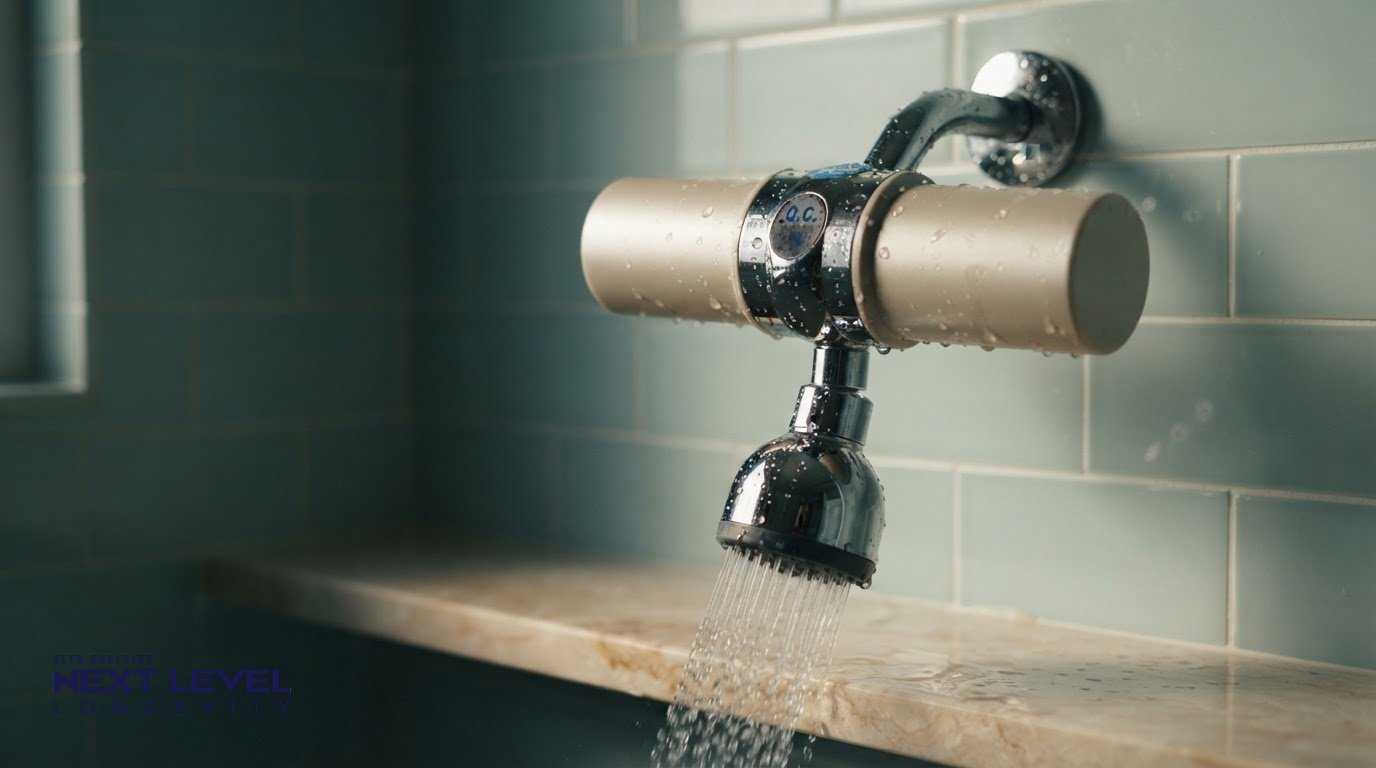
Glen B. Caulkins’s work connects water treatment with questions about minerals and finished-water composition. For shower filtration, PristineHydro offers the Aqualux filter with head or the Ultimate Dual KDF inline filter, which works with an existing shower head. These products are not medical advice or treatment; they are practical options within a broader inquiry into water.
If you’re ready to discuss your water-treatment questions, start a conversation with Glen B. Caulkins. Bring the concern you want to solve, and take the next step at a pace that feels right for your home.
Frequently Asked Questions
What is the current drinking water quality in Costa Mesa?
Costa Mesa doesn’t have one water-quality result that describes every tap. Water district service areas differ, and a utility report describes its monitored supply, not each home’s plumbing. For a clearer picture, identify the district serving your address and review its latest water-quality report. If your concern involves a particular tap or household plumbing, a sample from that location can answer a different question.
What contaminants have been detected in Costa Mesa drinking water?
Reported monitoring has included trihalomethanes, haloacetic acids, fluoride, uranium, combined radium, and arsenic, as well as nitrate and nitrite. Some records also name individual disinfection byproducts, including bromoform and bromodichloromethane. A contaminant’s detection alone doesn’t show its concentration or regulatory status. A report listing uranium and another listing a disinfection byproduct describe separate measurements, not one overall water-quality result.
Does Costa Mesa tap water meet federal and California drinking water standards?
There isn’t one citywide answer that applies equally to every Costa Mesa address and contaminant. Compliance must be assessed by the water district, comparing each regulated contaminant’s results with its applicable standard. A detection or comparison with a health goal alone doesn’t establish a legal violation. For a location-specific assessment, use the serving utility’s compliance report and distinguish enforceable limits from health-based guidance.
What steps can Costa Mesa residents take to improve tap water taste or remove contaminants?
Start by naming your goal: taste, a particular contaminant, or both. For taste, a point-of-use filter treats water at the kitchen tap. For contaminant reduction, choose a system with performance evidence for the specific substance, then maintain it according to its instructions. If your concern is lead, contact the water utility about testing and lead levels. A general TDS reading can’t identify which contaminant is present.
Frequently Asked Questions
What is the current drinking water quality in Costa Mesa?
What contaminants have been detected in Costa Mesa drinking water?
Does Costa Mesa tap water meet federal and California drinking water standards?
What steps can Costa Mesa residents take to improve tap water taste or remove contaminants?
More articles