Adding Minerals to Reverse Osmosis Water: A Guide
October 18, 2026 · 16 min read

If reverse osmosis removes minerals, does that mean you need to put them back? A flat or unfamiliar taste can make the question feel urgent. But properly treated RO water isn’t inherently unsafe, and remineralization isn’t a fix for water that hasn’t been treated well. If you’re asking how to add minerals to reverse osmosis water, the useful first step is to separate taste preference from health claims.
Mineral addition is an optional finishing choice. You can use a post-filtration cartridge for a continuous approach, or add a liquid or powder concentrate when you want more control over each glass. Each method has practical tradeoffs, and the right fit depends on your water, routine, and taste.
This guide explains why people remineralize RO water, compares these approaches, and shows what to consider before choosing one. Glen B. Caulkins studies finished-water chemistry and founded PristineHydro, which offers mineral concentrates and an under-counter Water Revival System. That commercial connection matters, so product options are presented as choices, not medical interventions or proven routes to better health.
Key Takeaways
- Remineralization is an optional finishing step, not a requirement for every RO system or a remedy for unsafe water.
- Because RO results vary with the system and source water, identify what you want to change before choosing a mineral approach.
- Compare cartridges, concentrates, and mineral-containing ingredients by how much control, upkeep, and composition clarity each offers.
- For how to add minerals to reverse osmosis water, start with the instructions for your RO system and the mineral product, then assess the result.
- PristineHydro offers mineral concentrates and an Under-Counter Water Revival System; consider these as practical options, not medical interventions.
Why Add Minerals to Reverse Osmosis Water? Start With the Reason
Before choosing a mineral product or filter, ask what you want to change. Some people prefer the taste or composition of water with selected minerals added back. That preference can be a reasonable guide, but it doesn’t establish a medical need. Properly treated reverse osmosis water isn’t inherently dangerous just because its mineral content is lower.
Remineralization adds selected dissolved minerals to water after reverse osmosis; filtration separates substances from water, while remineralization changes the finished water’s composition. The distinction helps keep the decision grounded. If you’re considering how to add minerals to reverse osmosis water, begin with the water your system actually produces and the reason you want to adjust it.
What reverse osmosis changes in finished water
A reverse osmosis system pushes water against a semipermeable membrane, which allows water molecules through while reducing many dissolved substances. Those substances can include minerals such as calcium and magnesium. The Reverse Osmosis process is used in different applications, but household systems don’t all produce identical results.
Finished-water composition depends on the incoming water, the system’s design, and its condition. A system may also include stages after the membrane that affect the final result. Maintenance matters because filters and membranes have specific service needs. In short, “RO water” describes a treatment approach, not a fixed mineral profile. A total dissolved solids reading can indicate a change in dissolved material, but it doesn’t identify which minerals are present.
Taste preference is not proof of a health requirement
Water that tastes flat or unfamiliar can be less appealing to someone accustomed to mineral-containing water. That reaction is sensory, not a diagnosis. Adding minerals may shift the flavor, but a better-tasting glass doesn’t prove a health benefit, and a flat taste doesn’t show that the water is harming you.
Mineral intake is considered across the whole diet, not from drinking water alone. Foods can contribute minerals, and water can contribute too, depending on its composition. Whether a person gets enough of a nutrient depends on more than the mineral content of one glass of water. This section can’t determine an individual’s nutritional needs.
The same care applies to pH claims. A change in water’s pH or mineral content is a measurable chemistry difference, not proof of a health outcome. Claims about improved health, mineral absorption, or bodily pH need evidence for those specific effects. For many households, the practical question is simpler: does the water taste the way they prefer, and is the treatment system maintained according to its instructions?
How Mineral Addition Works: Drops, Cartridges, and Mineral-Rich Ingredients
Each method follows the same basic sequence: reverse osmosis treats the water, then selected minerals enter it afterward. The difference is how they’re added and how much attention the process requires. Some systems use a cartridge in the post-filter stage; other approaches let you add a measured concentrate to a glass or container.
A method’s label alone doesn’t establish the finished water’s mineral composition. “Mineral,” “alkaline,” or “remineralizing” can describe a broad category, not a precise formula or final concentration. Products and ingredients differ. To understand what’s added, look for the actual ingredients, directions, and any composition information provided for the specific product.
Post-filter cartridges and built-in remineralization
A post-filter cartridge sits downstream of the RO membrane. Water passes through media inside the cartridge, which can release selected minerals through contact with that material. In systems with built-in remineralization, the process is integrated into the system rather than added separately to each glass. The media, resulting composition, and replacement schedule depend on the model.
Follow the instructions for the specific RO system and cartridge. Don’t assume that a replacement part or service interval fits every model. If a system includes a remineralization stage, its product documentation is the place to find what that stage is designed to do and how to maintain it.
Mineral concentrates and other user-added methods
Concentrates let the user add minerals after treatment, which can make it easier to adjust water in small amounts according to the product directions. Mineral-containing salts and pitchers are other broad categories, but their ingredients and results aren’t interchangeable. A category name can’t tell you the mineral balance in the finished glass.
For any concentrate, use the current product label and directions rather than a generic recipe. PristineHydro offers mineral concentrates, but the product’s own current ingredient and usage information should guide how it’s used. Don’t infer a formula, concentration, or health effect from the word “mineral” alone.
The World Health Organization’s review of minerals in drinking water discusses calcium and magnesium in water and their potential public-health significance. It doesn’t make every remineralization method equivalent or establish that one product suits every water supply. Its findings are best read as context for water composition, not as a dosing instruction.
To decide how to add minerals to reverse osmosis water, compare the practical differences: a cartridge works as part of the system and requires system-specific upkeep; a concentrate involves following its label each time you use it; other mineral-containing ingredients depend on their own formulation. If you want to explore the broader questions behind finished-water chemistry, Glen’s research and writing offers a related place to continue.
Which Remineralization Method Fits? Compare Control, Upkeep, and Clarity
The useful comparison isn’t simply which method adds minerals. It’s how the method fits your routine, what information it gives you about the finished water, and how much ongoing attention it requires. A system designed to remineralize handles the step within a compatible RO setup. A separate concentrate gives you a user-directed step after filtration. Neither approach is automatically right for every household.
“Composition clarity” means how readily you can learn which minerals are present and what the maker states about the product. A method name or broad label alone can’t answer that. If the composition matters to your choice, look for specific product information rather than inferring the finished-water profile from a category.
When a cartridge may suit a hands-off routine
A cartridge may appeal if you want remineralization integrated into a compatible RO system instead of adding something each time you pour water. The tradeoff is that upkeep remains part of the routine: follow the instructions for your exact model and its replacement parts. Output can vary with system design and incoming water, so integration doesn’t guarantee identical mineral levels across homes.
When a concentrate may suit a more adjustable routine
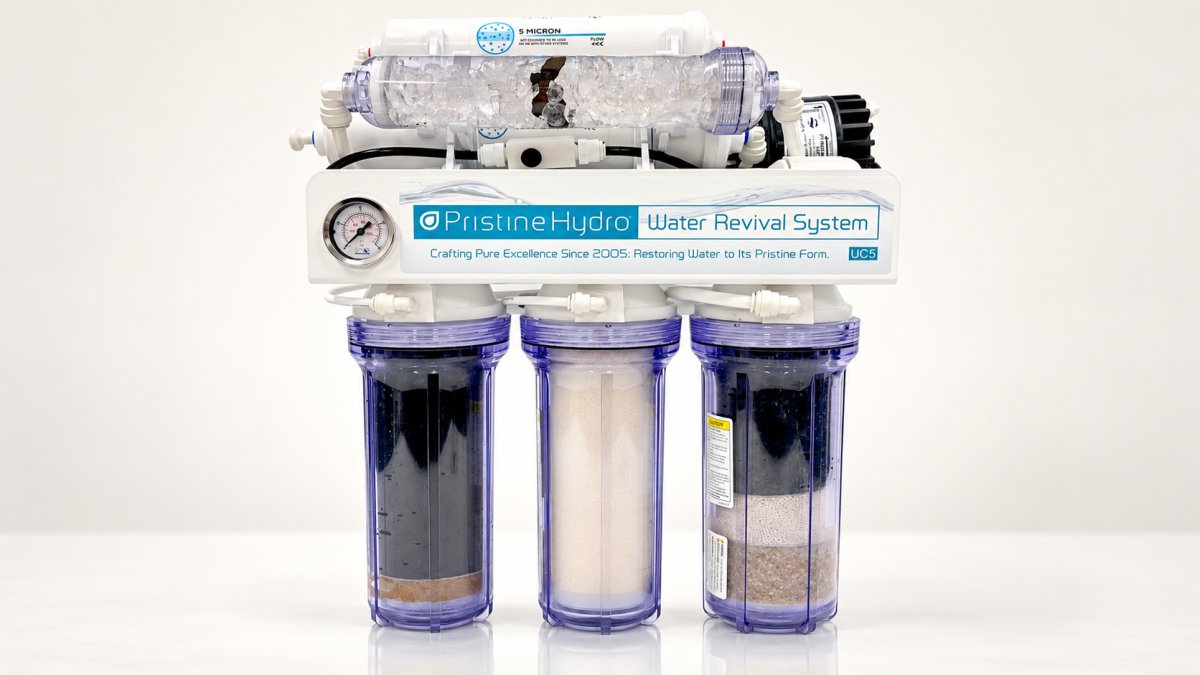
A concentrate may suit you if you’d rather add minerals after filtration as a separate step. That gives you control over whether and when you use it, but it also means following the actual label directions each time. PristineHydro offers mineral concentrates and an Under-Counter Water Revival System designed to purify and remineralize drinking water. These are distinct options, not medical interventions.
In practical terms, choose based on your routine and the information you can find about the method. A cartridge puts the finishing stage inside the system; a concentrate keeps it separate. If you’re still deciding how to add minerals to reverse osmosis water, compare the instructions and composition details for the specific options you’re considering, then move to the next step with a clear preference in mind.
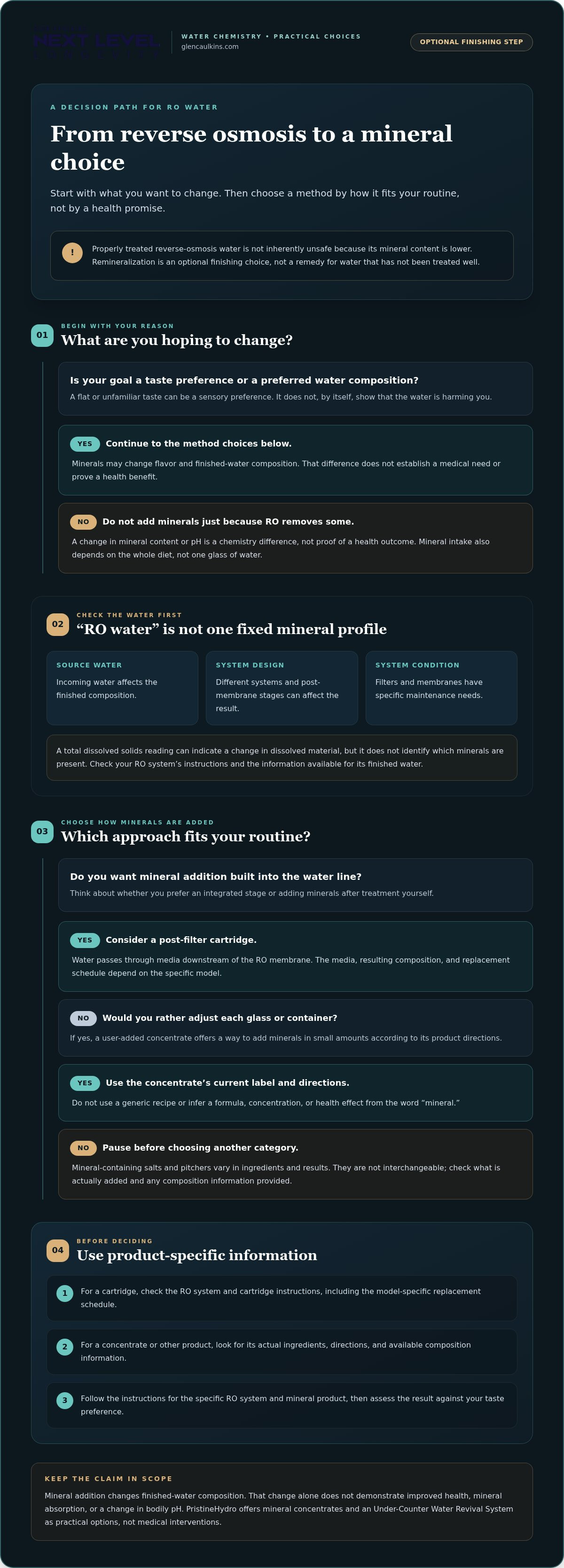
Adding Minerals to RO Water: Step-by-Step Guide
A careful trial starts with a clear question, not a target number pulled from a generic recipe. Are you aiming for a taste you prefer, a particular mineral composition, or a practical feature of your setup? Those goals call for different kinds of information. Use this sequence to make a change you can interpret.
- Identify your goal. Write down what you want to learn or change. If the aim is taste, note what seems unfamiliar. If you want a specified mineral composition, identify which minerals matter and how you’ll verify them. Taste alone can’t establish that composition.
- Review your RO system and chosen method. Check the instructions for your exact system before adding a cartridge or changing its setup. For a concentrate, read its current label and usage directions. Compatibility, installation, and care requirements can differ by product.
- Follow the directions as written. Don’t substitute a generic dose or assume that directions for one product apply to another. If a method requires a replacement schedule or specific preparation, follow the instructions for that product.
- Assess the result. If taste is your goal, compare the water under similar conditions and change one variable at a time. If you need to know which minerals are present or their concentrations, use composition information or suitable testing rather than relying on taste.
What taste, pH, and TDS can and cannot tell you
Taste is personal. A change may be noticeable, but taste can’t identify which mineral caused it or measure its concentration. pH describes how acidic or alkaline a sample is. It doesn’t reveal the complete mineral profile, and a pH shift alone doesn’t demonstrate a health benefit.
TDS alone does not identify which dissolved minerals are present. Total dissolved solids is a broad measure of dissolved material. It can help show that the overall amount has changed, but it doesn’t distinguish calcium from magnesium or identify other individual substances. Use the measure that matches your question: sensory comparison for taste, pH measurement for pH, and appropriate composition data or testing for specific minerals.
Water also begins with a source. For readers in the Laguna Woods area, current water-quality information for the relevant provider and service address can offer useful context. Local sources and treatment conditions aren’t necessarily identical, so avoid assuming one neighborhood’s report describes every home or the water after it passes through an RO system.
Keep the process modest: define the goal, make a compatible change, follow the specific instructions, then assess only what your chosen method can actually tell you. For more context on the questions behind Glen B. Caulkins’s work on water and finished-water chemistry, explore Glen’s research and writing.
PristineHydro Options for Remineralizing RO Water
Glen’s interest in water includes how treatment shapes finished-water composition. That research sits alongside a commercial interest: PristineHydro sells water products, including mineral concentrates and an under-counter Water Revival System. Keep that relationship in mind when weighing the research discussion and the product options.
The decision still begins with your own purpose. You might prefer water treated and remineralized within one system, or want to add a concentrate after treatment. Neither choice is a medical intervention, and neither should be treated as a guaranteed health outcome. Compare intended use, system fit, instructions, and the information available about each product.
How the Water Revival System relates to this decision
PristineHydro’s Under-Counter Water Revival System is designed to purify and remineralize drinking water. It may suit someone considering an integrated approach for a kitchen drinking-water setup rather than adding minerals separately after filtration.
System design and setup details matter. Use the current product information for the specific model to understand its verified specifications, installation requirements, and maintenance instructions. Don’t assume that an under-counter drinking-water system treats every household tap or that its results apply to other RO systems. Its described purpose is water treatment and remineralization, not diagnosing or addressing a health condition.
Research interest and product evidence answer different questions. An interest in finished-water composition doesn’t, by itself, establish a product’s performance or a health effect. Keep those distinctions visible as you compare options.
How to explore mineral concentrates thoughtfully
A mineral concentrate is a separate, user-added option for water that has already been treated. Its ingredients and directions are product-specific, so rely on the current label rather than a generic formula or directions for another concentrate. Don’t infer an ingredient list, concentration, or health outcome from the product category alone.
Read the product information alongside your RO system’s instructions. Note what the label says about ingredients and use, then decide whether the approach fits your routine and the composition details you want. If your purpose is a specific mineral profile, taste alone won’t verify it. If you’re simply exploring water products, start with the product information and keep the choice proportionate to your goal.
Explore PristineHydro water products to review current options and their product information. Use the details for the specific product you’re considering, then choose the next step that fits your water and preferences.
Choose a Next Step That Matches Your Goal
The next step doesn’t need to be a sweeping change. Start with one clear reason for adjusting your water, then choose a method whose instructions and composition information you can understand. If your interest is taste, judge the result by taste. If you’re seeking a particular mineral profile, look for evidence that can speak to composition rather than relying on a taste test or a single general reading.
That distinction keeps the question of how to add minerals to reverse osmosis water practical and proportionate. Remineralization can be a personal finishing choice, not a judgment that your current water is harmful. A careful decision leaves room to prefer a different taste, keep the water as it is, or learn more before changing anything.
Glen B. Caulkins’s work connects water chemistry with broader questions about minerals and the environment. PristineHydro’s products reflect that interest, and exploring them is one option if you’re ready to compare specific approaches. Explore PristineHydro water products and take the next step at a pace that feels right for you.
Frequently Asked Questions
Is it necessary to add minerals to reverse osmosis water?
No. Adding minerals isn’t a prerequisite for properly treated RO water. Before changing anything, check that your unit is maintained on schedule and used according to its instructions; mineral addition can’t compensate for neglected filters or a system operating outside its directions. A preference for mineral character is a separate choice. If your concern is personal nutrition or health, assess it in the context of your full diet with qualified professional guidance.
Can I add mineral drops to reverse osmosis water?
Yes. Mineral drops or concentrates are generally added to water after it leaves the RO system, following the product’s own directions. Check the ingredient panel and whether it specifies a serving volume, mixing method, or storage conditions. Keep the concentrate separate from the system unless its instructions explicitly say otherwise. This helps prevent applying one product’s directions to a different formula or unintentionally altering system components.
How much mineral concentrate should I add to RO water?
Use the current label’s stated amount for the stated volume of water. Don’t transfer directions from another concentrate or rely on taste to set the amount. Products can have different formulations and strengths, so a universal quantity may not match the product’s intended use. If you use a bottle or pitcher, measure the water volume consistently and follow the label rather than experimenting beyond its directions.
Does adding minerals to RO water change its pH?
It can. Substances introduced by a remineralizing stage or concentrate may affect measured pH, but the change depends on the ingredients and starting water. Read product statements for what they actually measure, and use a suitable test method if a pH reading matters to your purpose. Don’t treat a particular pH as a medical target or infer a health benefit from a change in the reading.
What happens if I drink reverse osmosis water without adding minerals?
Usually, no special consequence follows solely from drinking properly treated RO water without a remineralization stage. Keep the system maintained and use it as intended; output depends on the system and its operating condition. Water can contribute to mineral intake, but nutrition comes from a broader dietary pattern. If you’re concerned about nutrient adequacy, review your diet with a qualified health professional rather than changing your water based on symptoms.
How can I tell which minerals are in remineralized RO water?
Look for a product analysis that names the minerals, or arrange a water test that reports the specific elements or compounds you want to know about. Test a sample taken after the remineralization stage, using the lab’s collection instructions. A test of source water won’t show what the finished system adds. Keep the results tied to the system setup and sampling date, since replacements or adjustments can change the water.
Can remineralization remove contaminants from reverse osmosis water?
No. Adding minerals isn’t a contaminant-removal treatment, and it can’t confirm that earlier treatment worked as intended. For a concern about a particular contaminant, consult the RO system’s performance documentation for that contaminant and maintain the unit according to its schedule. If water sources or conditions change, reassess the treatment question directly rather than assuming a mineral adjustment addresses it.
Frequently Asked Questions
Is it necessary to add minerals to reverse osmosis water?
Can I add mineral drops to reverse osmosis water?
How much mineral concentrate should I add to RO water?
Does adding minerals to RO water change its pH?
What happens if I drink reverse osmosis water without adding minerals?
How can I tell which minerals are in remineralized RO water?
Can remineralization remove contaminants from reverse osmosis water?
More articles