Fluoride Water Filters for Newport Beach Homes: Costs and Capacity
October 28, 2026 · 15 min read
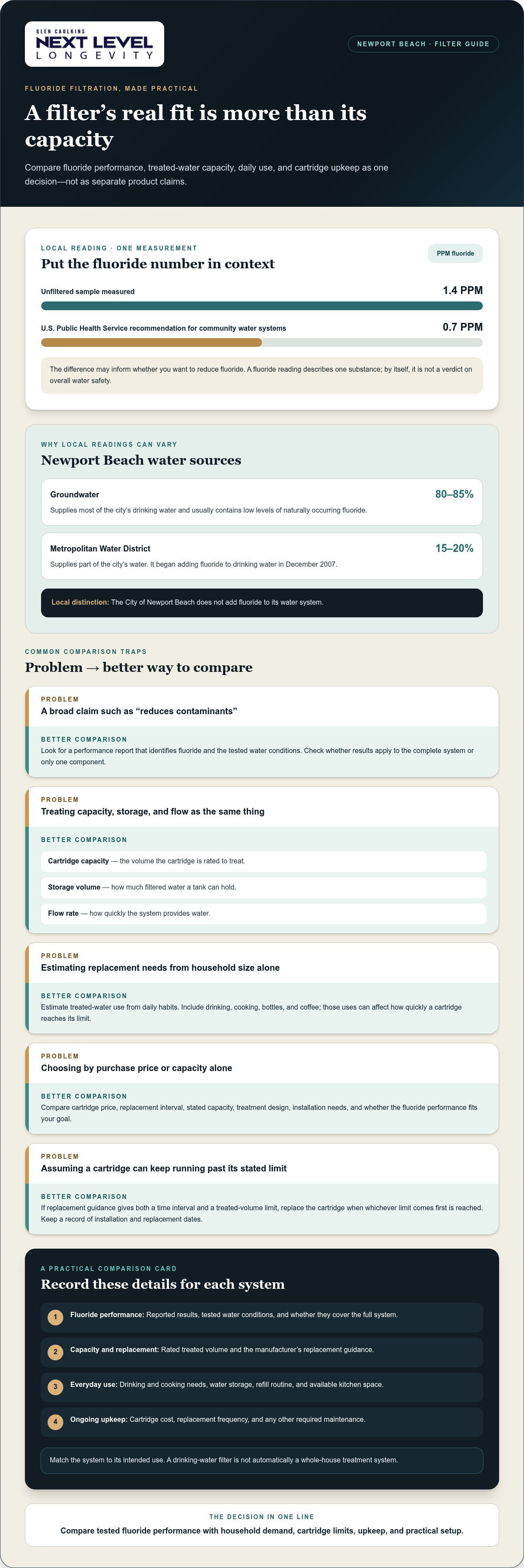
A fluoride reading alone doesn’t determine whether Newport Beach tap water is safe to drink. An unfiltered sample measured 1.4 PPM fluoride, while the U.S. Public Health Service recommends 0.7 PPM in community water systems. That difference may influence whether you want to reduce fluoride, but it isn’t, by itself, a verdict on overall water safety. Choosing a fluoride water filter in Newport Beach means looking at how well it reduces fluoride, how much water it can treat, and how often its cartridges need replacing.
It’s reasonable to want a clear answer before choosing a fluoride water filter in Newport Beach. The right fit depends on the fluoride level you’re addressing, how your household uses drinking water, and the filter’s stated capacity. This guide explains how to interpret local readings, what filter methods can and can’t establish, and which factors affect capacity and cartridge upkeep, so you can compare options based on what they actually do.
Key Takeaways
- Assess tap-water safety separately from whether you want to reduce fluoride; one measurement does not describe every aspect of water quality.
- Compare filter methods by their fluoride-reduction performance and the conditions under which that performance is reported.
- Estimate ongoing upkeep by weighing cartridge capacity against your household’s water use and replacement schedule.
- Look beyond the filter’s purchase price: cartridge type, replacement frequency, and system design all shape long-term costs.
- Consider the Under-Counter Water Revival System when you want a home drinking-water option, and match your choice to the specific filtration goal.
Is Newport Beach Tap Water Safe To Drink?
Newport Beach tap water’s safety and its fluoride level are separate questions. An unfiltered sample measured 1.4 PPM of fluoride, while the U.S. Public Health Service recommends 0.7 PPM in community water systems.
That difference can guide a filter choice, but it doesn’t establish whether water is safe overall. A fluoride reading describes one substance, not the complete water profile. Environmental Working Group identified 16 contaminants in Newport Beach tap water above its recommended guidelines. That finding alone doesn’t show whether the water meets applicable standards or indicate the risk for an individual household.
The City of Newport Beach supplies local water through its municipal system. Find the latest water quality report on the City’s official water quality or annual Consumer Confidence Report page. Check the report year and water system name to make sure you’re reading the local document.
Don’t assume a home filtration rebate applies simply because you live in Newport Beach or Orange County. Check the relevant program’s eligibility terms, and weigh a filter’s stated performance and maintenance needs when deciding whether it suits your home.
Testing and Product Selection
Fluoride-filter testing is useful only when the results match the filter, test method, and operating conditions. Look for a performance report that identifies fluoride and describes the tested water conditions, rather than relying on a broad claim such as “reduces contaminants.” Check whether results apply to the complete system or only one component. Then compare the reported performance with your goal and the manufacturer’s replacement guidance.
Reverse osmosis is one method to compare, but the name alone doesn’t prove a particular model’s fluoride performance. Start with the contaminant you want to reduce, then consider product-specific test evidence, installation needs, water use, and cartridge replacement requirements.
Local Rebates and Filtration Rules
For a Newport Beach or Orange County home, distinguish a voluntary drinking-water filter from equipment required by a specific rule. A municipal water report describes the supplied water; it doesn’t, by itself, mean a household must install a filter. Rebate eligibility depends on the program, so read its terms for the equipment, property, and work covered before factoring a rebate into your budget.
The total cost depends on the system and its requirements. Compare the purchase price, treatment design, installation needs, and replacement cartridges. Consider stated fluoride performance and maintenance alongside the initial cost. A good recommendation should fit the water concern and household use, not just a product label or a single test result.
Filter capacity and ongoing costs
Filter capacity tells you how much water a cartridge can treat before replacement. It differs from a system’s storage volume and flow rate. A tank may hold filtered water, while the cartridge has its own treatment limit. For a Newport Beach household, compare all three details with everyday drinking and cooking needs.
Start with the manufacturer’s stated capacity and replacement guidance, then consider how much treated water your household uses. A household that fills bottles, cooks with filtered water, and makes coffee may use a cartridge faster than one filtering drinking water alone. Use daily habits to estimate replacement frequency rather than relying on household size as a shortcut.
Flow rate also affects daily use. A slower filter may still suit your household if you can store filtered water for later. Countertop systems vary in how much water they provide and whether they need plumbing or electricity, so check the specific product details. Storage space and refill routines matter, too.
Ongoing costs include replacement cartridges and any other required maintenance. Compare each system’s cartridge price and replacement interval, then consider its stated capacity. A lower initial cost doesn’t necessarily mean lower upkeep if cartridges need frequent replacement. And greater capacity matters only if the system’s filtration performance fits the concern you’re addressing.
For an apples-to-apples comparison, record these details for each candidate:
- Capacity: The volume the cartridge is rated to treat.
- Replacement guidance: The manufacturer’s interval or capacity limit.
- Household use: Drinking, cooking, and other intended uses.
- Practical setup: Storage space, refill steps, and plumbing needs.
If replacement guidance gives both a time interval and a treated-volume limit, follow whichever limit comes first. Replace the cartridge at that point rather than assuming it will continue performing as before. Keep a simple record of installation and replacement dates to plan upkeep without guesswork.
Finally, match the system’s intended use to your actual need. A drinking-water filter is not automatically a whole-house treatment system. For context on how filtration relates to broader water chemistry, explore Glen’s water research. A useful choice balances tested performance, household demand, cartridge upkeep, and available kitchen space.
Fluoride levels in tap water
Newport Beach’s fluoride level reflects its water sources and treatment. Groundwater supplies 80-85% of the city’s drinking water and usually contains low levels of naturally occurring fluoride. Metropolitan Water District supplies 15-20% of Newport Beach’s drinking water, so the source mix helps explain why local readings may vary.
The City of Newport Beach does not add fluoride to its water system. Metropolitan Water District began adding fluoride to drinking water in December 2007 to help prevent tooth decay. These details describe different parts of the supply: the city’s treatment approach and the regional district’s fluoridation practice.
An unfiltered Newport Beach sample measured 1.4 PPM of fluoride. The U.S. Public Health Service recommends 0.7 PPM in community water systems. Treat these figures according to what they represent: one is a sample measurement, while the other is a public-health recommendation. Neither figure alone describes every tap or all aspects of water quality.
Fluoride is only one part of water chemistry. A fluoride reading doesn’t describe other contaminants, minerals, or treatment residues. Fluoride levels in drinking water are regulated under California state laws and regulations. To understand the water supplied to your home, consult the current Newport Beach water report and note its reporting period and source information.
Separate these details as you review a water report or filter claim:
- Source: Whether the report describes groundwater or water supplied by Metropolitan Water District.
- Measurement: The fluoride value and unit, such as PPM or mg/L.
- Purpose: Whether you want to reduce fluoride or address another water concern.
- Filter evidence: Whether results identify fluoride and the specific tested system.
These distinctions matter because a filter’s suitability depends on documented performance, not its label alone. A general claim about reducing contaminants doesn’t establish fluoride reduction. Look for fluoride-specific results and read their conditions before comparing products.
Newport Beach’s water sources and treatment practices provide context for local fluoride readings, but they don’t define your household’s goal. Start with the water report, identify what you want to address, then compare relevant filter evidence. This keeps one measurement from standing in for a broader assessment of tap-water quality.
Filter types for fluoride
Filter type can narrow the choices, but it doesn’t establish fluoride reduction on its own. Reverse osmosis uses a membrane to separate dissolved substances from water. A fluoride-focused cartridge uses treatment media selected for that purpose. In either case, assess the specific system instead of assuming that every product in a category performs alike.
Reverse osmosis is one method to consider for drinking water at a kitchen tap. The system’s configuration, maintenance, and product-specific evidence all matter. Its membrane is part of a treatment setup, so a general claim about reverse osmosis doesn’t verify every model’s performance. Review documentation for the exact product and its stated operating conditions.
Cartridge filters vary in their media and intended uses. Some address taste or other water characteristics; others are designed to target fluoride. The words “carbon” or “pitcher” don’t establish fluoride reduction. Look for evidence that names fluoride and the filter model instead of relying on a broad claim about improved water quality.
Product format is a separate consideration. Pitcher and countertop filters sit near the point of use, while an under-sink setup treats water at a kitchen fixture. These descriptions explain placement and access, not which contaminants the system reduces. A whole-house system serves a different purpose from a drinking-water filter, so match the equipment to the water use you want to address.
Compare options using a few practical criteria:
- Target: Does the product specifically address fluoride?
- Evidence: Does its documentation identify the model and tested conditions?
- Use: Does its installation and water access fit your kitchen routine?
- Upkeep: Are replacement instructions clear for the system you choose?
Be precise about performance claims. A test result for one cartridge or system doesn’t automatically apply to another model, even if they use similar methods. Test conditions matter, including the water entering the device and the cartridge’s condition. Keep those details attached to the performance claim when comparing products.
For a Newport Beach home, the useful comparison isn’t simply membrane versus cartridge, or pitcher versus under-sink. First, choose a format that fits your use. Then assess the evidence for fluoride reduction on the exact model. Finally, weigh setup and maintenance against how your household uses drinking water. This sequence clarifies the decision without treating a filter category as proof of performance.
Fluoride filter cartridges
Cartridge replacement depends on filter design, treated-water volume, and the manufacturer’s instructions. Follow the stated time interval or capacity limit, whichever comes first. There’s no single replacement schedule for every fluoride cartridge because systems use different media and operate under different conditions.
How can you tell when it’s time to replace a cartridge? Track its installation date and the volume treated, then compare both with the replacement guidance. A drop in flow or a change in taste can signal that a cartridge needs attention, but neither confirms that fluoride reduction remains effective. Use the cartridge schedule, not taste or appearance, as your main guide.
A cartridge’s rated capacity describes the amount of water it is designed to treat under specified conditions. It doesn’t mean every household will use it at the same pace. For example, a family filtering water for drinking, cooking, and beverages will reach capacity sooner than someone filtering drinking water alone. Your daily routine shapes the replacement schedule.
Before buying a replacement, match it to the exact filter model. Similar-looking cartridges may use different media, fit differently, or serve different treatment stages. Check the model name and cartridge designation on the system or in its documentation. A cartridge intended for another model may not fit or perform as designed.
Use this simple record to manage maintenance:
- Install: Write down the date the new cartridge goes into service.
- Track: Estimate treated-water use from your household’s regular routine.
- Compare: Review both the manufacturer’s time guidance and capacity limit.
- Replace: Use the correct model-specific cartridge when guidance calls for it.
Fluoride reduction claims also depend on a cartridge’s tested performance. A general water-filtration label doesn’t show how much fluoride a particular cartridge reduces. Look for documentation naming fluoride, the tested cartridge or system, and relevant operating conditions. Keep that evidence separate from maintenance guidance: a replacement schedule tells you when to change a cartridge, while a test result describes performance under stated conditions.
For a Newport Beach household, cartridge upkeep is part of choosing a system, not an afterthought. Compare the cost and availability of compatible replacements, stated capacity, and expected filtered-water use. These details help estimate ongoing expenses without relying on a universal lifespan claim.
Glen B. Caulkins’ water research and writing explore how filtration choices relate to finished-water composition. Use that wider context alongside product-specific testing and cartridge instructions when planning maintenance.
Glen B. Caulkins: Under-Counter Water Revival System
Glen B. Caulkins’s Under-Counter Water Revival System is a home drinking-water option for a dedicated kitchen setup. Glen has a commercial interest in PristineHydro water-treatment products, including this system. Assess any fluoride-related choice using product-specific performance documentation, not the system name or general filtration language. Match the evidence to your goal, then consider how an under-counter system fits your kitchen and household routine. Glen’s wider work connects water treatment with finished-water composition. Explore that perspective through Glen’s water research.
Choose a filtration path that fits your home
Your next step is to define what you want treated water to achieve. When choosing a fluoride water filter in Newport Beach, compare fluoride-specific performance evidence with cartridge instructions and household use. Then consider capacity, upkeep, and how the system fits your kitchen. A clear priority makes product comparisons more useful.
PristineHydro products serve different settings: the Under-Counter Water Revival System and Travel-Portable Water Revival System are for home and portable use, while the Aqualux filter with head is a shower-filtration option. Product names alone don’t establish fluoride reduction, so match performance claims to your specific goal. Glen B. Caulkins connects practical water options with wider research into water chemistry and finished-water composition.
For a thoughtful next step, contact Glen B. Caulkins to explore the available information and options. Take the decision at your own pace, with evidence and everyday fit in view.
Frequently Asked Questions
Does Newport Beach tap water contain fluoride, and what is the current level?
Yes. A tested unfiltered Newport Beach sample measured 1.4 PPM fluoride. That reading describes the tested sample, not every tap or every date. Water sources and treatment can affect results. For your home’s current supply, consult the latest Newport Beach water quality report. A household-specific laboratory test can provide more direct information about water at your tap.
What types of water filters remove fluoride effectively?
Reverse osmosis is an option to compare for fluoride reduction, but performance depends on the specific system and test conditions. Judge other filter types by fluoride-specific evidence, not broad claims about taste or contaminant reduction. Compare the exact model, its fluoride test results, cartridge guidance, and intended use. This product guide is not health advice and cannot determine what is in your water.
Which NSF/ANSI certifications verify a filter reduces fluoride?
Look for certification documentation that explicitly names fluoride reduction for the exact model. An NSF/ANSI mark alone doesn’t establish that a filter reduces fluoride; the certification’s scope matters. Check whether the listing covers contaminant-reduction performance or only materials and components. If the product documentation doesn’t identify fluoride as a tested or certified reduction claim, don’t treat the mark as proof of fluoride performance.
Do standard pitcher filters or refrigerator filters remove fluoride?
Not necessarily. A pitcher or refrigerator filter’s format doesn’t tell you which substances it reduces. Check the specific model’s documentation for a fluoride claim and supporting performance details. For example, a filter marketed for taste may not be intended to reduce fluoride. Check cartridge replacement guidance, too, since stated performance applies to the system under its defined operating conditions.
How much do fluoride-removing filters cost in Newport Beach, including replacement cartridges?
Costs depend on the system, its treatment design, and the replacement cartridges it requires. Compare the current product price with the cost and replacement guidance for compatible cartridges, then consider your household’s filtered-water use. Don’t estimate ongoing expenses from the upfront price alone. Product pages show current pricing; don’t apply one system’s cartridge costs or capacity to another model.
Where can I buy or install a fluoride water filter near Newport Beach?
Glen B. Caulkins offers drinking-water systems and filters for purchase online and at the Laguna Woods retail store: 24102 El Toro Rd, Suite D, Laguna Woods, CA 92637, phone (949) 581-9191. The location serves readers in Newport Beach, Costa Mesa, Laguna Beach, Carlsbad, and Irvine. Choose a system based on its intended use and documented filtration performance.
Are reverse osmosis systems the best option for removing fluoride, and what are the trade-offs?
Reverse osmosis is one option to compare, but the “best” choice depends on your priorities. Consider documented fluoride performance alongside installation needs, maintenance, cartridge costs, and the water characteristics you want from the finished system. The Under-Counter Water Revival System uses reverse osmosis and dual deionization, then adds minerals such as magnesium and calcium bicarbonate. Compare those features with your household’s needs before choosing.
Frequently Asked Questions
Does Newport Beach tap water contain fluoride, and what is the current level?
What types of water filters remove fluoride effectively?
Which NSF/ANSI certifications verify a filter reduces fluoride?
Do standard pitcher filters or refrigerator filters remove fluoride?
How much do fluoride-removing filters cost in Newport Beach, including replacement cartridges?
Where can I buy or install a fluoride water filter near Newport Beach?
Are reverse osmosis systems the best option for removing fluoride, and what are the trade-offs?
More articles