Home water revival systems and purification
October 29, 2026 · 15 min read

Water claims deserve a closer look than a single pH or TDS reading can provide. PristineHydro water is produced through a 10-stage purification and remineralization process. Understanding what each stage does, and what a finished-water measurement can actually show, gives you a steadier basis for judging the claims.
It’s reasonable to want water that tastes good and to understand how it has been treated. But a meter reading, product description, and customer testimonial each tell a different part of the story. None alone explains a sample’s full composition or proves a health outcome.
This article explains purification and remineralization, which water-quality measures are useful, and how to assess claims and testimonials. It also describes how PristineHydro water and its home systems fit into the picture, so you can weigh the treatment approach against the evidence relevant to your decision.
Key Takeaways
- Understand how purification and remineralization work together, and what a multi-stage process is intended to do.
- Compare an under-counter system with a travel-portable option based on where and how you want to use treated water.
- Learn why TDS and pH readings describe only parts of water chemistry, not the full composition or quality of a sample.
- Assess water-quality claims by looking for the measurement method, sample context and evidence behind the statement.
- Use testimonials as personal accounts, then separate reported taste or experience from measurable results and health claims.
PristineHydro home water revival systems
PristineHydro offers bottled water and home treatment options. The right choice depends on where you drink water and how you use it.
US Availability
PristineHydro water is available online and at the Laguna Woods storefront. The business serves customers in Laguna Woods, Newport Beach, Costa Mesa, Laguna Beach, Carlsbad, and Irvine, with online ordering as an additional purchase route.
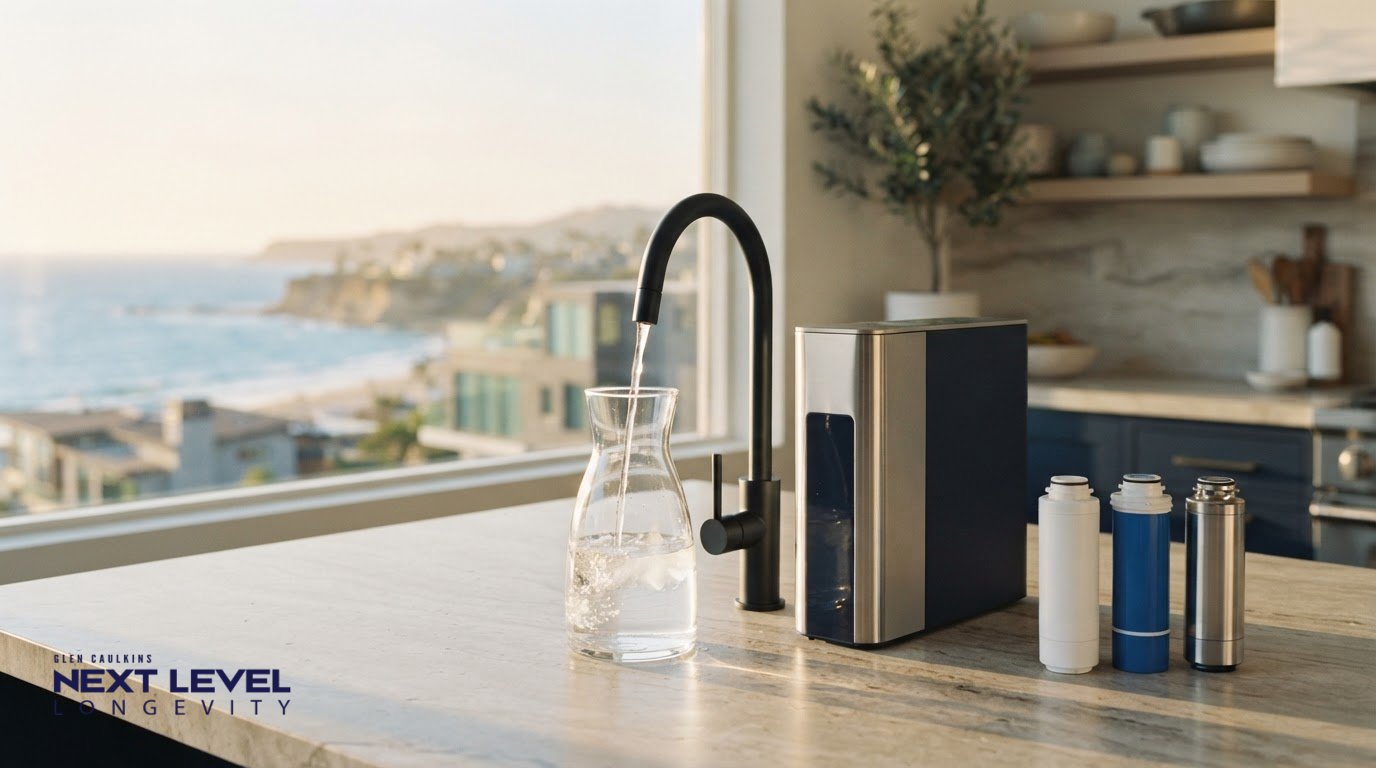
For water at home, the Under-Counter Water Revival System treats drinking water at the kitchen sink. The Travel-Portable Water Revival System provides a movable countertop option for homes, offices, and trips. Neither replaces bottled water as a purchase format. Consider where you want water available before choosing.
Ordering and Subscriptions
Customers can order through the online store or purchase at the Laguna Woods retail storefront. The direct routes cover online ordering and in-person retail. For regular household needs, first decide whether you want bottled water or a system that treats water where you use it.
Plan around your expected use and preferred format. Bottled water is purchased as a product, while a home system treats drinking water at its point of use. Choose the option that suits your routine rather than assuming both follow the same purchasing pattern.
The two systems suit different settings. The Under-Counter Water Revival System is designed for kitchen use. It uses reverse osmosis and dual deionization, then adds minerals such as magnesium and calcium bicarbonate. This filter-then-remineralize approach connects the treatment process with the composition of the finished water.
The Travel-Portable Water Revival System also uses a filter-then-remineralize approach. Its countertop format can move between homes, offices, and trips. Location is a useful deciding factor: a fixed kitchen setup serves one point of use, while a portable unit can travel with you.
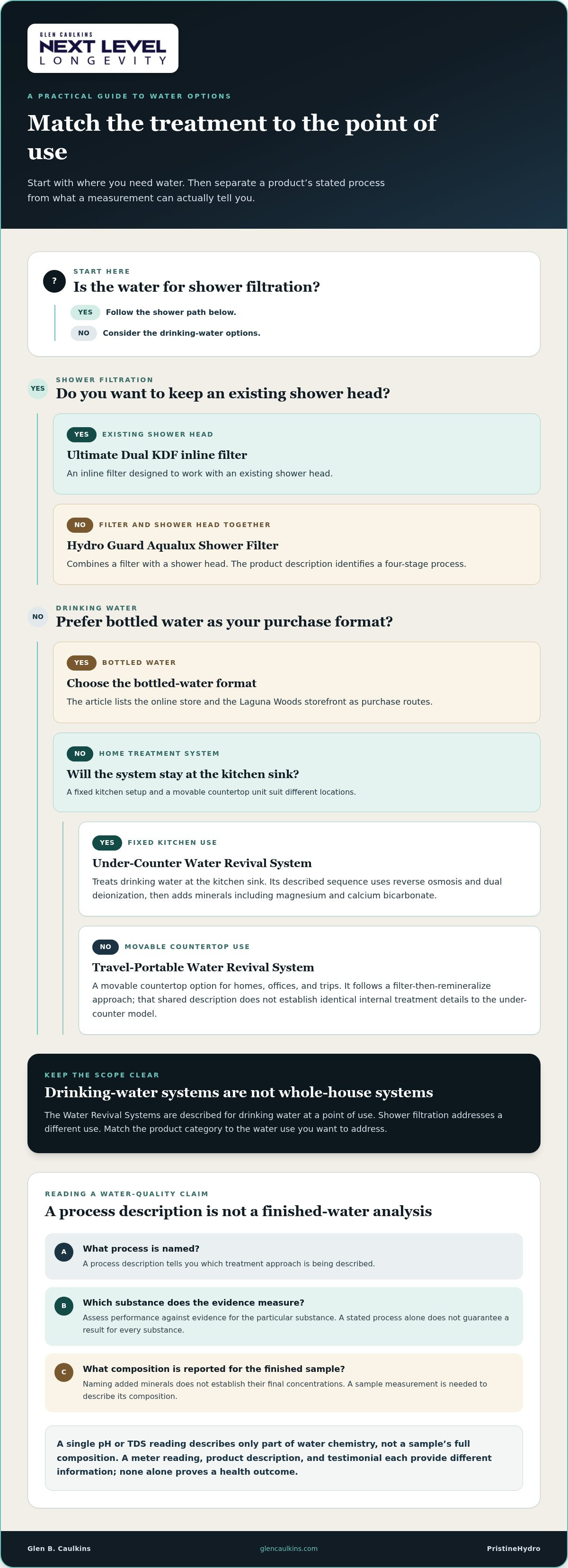
These systems treat drinking water, not water throughout the whole house. Shower filtration addresses a different use. Aqualux combines a filter with a shower head, while the Ultimate Dual KDF inline filter works with an existing shower head. Match the product to the water use you want to address.
Before choosing, consider where you need treated water, whether you prefer bottled water or a treatment system, and whether the system should stay in one place. A Laguna Woods household focused on kitchen use may prefer an under-counter format. Someone moving between home and office may value portability.
For customers in Newport Beach, Costa Mesa, Laguna Beach, Carlsbad, and Irvine, online ordering offers a direct purchase route. The Laguna Woods storefront is an in-person option. Choose the purchasing route and water format that fit your routine.
Water purification and remineralization
Purification and remineralization are separate steps. The Under-Counter Water Revival System combines reverse osmosis and dual deionization, then adds minerals such as magnesium and calcium bicarbonate. It treats incoming water first, then changes its mineral composition. Understanding the sequence helps explain the process without mistaking it for a complete water analysis.
Reverse osmosis uses a membrane to separate water from many dissolved substances. Dual deionization is a separate treatment step that uses ion exchange to reduce dissolved ions. Because the methods work differently, their presence describes a treatment approach, not a guaranteed result for every substance. Assess performance claims against evidence for the particular substance.
Remineralization follows treatment. The system adds minerals that include magnesium and calcium bicarbonate, changing the finished water’s composition. Naming these minerals doesn’t establish their concentrations in a particular sample or how much of each remains after use. A sample measurement is needed to describe its composition.
The Travel-Portable Water Revival System also follows a filter-then-remineralize approach. That shared description does not mean every internal treatment detail matches the under-counter model. When comparing the systems, remember that a shared purpose doesn’t establish an identical configuration.
When reading treatment descriptions, separate three questions: What process is named? Which substances does the evidence measure? What mineral composition is reported after treatment? A process description addresses the first, a relevant test the second, and a finished-water analysis the third. These questions are related, but not interchangeable.
Reverse osmosis and deionization target dissolved substances, while remineralization adds specified minerals afterward. These process descriptions alone don’t establish every characteristic of the finished water. Naming magnesium and calcium bicarbonate, for example, identifies minerals added by the approach, not their final concentrations or every other component.
Glen B. Caulkins’s interest in finished-water structure makes this distinction central to his work. His water research and educational writing focus on helping consumers better understand how these distinct purification and remineralization stages function together in systems like **pristinehydro water**.
PristineHydro describes the Hydro Guard Aqualux Shower Filter as using a four-stage process. That description adds another example of why a stated process should be kept distinct from a finished-water analysis. The number of stages identifies the format of the described approach; it does not, by itself, identify the substances addressed, the evidence used to assess them, or the final mineral composition. Readers can therefore treat the process label as a starting point for understanding the product description, while avoiding conclusions that the label alone cannot support. The same care applies when comparing a shower filter with systems that explicitly describe reverse osmosis, dual deionization, or remineralization. A shared aim of treating water does not establish that the methods, measured outcomes, or resulting compositions are the same. To understand a particular claim, look for details that connect the named process to relevant measurements and to the composition of the water after treatment. Without those details, the four-stage description communicates the stated process structure, but not a complete account of the finished water.
Water quality claims and customer testimonials
Claims and reviews provide different kinds of information. Assess each by asking what it can actually establish.
Water Quality Claims
PristineHydro describes its systems as filtering water and then remineralizing it. To assess a performance claim, identify the specific product and result, then look for evidence that measures that result. A process description explains the approach but doesn’t establish performance for every substance.
Useful evidence connects a result to its sample and test method. Check whether the document identifies the product, sample conditions, substances measured, and scope. These details help distinguish a product-specific test from a general explanation of treatment and show whether the result answers your question.
How does PristineHydro water compare with other bottled or purified water brands? There’s no meaningful universal ranking without comparable evidence. Compare source descriptions, treatment methods, finished-water measurements, and the scope of supporting tests.
Keep composition claims distinct from performance claims. A mineral description concerns what a product is intended to add or contain. A removal claim concerns a particular substance and test result. Evidence for one doesn’t answer the other; compare each claim with evidence suited to that question.
Customer Testimonials
Testimonials describe individual experiences, not controlled comparisons. A comment about taste may reveal someone’s preference, but it can’t predict another person’s experience. Taste impressions can also vary with serving temperature, the glass, and familiarity with a particular water.
Look for concrete context in reviews. Does the account describe bottled water or a home system? Does it explain what the customer noticed, such as taste or ease of use? Specific details make feedback more useful without turning it into proof of a technical result.
Separate firsthand observations from conclusions about composition or performance. A customer may accurately describe an experience without having measured the water. Treat a review as a record of that person’s experience, not a substitute for product documentation or test evidence.
For a fair comparison, apply the same questions to each option. Match product format, treatment description, measurement type, and test scope. If one brand provides a mineral analysis and another only a general process description, the information doesn’t support a direct comparison of mineral content. This distinction grounds decisions in evidence rather than broad labels.
The page claims consuming 0.1 ounce of bottled water inhibited estrogenic activity by 60% and androgenic activity by 90%; these statements need evidence tied to specific samples and methods.
What is PristineHydro water?
The term describes bottled drinking water sold under a brand name. It identifies a product, not a natural water source. Spring, well, or municipal supply describes origin; bottled water describes packaging and distribution. To understand a product, distinguish its source, treatment steps, and finished-water composition.
The described process combines purification and remineralization across 10 stages. Purification treats incoming water through several steps. Remineralization adds minerals back after treatment. Those stages describe a method, not a complete ingredient list. For example, the phrase “remineralized water” doesn’t tell you which minerals are present or their concentrations.
Reverse osmosis is one treatment method used in the home-system context. It separates water through a membrane and directs concentrated reject water away. Bottled water and under-counter treatment are different delivery formats: one comes in a container, while the other treats water at a household tap. Compare the product separately from its treatment route.
Start with the label. Identify whether it names a source or treatment process, then look for reported mineral measurements and distinguish composition claims from taste descriptions. For example, a statement about silica concerns one constituent; it doesn’t describe every mineral or establish the water’s full chemical profile.
Mineral content can affect taste, but taste alone cannot identify composition. Two samples may taste similar yet contain different dissolved substances. A laboratory result can answer a specific question, such as whether a sample contains a measured mineral, but it doesn’t automatically describe every bottle or household batch. Sample origin and collection conditions matter.
Keep three questions separate: What source supplied the water? How did treatment change it? What remains in the finished product? A treatment description addresses the second question, and a laboratory measurement addresses a defined part of the third. Neither explains the source on its own. This distinction helps prevent one product phrase from being mistaken for a complete analysis.
For everyday decisions, compare the practical format with the information provided. A sealed bottle suits portable use; a household system treats water at its point of use. Then assess claims against relevant evidence. A mineral statement calls for mineral measurements, while a purification claim calls for test results tied to named substances. Keep the label, process, and evidence distinct.
Who owns and operates PristineHydro?
Glen B. Caulkins founded PristineHydro, the water business connected to his wider research. The company has operated since 2005. Its work reflects a sustained interest in water chemistry, minerals, environmental exposure, and biological resilience. This founder context helps explain why its practical systems sit beside educational work about water.
Caulkins is also an author and independent researcher whose interests extend beyond filtration equipment. His work considers how water composition relates to minerals, food, environmental chemistry, and everyday life. This broader perspective provides context for the questions behind the products, but doesn’t replace evidence about a particular system or water sample.
His writing explores these connected subjects. Dire Straits Volume I: The Chemistry We Inherited examines industrial changes to water, air, soil, and food. Its subtitle is How Industrialization Changed the Environment of Human Life. Dire Straits Volume II: The Biology We Depend On explores finished-water composition, minerals, magnesium, bicarbonate, and biological regulation. Both volumes are forthcoming.
That distinction matters. A book can explain an author’s framework, a product test can address a defined performance question, and a customer account can describe an individual experience. These forms of information aren’t interchangeable. An idea about mineral context, for example, doesn’t establish a system’s removal performance; that requires relevant evidence about the system and substance.
Caulkins’s commercial interests are also relevant. He founded the business that offers water products alongside his research interests. This connection is a reason to assess claims carefully, not dismiss them automatically. Look for clear treatment descriptions, measurements tied to specific samples, and evidence matched to each performance claim.
His work offers a particular perspective: water is part of a wider environmental and biological story. That perspective connects the product business with his writing and helps explain the attention given to mineral composition and finished-water chemistry. Consider those questions while distinguishing proposed explanations from demonstrated results.
To understand the person behind that perspective, explore Glen B. Caulkins’s research and background. His author profile provides a useful starting point for tracing how water, environmental chemistry, and lifelong inquiry connect. Then assess any product or water-quality statement on its own supporting evidence, rather than relying on founder identity alone.
Glen B. Caulkins: Under-Counter Water Revival System
The Under-Counter Water Revival System offers households a point-of-use option for treating kitchen drinking water. Glen B. Caulkins founded PristineHydro, and this system brings his interest in water chemistry into a practical home setting.
It uses reverse osmosis and remineralization, then stores treated water for use at a dedicated faucet. Consider it if you want an installed kitchen system rather than bottled water or a travel-portable format. Cabinet space, plumbing access, installation, and ongoing filter maintenance all matter to the decision.
To explore the thinking behind this approach, read Glen’s research on water treatment and finished-water composition.
Choose the next step that fits your water routine
Water decisions start with the setting. A kitchen system, a portable option, and a shower filter address different uses. Consider where you want treated water, how you’ll use it, and what evidence matters to your decision. If you’re weighing PristineHydro water against a home system, remember that bottled water and point-of-use treatment suit different routines.
Glen B. Caulkins offers the Under-Counter Water Revival System for kitchen use and the Travel-Portable Water Revival System for portable use. The Aqualux filter with head and Ultimate Dual KDF inline filter are shower options. Since the products are part of a business connected to his research, assess performance claims against relevant measurements rather than relying on affiliation or personal accounts alone.
A considered choice doesn’t require certainty about every aspect of water chemistry. It starts with a clear purpose and questions that match that purpose. To discuss water and explore Glen’s work, contact Glen B. Caulkins. Take the next step at your own pace, guided by the use you have in mind.
Frequently Asked Questions
What types of water products or services does PristineHydro offer?
PristineHydro offers bottled PristineHydro water, drinking-water systems, shower filters, mineral concentrates, Electrolyte Balance, and replacement filters. Its systems are the Under-Counter Water Revival System and Travel-Portable Water Revival System. Shower options include the Aqualux filter with head and Ultimate Dual KDF inline filter. Products and bottled water are available online and at the Laguna Woods storefront for customers in Laguna Woods, Newport Beach, Costa Mesa, Laguna Beach, Carlsbad, and Irvine.
What are the ingredients and mineral content of PristineHydro water?
PristineHydro water is described as purified and remineralized, with magnesium and calcium bicarbonate added through its treatment approach. Those mineral names don’t establish the exact concentration in an individual sample. A relevant laboratory analysis can measure a specific sample’s composition, which may depend on source water and treatment conditions. The product guide is not health advice and cannot determine water composition; consult your utility’s water report or obtain a lab test to learn what’s in your water.
Does PristineHydro publish water quality test results or certifications?
A reported sample measurement and product certification answer different questions. A useful report identifies the sample, substances measured, method, and scope. A certification should identify the applicable standard and exact model. A laboratory measurement or laboratory accreditation doesn’t, by itself, establish that a product holds a certification. Keep these forms of evidence distinct when assessing a claim.
What do customers say about PristineHydro water?
Customer reviews can offer individual impressions about taste, convenience, or household routines. They don’t establish that everyone will share the experience or verify mineral levels and contaminant removal. Read each account in context, separating personal observations from technical or health claims. For a specific water-quality question, rely on measurements tied to a defined sample and test method, not testimonials alone.
How does PristineHydro water compare with other bottled or purified water brands?
There’s no meaningful universal ranking without comparable evidence. Compare source descriptions, treatment methods, finished-water measurements, and the scope of supporting tests.
Frequently Asked Questions
What types of water products or services does PristineHydro offer?
What are the ingredients and mineral content of PristineHydro water?
Does PristineHydro publish water quality test results or certifications?
What do customers say about PristineHydro water?
How does PristineHydro water compare with other bottled or purified water brands?
More articles