KDF Shower Filter: How It Works and What It Can, and Cannot, Do
October 19, 2026 · 16 min read
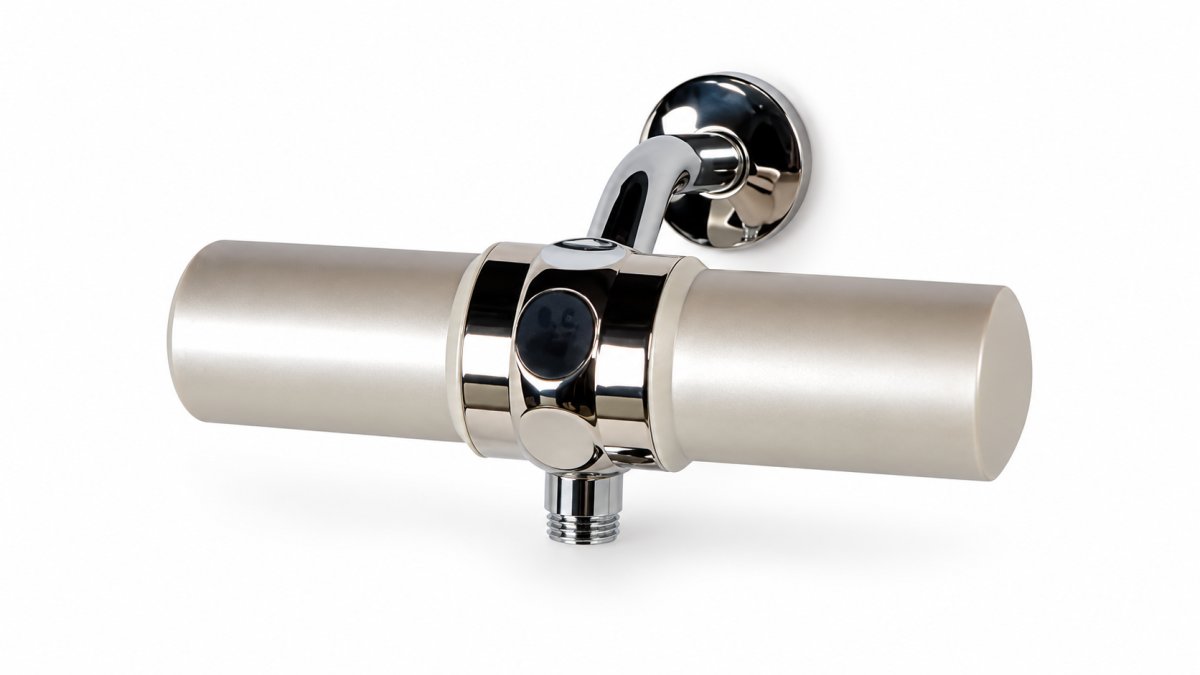
What does a shower filter’s label tell you about the water coming out of it? That’s an important question when you’re considering a kdf shower filter. KDF describes a copper-zinc filter medium that uses an oxidation-reduction reaction to interact with certain substances, including free chlorine. But the presence of KDF alone doesn’t show how well a finished filter performs.
To compare filters, separate three things: the media inside the unit, the specific substances the product is designed to address, and the evidence for the complete filter. This article explains how KDF works, why conditions matter, and how to assess performance claims without mistaking a material description for test results. It also distinguishes chlorine from chloramine and filtration from water softening, so you can focus on the treatment your water and priorities call for.
Start with the water reaching your shower and the change you want a filter to make. Then look for evidence that applies to the particular model and substance. The goal is practical understanding, not promises about skin, hair, or health.
Key Takeaways
- KDF names a copper-zinc filter medium, not proof of how a complete kdf shower filter performs.
- To assess a performance claim, look for the tested model, the specific substance, the test conditions, and the report date.
- Start with your water source and the concern you want to address. A utility report provides context, not household-specific test results.
- Evidence for one substance or test condition does not establish performance for other substances or conditions.
- PristineHydro offers the Ultimate Dual KDF inline filter. Assess it by the evidence and product information for the complete filter, not the media name alone.
What Is a KDF Shower Filter, and What Does KDF Mean?
A KDF shower filter is a point-of-use filter that contains KDF media, a copper-zinc material used in some water-treatment products. It treats water as it passes through that particular assembly. KDF identifies one type of media. It does not establish a finished product’s performance, certification, or ability to reduce every substance mentioned in a product claim.
A shower filter treats water at the shower. A drinking-water system treats water at a drinking-water outlet, while a whole-house system serves a different purpose by treating water for broader household use. These categories are not interchangeable. A shower filter’s name alone does not tell you what happens to water at a kitchen tap or elsewhere in the home.
Water composition varies by source and treatment. Municipal supplies and private wells can have different characteristics, and water systems may use different treatment methods. The useful question is specific: what is in the water reaching this shower, and what change do you want a filter to make? The word “KDF” cannot answer those questions by itself.
What does KDF stand for in water filtration?
KDF stands for Kinetic Degradation Fluxion. The name refers to a copper-zinc filter medium used in some water-treatment designs. A medium is the material inside a filter that interacts with water. It is not another name for the complete filter, which has a housing and may include other components.
Seeing KDF in a product description identifies a material. It does not establish how effectively a particular model treats a particular substance or whether the finished product has been certified. Those are separate claims that depend on the product and supporting evidence.
Where does KDF fit in a shower filter?
KDF may be used alongside other media in a shower-filter assembly. A design can combine materials for different purposes, but products vary. Do not assume that one filter contains the same components or arrangement as another. The type and amount of media are product details, not part of the general definition of KDF.
First identify the material, then assess the complete filter. A claim about KDF as a category is not automatically evidence for every filter that contains it. Check the specific model and the substance it claims to address. The name starts the inquiry; it does not settle it.
How KDF Media Works in Water, and Why Conditions Matter
KDF media is commonly described as working through oxidation-reduction, or redox, reactions. These chemical changes involve electrons: oxidation is the loss of electrons, while reduction is their gain. In the proposed account of KDF media, copper and zinc participate in electron exchange with certain substances in water. This describes a possible mechanism, not how much a finished filter reduces a substance during use.
Some descriptions explain chlorine reduction as a change from free chlorine to chloride. That example does not describe every substance or every filter. Chemical form matters, and substances with similar names may behave differently. A mechanism description alone does not establish a measured result for a particular product.
A proposed redox mechanism can help explain how KDF might interact with certain substances. Only testing of the finished filter can demonstrate its performance under specified conditions.
What is oxidation-reduction in a KDF filter?
Think of electron transfer as a chemical exchange, not a screen catching particles. KDF media is described as a copper-zinc material that can take part in redox reactions. That description does not mean every contaminant reacts with the media in the same way, or that a reaction produces a meaningful reduction at the outlet. The result depends on the substance and the filter setup.
This distinction helps when reading product claims. A proposed mechanism may still leave practical questions unanswered: Was the exact substance measured? Was the finished model tested? Did the test conditions reflect the filter’s intended use? Without those details, a chemistry description cannot tell you the size or duration of an effect.
Why do contact time and water conditions matter?
For a reaction to occur, water must pass through the media. Flow rate affects how long the water remains in contact with it. Water chemistry, filter construction, and the amount and arrangement of media can also influence results. Do not apply a test on one design or under one set of conditions to another model or every shower.
Laboratory findings describe the conditions used in a test. Shower use has its own flow patterns and water characteristics, so useful evidence identifies the tested model, the substance measured, the method, and the operating conditions. A result without that context is difficult to interpret.
When assessing a kdf shower filter, treat the chemistry as the beginning of the inquiry, not the conclusion. Glen B. Caulkins’s research explores water chemistry and its wider context, while his work with PristineHydro connects those questions to practical filtration products.
How to Judge KDF Shower-Filter Claims and Test Evidence
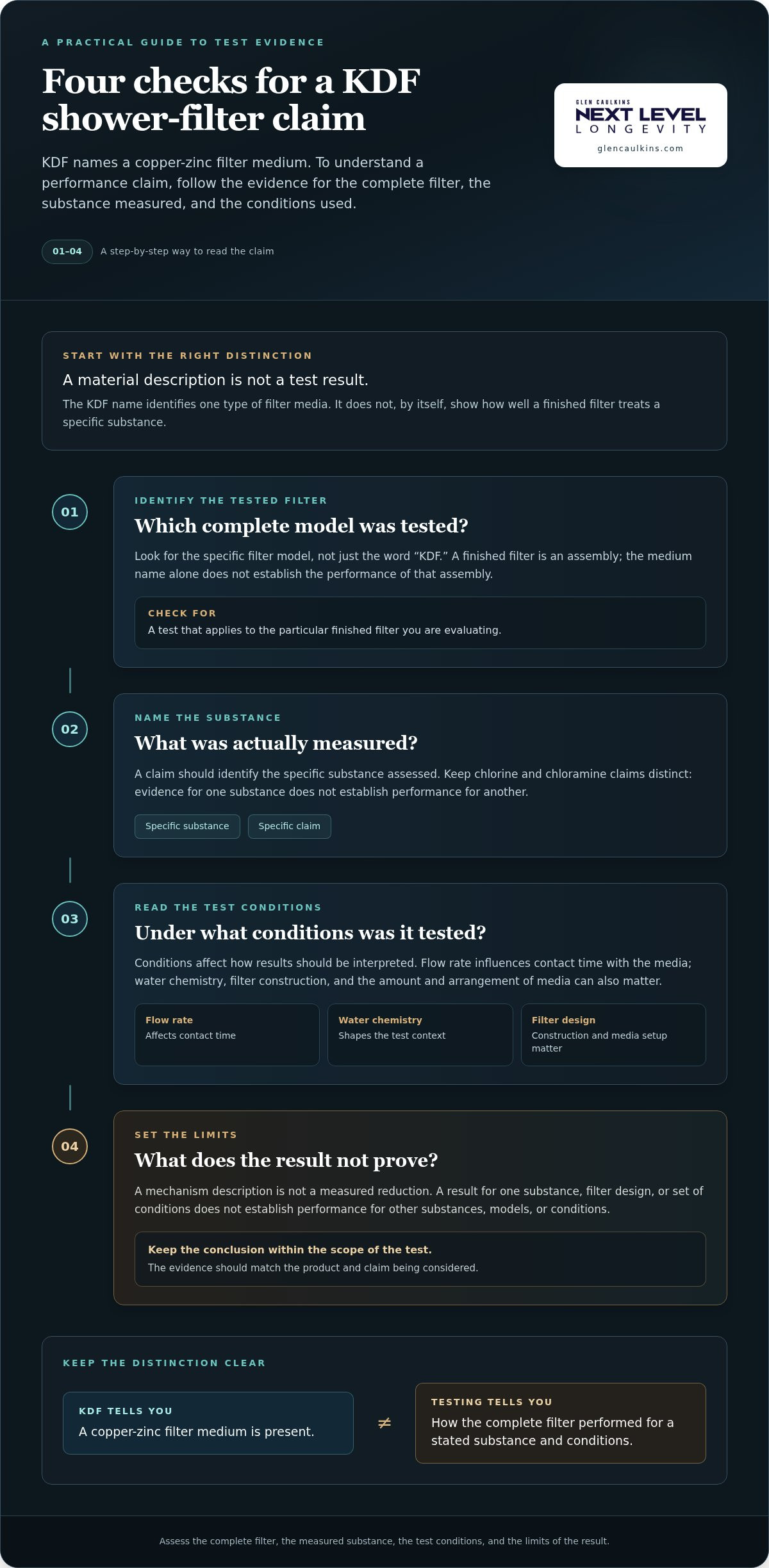
A useful performance claim answers four questions: Which filter was tested? What substance was measured? Under what conditions? What does the result not prove? Without those details, a percentage or broad phrase can sound precise while leaving the evidence unclear.
| Claim | Tested substance | Test conditions to look for | What the result does not establish |
|---|---|---|---|
| Reduces chlorine | The specific form measured, such as free available chlorine | Test method, flow conditions, and whether testing covered the rated service life | Reduction of chloramine, metals, or other substances |
| Reduces chloramine | Chloramine identified directly | Method, water conditions, and the exact filter model | Reduction of chlorine or unrelated contaminants unless separately measured |
| Reduces “toxins” | Each named substance, not a broad label | A report showing how each substance was tested | Any result for substances the report does not identify |
What should a shower-filter test report identify?
Start with the exact product or sample. Then check the substance measured, test method, operating conditions, and report date. A result for one substance does not establish reduction of another, even if both appear in the same product description. The report should make its scope clear. If the model or test conditions differ from the product claim, the evidence may not answer your question.
Distinguish a laboratory’s accreditation from certification of a product. Accreditation describes a laboratory’s recognized competence for specific testing activities. It does not, by itself, certify a filter or confirm every claim made about it. A cited standard or certification also has a defined scope. For example, NSF/ANSI 177 addresses free available chlorine reduction in shower filtration, not every possible contaminant claim or a health outcome.
How should readers interpret broad removal claims?
Words such as “toxins” group together substances with different chemical properties. A useful claim names what was tested and ties the result to a report. Keep the qualification close: a test on a sample under stated conditions is evidence about that sample and those conditions, not a guarantee of identical results in every unit or household.
Careful reading does not require assuming a claim is false. It means separating the claim from what its documentation demonstrates. For an individual kdf shower filter, look for evidence tied to the finished model, not just a description of its media. Glen B. Caulkins founded PristineHydro, so there is a commercial relationship when his research and the company’s products are discussed together. Evaluate product claims against the same standard of specific, applicable evidence.
What to Consider Before Using a KDF Shower Filter at Home
Choose a filter by starting with the water and the purpose, not the product label. This sequence helps keep the decision grounded:
- Identify the water source. Find out whether your home receives municipal water or another supply.
- Name the concern. Be specific about the substance or water characteristic you want to address.
- Review relevant evidence. Match the product’s test information to that concern.
- Check fit and upkeep. Read the model’s connection instructions and maintenance guidance before choosing.
This process helps separate a household need from a general claim about filter media. Water varies by source and treatment, so a decision that fits one home may not fit another.
How can you identify what is in your shower water?
If your home uses municipal water, start with the current report from the water utility serving your address. Use it as context about the supply, not as a household-specific test of the water at your shower. For a private or other source, gather available water information before deciding what treatment may be relevant.
Appearance or smell alone cannot reliably identify a substance or establish its concentration. A product advertisement cannot diagnose your water either. In Laguna Woods, consult current utility information that applies to your service address rather than assuming every local home receives water with identical characteristics.
Which practical fit and maintenance questions matter?
Before selecting a kdf shower filter, review the specific product’s connection and setup instructions. A filter must fit the intended setup, and general descriptions of filter types cannot establish compatibility with your shower. Follow the manufacturer’s replacement guidance for that model. Do not apply a universal replacement interval or assume one filter’s instructions suit another.
Keep the goal narrow and evidence-based. Choose a product to address a stated water-treatment concern, not on the promise of a health or cosmetic result. PristineHydro offers shower filters, including the Ultimate Dual KDF inline filter and the Aqualux filter with head. Glen B. Caulkins founded PristineHydro, a commercial relationship to keep in mind when considering his research alongside the products.
Once you’ve identified your water source and the question you want to answer, explore PristineHydro shower filters with those criteria in mind.
Where the Ultimate Dual KDF Inline Filter Fits in the Picture
Understanding KDF as a filter medium gives you a starting point. Choosing a product still means assessing the complete filter, its intended setup, and the evidence available for the claims that matter to you. PristineHydro offers the Ultimate Dual KDF inline filter. Its name identifies a product and format, but “KDF” and “inline” alone do not establish performance, compatibility, or what comes with it.
This distinction is useful when comparing shower-filter options. A filter’s overall design and supporting documentation matter more than a familiar media name. Glen B. Caulkins founded PristineHydro, so discussion of the company’s products on a site featuring his research has a commercial interest as well as an educational purpose.
How does an inline filter differ from a shower filter with an included head?
An inline filter is a separate filter unit placed in the shower connection. A filter sold with a shower head combines those elements in one product offering. These format labels describe arrangement, not effectiveness. Neither format is inherently better at reducing a substance. That depends on the specific filter and the evidence for its performance.
For setup and compatibility, rely on the exact product information rather than assuming one shower’s fittings or arrangement will suit another. Product details should guide you on how a unit connects and what it includes. Do not infer those details from the word “inline,” from photos, or from another model’s instructions.
What is a useful next step for readers considering KDF?
Return to the concern you identified earlier. Which substance or water characteristic are you trying to address? Then look for evidence that names the tested product, the substance measured, and the conditions behind the result. A description of KDF media may help explain a design, but it cannot substitute for applicable evidence about the complete filter.
Apply the same care to upkeep. Use the manufacturer’s instructions for the exact model, including its replacement guidance. Do not assume that maintenance directions or performance findings for one product apply to another. This keeps the decision tied to your water, the product’s documentation, and its intended use.
If the Ultimate Dual KDF inline filter fits your intended use, review its current product information alongside the available evidence and setup details. Explore PristineHydro’s water-filter options and compare the complete product, not just its filter media.
Make Your Next Filter Decision With Clear Evidence
Let your next step follow from the water concern you identified and the information available for the product you’re considering. Ask one clear question: does the filter’s documented purpose match the change you want it to make? If not, pause before treating a familiar media name as a reason to buy.
Water treatment connects to wider questions about environmental chemistry and everyday choices. Glen B. Caulkins’s research and practical work with filtration bring those questions together while distinguishing interpretation from demonstrated results. He founded PristineHydro, so his work and the company’s products have a commercial relationship.
For a product-focused next step, explore PristineHydro’s water-filter options. Compare the product information with your intended use and the evidence for the claims that matter to you.
Frequently Asked Questions
What is a KDF shower filter, and what does KDF stand for?
A KDF shower filter is a shower-point filter that uses KDF media. KDF stands for Kinetic Degradation Fluxion. Treat the name as a description of the filter material, not a complete buying specification. Two products that mention KDF may differ in their other components and design, so the shared term alone does not make them equivalent.
Does a KDF shower filter remove chlorine from shower water?
Some KDF filters are intended to reduce free chlorine, but do not assume every model does so equally. If chlorine is your concern, check whether the product’s stated purpose and supporting information address it specifically. Smell, taste, or how the shower feels is not a substitute for a measured result. A sensory change does not establish how much chlorine, if any, was reduced.
Can a KDF shower filter remove chloramines?
Not necessarily. Chloramine behaves differently from free chlorine, so a chlorine claim does not answer whether a filter reduces chloramine. If your supply uses chloramine, look for information that addresses that disinfectant directly. A product description that mentions both substances is not, by itself, evidence that each was measured or reduced under the same conditions.
What does KDF 55 mean in a shower filter?
KDF-55 identifies a type of KDF media. The number is not a measure of a shower filter’s overall effectiveness, expected service life, or certification status. Treat it as one material detail. For a buying decision, consider whether product information connects the media to your intended use and whether the complete product has relevant supporting documentation.
How do I know whether a KDF shower filter’s claims are supported?
Compare each claim with the evidence rather than relying on words such as “tested” or “certified” by themselves. A mark or laboratory reference matters only within its stated scope. Evidence about one contaminant does not automatically support a claim about another. Keep the product information and any report you rely on so you can compare the stated claim with the actual test scope.
Do KDF shower filters remove every contaminant from water?
No. A media name does not establish broad contaminant removal. Different substances have different properties, and a filter may be designed to address only particular ones. Treat phrases such as “all contaminants” or “complete purification” cautiously unless product documentation names the substances and supports each claim. If you have a specific concern, make it the focus of your comparison.
How often should a KDF shower-filter cartridge be replaced?
There is no single replacement schedule for every KDF cartridge. Follow the instructions for that model and its stated service conditions. Keep the manual or product record where you can find it, and note the installation date if the manufacturer’s guidance uses time in service. Do not extend a cartridge’s use based only on unchanged appearance or how the water feels.
Is a KDF shower filter the same as a whole-house water filter?
No. A shower filter treats water at the shower; a whole-house filter treats water for broader household use. The distinction affects which taps and appliances receive treated water, so first decide where treatment is needed. This matters for households in Laguna Woods, Newport Beach, Costa Mesa, Laguna Beach, Carlsbad, and Irvine, where the product’s intended point of use should guide the choice.
Frequently Asked Questions
What does KDF stand for in water filtration?
Where does KDF fit in a shower filter?
What is oxidation-reduction in a KDF filter?
Why do contact time and water conditions matter?
What should a shower-filter test report identify?
How should readers interpret broad removal claims?
How can you identify what is in your shower water?
Which practical fit and maintenance questions matter?
How does an inline filter differ from a shower filter with an included head?
What is a useful next step for readers considering KDF?
What is a KDF shower filter, and what does KDF stand for?
Does a KDF shower filter remove chlorine from shower water?
Can a KDF shower filter remove chloramines?
What does KDF 55 mean in a shower filter?
How do I know whether a KDF shower filter’s claims are supported?
Do KDF shower filters remove every contaminant from water?
How often should a KDF shower-filter cartridge be replaced?
Is a KDF shower filter the same as a whole-house water filter?
More articles