Laguna Beach PFAS Water Filter Costs and Claimed Savings
October 26, 2026 · 15 min read
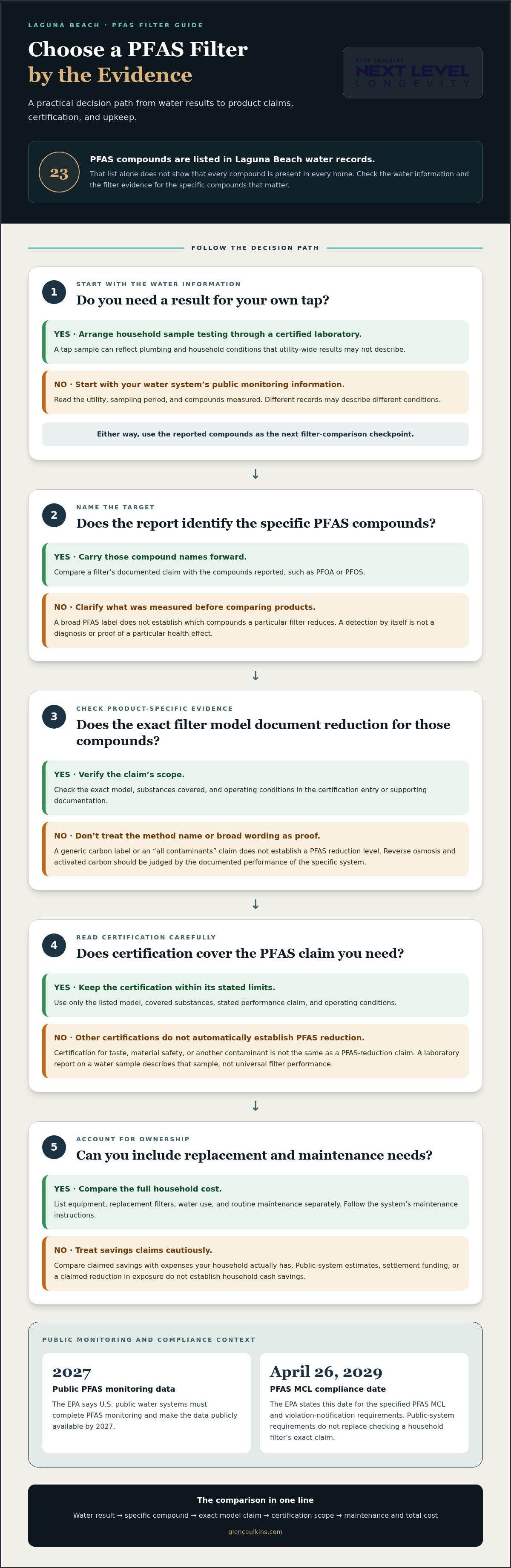
A filter is a household treatment choice, not an automatic conclusion about every tap. Laguna Beach water records list 23 PFAS compounds, but that list alone doesn’t show that every compound is present in every home. A Laguna Beach PFAS water filter is best judged by its specific PFAS-reduction evidence and certifications, rather than by a broad claim on the packaging.
It’s reasonable to want clear information before choosing a Laguna Beach PFAS water filter. This guide explains how to compare filtration methods, product-specific performance claims, costs, and maintenance. It also distinguishes public-water monitoring from testing at an individual tap.
The details matter: a certification covers defined performance claims, while maintenance affects a system’s ongoing operation. Understanding these distinctions can help you weigh the available evidence and upkeep before deciding whether additional treatment fits your household.
Key Takeaways
- Compare a filter’s specific PFAS-reduction claims and certification scope, not just broad wording on its label.
- Assess treatment costs over time by considering replacement filters, maintenance, and any installation needs alongside claimed savings.
- Understand what reverse osmosis and other treatment methods may change, then weigh those tradeoffs against your household’s priorities.
- Read local water results with attention to the utility, sampling period, and compounds measured; different records may describe different conditions.
- U.S. public water systems must complete PFAS monitoring and make the data publicly available by 2027, according to the U.S. Environmental Protection Agency.
Recommended water filters and listed certifications
Choose a filter by the specific PFAS compounds and reduction claims documented for its model, not by broad label language. Suitability depends on tested performance, where the system treats water, and how it must be maintained.
Recommended PFAS Water Filters
A PFAS water filter is a treatment device with documented performance for reducing specific compounds. For drinking water, compare point-of-use systems, which treat water at a particular tap, with whole-house treatment, which treats water entering the home. Match the product’s stated claim to the contaminant you’re concerned about.
Activated carbon can reduce some contaminants when testing supports that use for a specific system. Performance depends on the design, water flow, and replacement schedule. Reverse osmosis is another treatment method, but a model’s documented PFAS performance matters more than the method’s name alone. A generic carbon label or an “all contaminants” claim does not establish a PFAS reduction level.
Where can Laguna Beach residents get tap water tested for PFAS? Start with your water system’s public monitoring information. If you need a result for your own tap, arrange household sample testing through a certified laboratory. A tap sample can reflect plumbing and household conditions that utility-wide results may not describe.
What are the health risks of PFAS exposure through drinking water? PFAS are a broad group of chemicals, and potential health concerns depend on the compound and exposure. A detection in water is not, by itself, a diagnosis or proof of a particular health effect.
What steps should Laguna Beach residents take if their water tests high for PFAS? Confirm the result with a properly collected sample, identify the specific compounds reported, and compare the result with applicable drinking-water limits. Then choose a filter with a matching, documented reduction claim and follow its maintenance instructions.
Listed Filter Certifications
A filter certification is an independent evaluation against a defined standard and stated performance claim. Check the certification entry for the exact model, substances covered, and operating conditions. Certification for taste, material safety, or another contaminant does not automatically establish PFAS reduction.
Check whether the listed claim names the PFAS compounds, such as PFOA or PFOS, rather than using only a broad category. Also distinguish a certified product from a laboratory report on a water sample: the latter describes that sample, not universal filter performance. The U.S. Environmental Protection Agency says U.S. public water systems must complete PFAS monitoring and make the data publicly available by 2027.
The U.S. Environmental Protection Agency states that the compliance date for the PFAS MCLs in § 141.61, as specified in § 141.60, and for § 141.203 notifications of violations of the PFAS MCLs is April 26, 2029. Those public-system requirements provide context, but they do not replace checking the exact certification and reduction claim for a household filter.
Water treatment costs and claimed savings
Total treatment cost includes equipment, operation, and upkeep over time. For a household, compare the initial system cost with replacement filters, water use, and routine maintenance. Public-system cost estimates describe utility compliance, not a household filter budget.
Claimed savings are expenses a treatment choice is said to prevent or reduce. Test each claim against a specific household expense instead of treating broad promises as guaranteed returns. Estimates about public systems do not show savings available to an individual homeowner.
A settlement is a payment agreement that may help reimburse certain costs. A settlement directed toward public water systems does not, by itself, establish a household rebate or a guaranteed reduction in a resident’s water bill.
Does Laguna Beach offer rebates or assistance for PFAS water filters? Public-system funding and household rebates are separate forms of assistance. Count a rebate in your personal cost comparison only if a published Laguna Beach program identifies PFAS filters as eligible and explains its terms.
Build a practical comparison in three steps:
- List the system cost, filter replacements, and maintenance as separate entries.
- Record the exact savings claim, such as reduced bottled-water purchases, and compare it with your actual spending.
- Keep public utility estimates, settlement funding, and household expenses in separate categories.
For example, avoiding bottled-water purchases matters only if your household currently buys bottled water for drinking. A claim about lower exposure is different from a cash saving and should not be assigned a dollar value without a clear, evidence-based method. Disinfection and municipal treatment costs describe water-system operations, not a guaranteed household return.
Water quality also shapes the comparison. A filter chosen for specific contaminants may have different replacement needs from one selected for taste. Match each claimed benefit to the treatment purpose, and count maintenance as part of ownership. A simple household ledger can help: list current spending, proposed treatment expenses, and only savings tied to a real, recurring bill.
Filter certification and maintenance
A filter certification verifies a product against a defined standard and stated claim. For a California household, match the certified model and claim to the contaminant you intend to reduce. Certification for chlorine taste or material safety does not establish PFAS reduction. A laboratory test of one water sample is also different from certification of a filter model.
Maintenance helps keep a filter operating within its stated conditions. Record the installation date and model number, then follow the manufacturer’s instructions for replacement filters, cleaning, and flushing. Replacement timing depends on the product, its rated capacity, and the water passing through it. Don’t extend a stated replacement period just because the water still tastes normal. Taste and odor cannot show whether a filter continues reducing a specific contaminant.
For example, a filter that targets chlorine may improve taste, but that alone says nothing about PFAS. Chlorine is used to disinfect water; disinfection byproducts are compounds that can form when disinfectants react with organic matter. These are distinct treatment concerns, so a broad “water filtration” claim can obscure what a product actually addresses.
Laguna Beach water records provide one reason to keep treatment claims specific. Historical records list an average total trihalomethanes level of 41.4 ppb during 2012-2019, with a highest sample of 79.3 ppb and a federal limit of 80 ppb. Those figures describe trihalomethanes, not PFAS. A filter selected for one group should not be assumed to reduce the other.
A water softener is designed to reduce hardness minerals, not PFAS. If your home has a softener, treat it as a separate step in the water system. Check whether the drinking-water filter’s documentation addresses the target compound; don’t infer PFAS performance from softened water or scale reduction.
Use this simple maintenance record for each installed filter:
- Write down the product model and install date.
- Save the performance claim and replacement instructions that apply to that model.
- Log each filter change and follow the product’s stated flushing procedure.
- Arrange follow-up testing when you need to assess treated-water levels, using the same target compounds and appropriate sampling method.
Connect maintenance to the evidence. If a filter’s claim concerns PFAS, testing should examine the relevant PFAS compounds. If the concern is chlorine taste or disinfection byproducts, those targets require separate attention. A utility’s average result cannot establish how a filter performs at an individual tap. Model-specific documentation and consistent maintenance make comparisons clearer.
What PFAS levels have been detected in Laguna Beach water, and when?
PFAS are a group of human-made chemicals that includes many distinct compounds. Laguna Beach water records list 23 PFAS compounds, but a compound list is not a concentration result. It identifies substances associated with records, not the amount of each substance in a particular sample.
A concentration is the measured amount of a compound in a water sample. The Laguna Beach County Water District data shown by the Environmental Working Group covers 2013-2023. That date range matters: it describes the period covered by those records, not a single current reading at every home.
A monitoring period is the span of time represented by a testing program. The EPA Six-Year Review compliance monitoring for Laguna Beach County Water District covered 2012-2019. Because that period differs from the 2013-2023 water-quality data range, readers should keep the record types and dates separate rather than combining them into one continuous measurement.
To interpret a reported PFAS result, read the compound name, concentration, unit, sampling date, and water system together. A result for one compound cannot stand in for every PFAS. Likewise, a result from one sampling period does not describe every later sample. The 23-compound listing is useful as a guide to the range of chemicals considered in local records, but it should not be mistaken for 23 measured concentrations.
Keep these distinctions in view when comparing local information:
- Compound: The specific PFAS identified, rather than the family name alone.
- Concentration: The measured amount reported for that compound and sample.
- Sampling date: The time represented by the test, which helps show whether records cover different periods.
- Water system: The utility or source associated with the result; it matters because local records may cover different service areas.
For a household question, start with the water system named on the water-quality record and compare its date range with the result you’re considering. For a home-tap test, keep the sample location and collection date with the laboratory result. These details help distinguish a household measurement from a utility-wide record.
The available local timelines establish that Laguna Beach records span different monitoring periods, while the 23-compound listing establishes the breadth of PFAS tracked. They do not make every listed compound a confirmed, same-level detection in every home. Read each reported measurement on its own terms before using it to evaluate treatment or compare it with a standard.
Does Laguna Beach water meet California and federal PFAS standards?
A maximum contaminant level (MCL) is an enforceable drinking-water limit for a contaminant. In April 2024, the U.S. Environmental Protection Agency finalized federal limits of 4 to 10 parts per trillion for PFOS, PFOA, PFHxS, PFNA, and GenX. These limits apply to named compounds, so a general PFAS record cannot establish whether a sample meets them.
Health-based compliance is a regulator’s assessment of whether a water system meets applicable public-health requirements during a stated period. For April through June 2024, the EPA assessed Laguna Beach County Water District tap water as in compliance with federal health-based requirements. That assessment describes its stated period and requirements; it should not be read as a measurement of every PFAS compound at every home tap.
A PFAS concentration is the measured amount of a specific compound in a water sample. To determine whether local water meets a PFAS limit, the result must identify the compound and its concentration. A general record of PFAS monitoring cannot establish that comparison on its own. The sample, date, water system, and reported unit all shape what a result can show.
California and federal standards also require careful distinctions. The available California figure of 0.02 ppb refers to the state health goal for hexavalent chromium, not a PFAS standard. It cannot be used to judge PFAS compliance. For PFAS, compare a test result for each named compound with its applicable standard, using matching units and the relevant sampling date.
Federal rule timing matters, too. The EPA states that the compliance date for the PFAS MCLs in § 141.61, as specified in § 141.60, and for § 141.203 notifications of violations of the PFAS MCLs is April 26, 2029. A system’s earlier compliance assessment and its future deadline under the PFAS rule are distinct facts. Neither should be mistaken for a household tap test.
To interpret a local result, use this sequence:
- Identify the water system and the sampling period.
- Check whether the report names PFOS, PFOA, PFHxS, PFNA, or GenX.
- Compare each result with the applicable limit, keeping units consistent.
- Separate system-wide monitoring from a sample collected at your own tap.
This approach avoids treating a general compliance statement as proof about every compound or location. Sampling, treatment, and finished-water composition all shape how water-quality information should be interpreted.
Glen B. Caulkins: Under-Counter Water Revival System
The Under-Counter Water Revival System is a kitchen option for treating drinking water at the tap. It uses reverse osmosis and dual deionization, then adds minerals such as magnesium and calcium bicarbonate. If PFAS is your concern, compare the system’s specific performance documentation with the compounds and levels relevant to your decision. Don’t assume it reduces PFAS based on its name or general filtration claims.
Glen B. Caulkins’s work explores water treatment, finished-water chemistry, and minerals. For a portable countertop option, the Travel-Portable Water Revival System uses the same filter-then-remineralize approach and can move between homes, offices, and trips. Consider the intended use, product details, water-quality goals, and maintenance needs together.
Explore the PristineHydro system details on Glen B. Caulkins’s website.
Choose a practical next step for your home
Choosing a Laguna Beach PFAS water filter is a question of fit: where you want treated water, how you’ll maintain the system, and which performance claims address your needs. Keep those priorities in view as you move from water records to comparing household options. A useful choice is specific, manageable, and grounded in the product’s documentation.
Glen B. Caulkins offers the Under-Counter Water Revival System, the Travel-Portable Water Revival System, and the Aqualux filter with shower head. These options serve different settings. Compare their PristineHydro product details with your intended use, and don’t assume a general filtration claim establishes PFAS performance.
If you’re weighing those details and want to discuss your water-filter questions, contact Glen B. Caulkins. Take the next step at your own pace, with the evidence and household priorities in view.
Frequently Asked Questions
Should You Filter Your Laguna Beach Water?
Consider filtration when you want treatment for a specific concern, such as taste or a documented contaminant, and can maintain the system as directed. First identify your water system and any additional treatment in your home. For example, assess the drinking-water tap separately if your household has a softener. Household filtration is not a substitute for utility monitoring or public water treatment.
Does Laguna Beach, California have PFAS in its drinking water?
PFAS compounds have been tracked in local water records, but those records alone don’t establish what reaches every household tap. Laguna Beach homes may receive water through different systems, and plumbing can affect a tap sample. Identify the water system serving your address, then use its records for context. A sample collected at the kitchen tap answers a different question from a utility-wide monitoring result.
Which water filters are certified to remove PFAS from drinking water?
Certification applies to the exact product and performance claim it covers. In a certification directory or product certificate, match the model identifier, including any suffix, to the item being sold. Check that the listing names PFAS reduction, not only material safety or taste. If the replacement cartridge differs from the tested configuration, that distinction matters.
How much do PFAS water filters cost to buy and maintain?
There is no single useful cost figure for every home because installation, water use, filter replacement, and maintenance vary. For a fair comparison, record the equipment expense and each recurring filter change separately. Then consider whether the system treats a drinking-water tap or more of the home’s supply. Product guidance is not health advice and cannot determine water composition. Your utility’s water report or a lab test can.
Are reverse osmosis, activated carbon, or ion exchange filters most effective for PFAS?
No filtration method can be ranked by name alone; compare the model’s documented PFAS-reduction performance. Activated carbon can reduce some contaminants when testing supports that use, and reverse osmosis is another method to consider.
Does Laguna Beach offer rebates or assistance for PFAS water filters?
Count a rebate only if a published Laguna Beach program identifies PFAS filters as eligible and explains its terms. Public-system funding does not, by itself, establish a household rebate.
Frequently Asked Questions
Should You Filter Your Laguna Beach Water?
Does Laguna Beach, California have PFAS in its drinking water?
Which water filters are certified to remove PFAS from drinking water?
How much do PFAS water filters cost to buy and maintain?
Are reverse osmosis, activated carbon, or ion exchange filters most effective for PFAS?
Does Laguna Beach offer rebates or assistance for PFAS water filters?
More articles