Lead in tap water Laguna Woods
October 26, 2026 · 15 min read
A water report and the water at your tap answer different questions. Lead in tap water in Laguna Woods can come from lead-containing service lines or household plumbing as water travels to the faucet. The City of Laguna Woods directs residents to El Toro Water District for drinking-water quality and reliability information, but system-wide results may not reflect conditions inside an individual home.
It makes sense to look for a clear local answer, especially when water reports include sample dates and results that can be difficult to interpret. This article explains what lead is, how plumbing can introduce it, and why a utility’s monitoring record can’t settle every question about a particular tap.
You’ll find where Laguna Woods residents can get water-quality and reliability information, what testing can tell you, and how to interpret results in context. The aim is a practical path from the public record to the water coming from your faucet.
Key Takeaways
- Read water-quality results alongside their sample dates and monitoring scope to understand what they do, and don’t, say about a household tap.
- Find Laguna Woods drinking-water quality and reliability information through the local water district.
- Consider how a home’s age, plumbing materials, fixtures, and time without use can affect lead exposure.
- Learn why system-wide monitoring and a test of water from a specific tap answer different questions.
- Explore how an under-counter filtration system may fit into a household’s drinking-water approach.
Water quality testing and sample dates
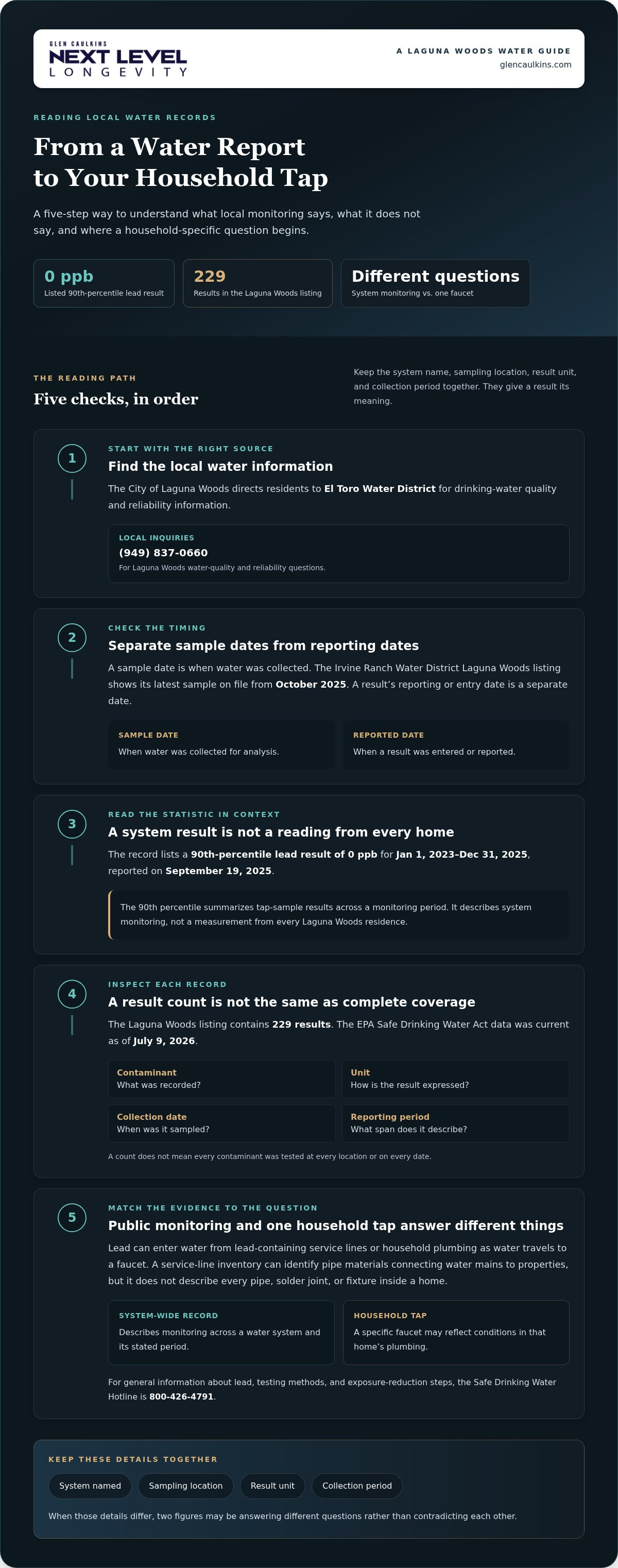
Water quality describes what testing finds in water, including measured lead levels. For anyone concerned about lead in tap water in Laguna Woods, a result needs context: where the sample was taken, when it was collected, and whether testing covered the water system or a specific household tap. These details show what a public record can establish, and what it cannot tell you about one faucet.
A sample date is when water was collected for analysis. Irvine Ranch Water District’s Laguna Woods listing shows its latest sample on file from October 2025. That date identifies the sample’s timing; it does not mean every home was sampled that month. A report may also show when a result was entered or reported, which is a separate date.
A 90th-percentile result summarizes tap-sample results across a monitoring period. Irvine Ranch Water District’s lead-and-copper record lists a 90th-percentile lead result of 0 ppb for Jan 1, 2023 - Dec 31, 2025. The result was reported on September 19, 2025. Read the value beside its period: it describes system monitoring, not a measurement from every Laguna Woods residence.
A contaminant record is a collection of reported test results, not a single sample. The Laguna Woods listing contains 229 results, while the EPA Safe Drinking Water Act data was current as of July 9, 2026. A count can indicate the breadth of entries, but it doesn’t mean every contaminant was tested at every location or date. Check each entry’s name, unit, collection date, and reporting period.
For a household concern, start with the water district’s current water-quality report and find the lead result and monitoring dates. Check whether the reported period matches the timeframe you want to understand. System-wide data and a sample from a particular faucet answer different questions because household plumbing can affect water after it leaves the public distribution system.
A service-line inventory identifies the materials in pipes connecting water mains to properties. Community and non-transient non-community water systems were required to submit service-line inventories by Oct. 16, 2024, under the federal Lead and Copper Rule Revisions, according to the U.S. Environmental Protection Agency. An inventory helps locate service-line materials; it does not describe every pipe, solder joint, or fixture inside a home.
Use dates as a guide, not as a substitute for location. An October 2025 sample on a local listing and a 2023-2025 monitoring result describe different aspects of water quality. For a precise reading, note the system named, sampling location, result unit, and collection period together. If those details differ, the figures may answer different questions rather than conflict.
Where to find drinking water quality and reliability information
Local drinking-water information comes from the agency responsible for water service in a community. The City of Laguna Woods directs residents to El Toro Water District for drinking-water quality and reliability information. The district is the local starting point for records and questions about the public water supply.
Reliability information describes the continuity and operation of water service. El Toro Water District lists (949) 837-0660 for drinking-water quality and reliability inquiries. Before calling, write down the topic you need addressed, such as a water-quality report, an interruption, or a reliability concern. A concise question helps keep the conversation focused.
When you have questions about a report, note its title and the specific entry you want to understand. Ask which period it covers, what the units mean, and where to find the underlying details. Keep the answers with your copy so you can compare information later without relying on memory or confusing separate entries.
The Safe Drinking Water Hotline is a federal information line for questions about drinking water. Residents can call 800-426-4791 for information about lead in drinking water, testing methods, and steps to minimize exposure. It can be useful when you need general explanations of testing terms or want to understand the purpose of a sampling method.
Use each contact for the question it addresses:
- Call El Toro Water District at (949) 837-0660 for Laguna Woods water-quality and reliability inquiries.
- Call the Safe Drinking Water Hotline at 800-426-4791 for general information about lead, testing methods, and exposure-reduction steps.
- Keep the report, your written question, and the response together for future reference.
A brief record makes follow-up easier. Note the date of your call, the agency or hotline you reached, the report or topic discussed, and any recommended steps. If the report uses unfamiliar terms, write them down before calling. This preparation helps you use local and federal information while keeping track of the question that prompted your search.
For Laguna Woods residents, El Toro Water District is the local starting point. The Safe Drinking Water Hotline offers broader guidance on lead and testing. Keeping these routes distinct helps direct each question to the right source and preserve useful answers for the next step.
Laguna Beach County Water District mails customers its water-quality report in June, covering tests from the previous year. This timing helps customers distinguish the report’s testing period from the date they are seeking clarification.
Homes built before plumbing rules changed
A home’s construction date offers clues about the plumbing materials that may remain inside it. In Laguna Woods, the key periods include homes built before the 1930s, homes built from the 1930s through the 1980s, and homes built before 1986. These dates help focus an inspection, but renovations can change what is present.
Lead pipes are pipes made from lead that can contribute lead to water. According to Laguna Beach County Water District, homes built before the 1930s primarily had lead pipes. California banned installing lead pipes in 1985. A home’s age alone doesn’t show whether its original service connection or interior plumbing was later replaced.
Lead solder is a joining material that can contain lead, used to connect sections of copper pipe. After the 1930s and through the 1980s, copper pipes were often used in homes, with lead-containing solder at their joints. Lead was a common component of plumbing solder until it was banned in 1991. So a house without visible lead pipes may still have older materials to consider.
Fixtures are the taps and plumbing components water passes through before reaching a glass. Homes built before 1986 are more likely to have lead pipes, fixtures, or solder. California prohibited plumbing materials from containing more than 0.25% lead in 2010. That later limit does not, by itself, identify materials installed in an older home.
Lead-free certification identifies plumbing fixtures and interior piping certified to meet lead-free requirements. California encourages customers to ensure these materials are certified lead-free, especially when they were installed before 2010. The installation date matters alongside the building’s original construction date: a remodeled kitchen may contain newer fixtures while older piping remains elsewhere.
To build a useful timeline, gather records of the home’s construction and renovations, then note which plumbing areas were replaced. A record of a kitchen update, for example, can help date work on the faucet and nearby plumbing, but may not describe pipes in a bathroom or behind a wall. Track each area separately rather than treating the whole home as one installation.
Look at age as a screening clue, not a water test. A home built in the 1970s could have copper pipe and lead solder, while later renovations may have replaced some components. Conversely, a newer fixture doesn’t establish the material of the lines feeding it. For a household-specific assessment, connect the home’s records and plumbing timeline with testing of water from the relevant tap.
Lead exposure from household plumbing
Practical steps at the tap can reduce potential contact with lead in household water. Children face particular health risks, so prevention and clear information matter.
Reducing Lead Exposure from Tap Water
Exposure-reduction steps limit contact with lead that may enter water inside a home. If water has stood in a faucet for six hours or longer, flush the cold-water pipes before using water for drinking or cooking. Use cold tap water for drinking, cooking, and baby formula. Boiling does not remove lead and can concentrate it.
A filter is another option to consider. LADWP representative Jonathan Leung recommended a filter certified to NSF 53 for lead reduction. Follow the filter’s instructions for use and replacement, since performance depends on using and maintaining it as directed. A filter doesn’t identify the amount of lead in water, and it shouldn’t be treated as a substitute for testing when you need a result for a particular tap.
Keep the steps practical: use cold water, flush after a long period without use, and follow a filter’s label if you choose one. Don’t judge lead exposure by water’s appearance or taste. Clear water can still require testing to determine whether lead is present.
Health Risks for Children and Pregnant People
Lead-related health risks are harmful effects associated with exposure to lead, a potent neurotoxin. The U.S. Centers for Disease Control and Prevention lists memory loss, abdominal pain, and depression among symptoms that can result from exposure over short or long periods. Symptoms alone cannot establish whether lead is present in water.
Lead exposure can decrease IQ and attention span in infants and children. Pregnant people should take potential lead exposure seriously and reduce avoidable contact; this section does not establish a specific health outcome for pregnancy. A water test addresses the sampled water, while personal health questions belong with a qualified health professional.
For a household, the practical sequence is to reduce avoidable exposure while investigating, keep track of the tap and water-use conditions, and use a filter only according to its lead-reduction instructions. These steps focus on drinking water without making assumptions about anyone’s health or the source of exposure.
Lead in drinking water primarily comes from service lines and household plumbing materials and components. Lead service lines, which run from the water main into a home, are often the most significant source of lead in tap water. In the Contra Costa Water District service area, the greatest chance of lead exposure is from pipes and fixtures in older homes. This helps explain why a household tap test can matter even when reports indicate clean water mains.
Researchers detected lead in tap water samples from 21 Watts households. Councilman Tim McOsker said the Watts water system's water mains were testing clean, and investigators were looking for lead entering the water between delivery and household taps, such as through laterals or faucets. Lead exposure from drinking water above the action level can delay physical and mental development in babies and children and cause slight deficits in attention span and learning abilities.
What are the EPA and California lead limits and action levels for drinking water?
A health goal describes the concentration an agency aims to achieve for protecting health. The U.S. Environmental Protection Agency’s health goal for lead in drinking water is 0 ppb. This goal is distinct from the action level used to determine when a public water system must take action based on tap-water samples.
An action level is a threshold tied to a system’s sampling results and required response. Under federal rules, a public water system must take action if more than 10% of its tap-water samples exceed 15 parts per billion of lead, according to the U.S. Environmental Protection Agency. The trigger applies to the share of samples in the system’s calculation, not to every tap individually.
Parts per billion, or ppb, expresses a concentration of a substance in water. The federal action-level value of 15 parts per billion refers to lead measured in tap-water samples. It is not a finding that water at any specific residence contains that concentration. A system’s sampling outcome and an individual household’s result have different scopes.
A plumbing-material standard limits the lead content of plumbing materials rather than setting a concentration for water. California’s requirements address what plumbing components may contain. They serve a different purpose from federal drinking-water rules, which assess lead in samples and establish when a public water system must act.
Keep the terms separate when reading a result:
- Health goal: the U.S. Environmental Protection Agency’s target for lead in drinking water is 0 ppb.
- Federal action level: a system must act if more than 10% of its tap samples exceed 15 parts per billion.
- Plumbing-material standard: California requirements address lead content in plumbing materials, not the concentration measured in water.
These benchmarks answer different questions. The health goal describes the desired concentration, while the action level determines when system-level action is required. A plumbing-material standard applies to components, not a water test. Treating one benchmark as a substitute for another can obscure whether a figure concerns a public-system response, a material requirement, or water from a particular faucet.
To interpret a figure, identify what it measures, which samples it covers, and which rule applies. Then consider whether the concern is about the public supply, plumbing materials, or water at a particular tap. Glen’s research on water and environmental chemistry explores these questions along the path from infrastructure to finished water.
Glen B. Caulkins: Under-Counter Water Revival System
Glen B. Caulkins’s Under-Counter Water Revival System is a kitchen option for households considering drinking-water filtration at the tap. It may suit you if you want to explore treatment for water used in drinking and cooking, alongside, not instead of, reviewing system-wide reports.
Keep the product decision separate from a lead test. Any claim about lead reduction should match the system’s specific test report, while a sample from your household tap addresses water at that location. The system does not replace testing or provide medical advice or treatment.
Glen’s water-first perspective connects filtration with questions about finished-water composition and the materials water meets along its path. To explore the Under-Counter Water Revival System in that context, visit glencaulkins.com.
Choose a Practical Next Step for Your Home
Understanding lead in tap water in Laguna Woods is a starting point, not the end of the inquiry. Next, connect what you’ve learned about your home’s plumbing with the water you use and the treatment you’re considering. Choose filtration based on its intended use and supported performance, not as a replacement for testing when you need to know what is present at a particular tap.
Glen B. Caulkins offers the Under-Counter Water Revival System for kitchen use, the Travel-Portable Water Revival System for flexible use between homes, offices, and trips, and the Aqualux all-in-one filter with shower head. Each serves a different purpose. Consider your setting and water-use needs as you explore the options.
If you’d like to discuss your concerns and consider a suitable next step, contact Glen B. Caulkins. A careful question is a good place to begin, and a clearer understanding can help you move forward with confidence.
Frequently Asked Questions
What is lead in tap water?
Lead in tap water means lead has entered the water through contact with plumbing materials or fixtures. It may be present even when water looks and tastes normal, so appearance alone cannot identify it. A clear glass from an older faucet, for example, does not reveal the water’s lead content. Testing water from the tap in question provides more relevant information than relying on sight or taste.
Which agency is responsible for drinking water quality?
Responsibility is shared across levels of government and local water service. The U.S. Environmental Protection Agency sets federal drinking-water requirements, while the City of Laguna Woods directs residents to El Toro Water District for local quality and reliability information. For questions about the public supply, contact the district. Concerns about plumbing inside a home involve its own fixtures and pipes, so a tap-specific test can help clarify that part.
Which water filters are certified to remove lead, and what do they cost?
An NSF 53-certified filter is recommended for lead removal. Nano and reverse osmosis filters are also identified as removing lead.
Frequently Asked Questions
What is lead in tap water?
Which agency is responsible for drinking water quality?
Which water filters are certified to remove lead, and what do they cost?
More articles