Reverse osmosis water filtration for your home
October 30, 2026 · 16 min read
Reverse osmosis water filtration can reduce dissolved substances such as fluoride, nitrate, and some metals, depending on the system and its tested performance. It is filtration, not sterilization, so bacteria and system hygiene require separate consideration. The process can also reduce minerals, changing the finished water’s composition.
It’s reasonable to ask whether water that has passed through a membrane is automatically safer in every respect. The short answer: filtration performance, clean components, and regular maintenance all matter. No single system suits every water source or household.
This guide explains how reverse osmosis works, what it may reduce, and how to compare home systems. It also covers bacteria, minerals, installation, and practical details that shape a suitable choice, helping you weigh what the technology does and doesn’t do.
Key Takeaways
- Compare a system’s tested contaminant-reduction claims with the substances you want to address.
- Choose between under-sink and countertop designs by considering your kitchen layout, water use, and installation needs.
- Learn why filtration and sanitation are different, and how system care relates to water quality.
- Understand how membrane filtration changes mineral content and what that means for the finished water.
- Use your household’s needs and preferred setup to decide whether an under-counter system is a practical fit.
Contaminant reduction testing
Testing helps distinguish a membrane’s general capabilities from a particular system’s documented performance. Read each claim alongside the model name and the specific substance it addresses.
NSF/ANSI Testing Standards
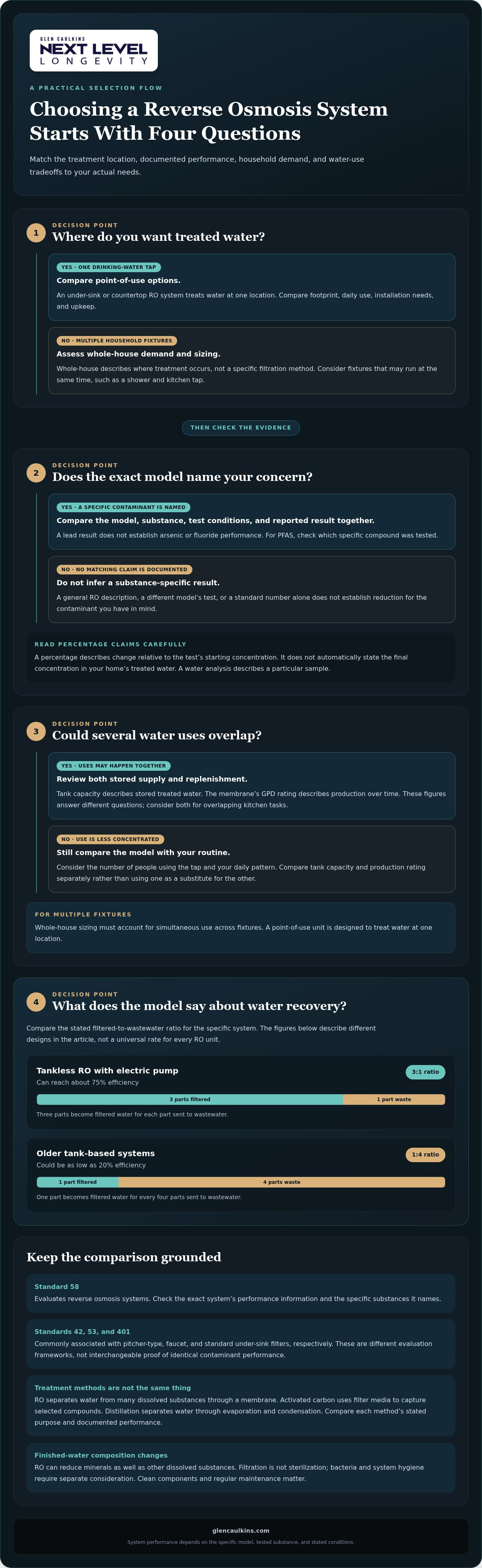
What are the NSF/ANSI standards for reverse osmosis water filters? NSF/ANSI Standard 58 evaluates reverse osmosis systems. Standards 42, 53, and 401 are commonly associated with pitcher-type, faucet, and standard under-sink filters, respectively. These standard numbers identify different evaluation frameworks, not interchangeable proof of identical contaminant performance.
Use Standard 58 as a starting point, then look for the exact system’s performance information. A standard number alone doesn’t show which substances the model reduces. For example, if your concern is nitrate, find a nitrate-specific claim for that model. Don’t infer nitrate performance from a general RO description or another system’s results.
Contaminant Reduction Claims
A reduction claim describes a system’s measured performance for a named contaminant under defined test conditions. Read the model name, contaminant, and reported result together. A claim for lead, for example, says nothing by itself about arsenic or fluoride. Likewise, results for one RO system don’t establish the performance of another system with a similar membrane.
Look for test information that identifies the substance and conditions used. A percentage describes a change relative to the test’s starting concentration; it doesn’t automatically tell you the treated water’s final concentration at home. Keep those questions separate. Performance claims help compare tested systems, while a water analysis describes a particular sample.
Reduction of Lead, Arsenic, PFAS, Nitrates, and Fluoride
How effectively do reverse osmosis filters reduce lead, arsenic, PFAS, nitrates, and fluoride? RO systems can reduce these substances, but performance depends on the specific system and contaminant tested. Look for a separate claim for each substance rather than assuming one result applies to all.
Lead, arsenic, nitrate, and fluoride are distinct contaminants. A model’s lead result cannot stand in for its arsenic or fluoride result. PFAS refers to a broad group of compounds, so check which specific compounds a test names. A claim for one PFAS compound does not establish performance for every compound in the group.
Use a simple comparison: match your concern to the named substance, then compare the result for the exact model. If its documentation names nitrate but not fluoride, it offers no specific fluoride result. This keeps each reduction claim tied to evidence, rather than broad assumptions about reverse osmosis.
How Can You Choose A Suitable RO System?
A typical US family uses more than 300 gallons of water each day, according to Glen B. Caulkins. Start by deciding whether treatment should serve a drinking-water tap or multiple household fixtures.
Tank Capacity and Filtered-Water Flow
A storage tank holds treated water for use at the tap. Its capacity describes the stored supply, while the membrane’s production rating describes how quickly the system makes more water. These figures answer different questions. Consider a kitchen where someone fills a pot while another person draws drinking water.
Compare tank capacity with your household’s daily routine and the number of people using that tap. A larger stored supply can help during periods of concentrated use, while the system’s production rate affects how quickly it replenishes. Review both figures in the exact model’s specifications rather than treating one as a substitute for the other.
Production Capacity and Whole-House Sizing
RO production capacity is commonly stated in GPD, or gallons per day. This rating describes production over time, not instant flow from the faucet. System design and incoming water conditions affect output. Compare the GPD rating with your intended use, then consider how stored water supports demand when several kitchen tasks happen close together.
Whole-house sizing involves a different demand pattern. A system supplying several fixtures must account for simultaneous use, such as a shower running while someone uses a kitchen tap. A point-of-use unit treats water at one location. Map which fixtures need treatment and when they may run together before comparing capacity.
Comparing Filtration Approaches
Reverse osmosis separates water from many dissolved substances through a membrane. Activated carbon uses filter media to capture selected compounds. Distillation separates water through evaporation and condensation. Whole-house filtration describes where treatment occurs, not a specific method. The useful comparison depends on which water you want treated and what the system needs to do.
For example, an under-sink RO unit treats water at a kitchen tap, while whole-house treatment serves multiple fixtures. Carbon filtration may be used on its own or as part of a larger treatment arrangement. Compare each approach’s stated purpose and performance claims. Don’t assume different methods address the same substances or household needs.
Water Waste and Recovery Rates
Tankless RO systems with electric pumps can reach about 75% efficiency, or a 3:1 filtered-to-wastewater ratio. Older tank-based systems could have efficiencies as low as 20%, or a filtered-to-wastewater ratio of 1:4. These figures describe different system designs, not one universal rate for every RO unit.
Recovery rate compares filtered water with water sent to waste. A 3:1 filtered-to-wastewater ratio means three parts become filtered water for each part sent away. A 1:4 ratio means one part becomes filtered water for four parts sent away. Compare the stated ratio for the specific model when considering water use.
What is reverse osmosis water filter system?
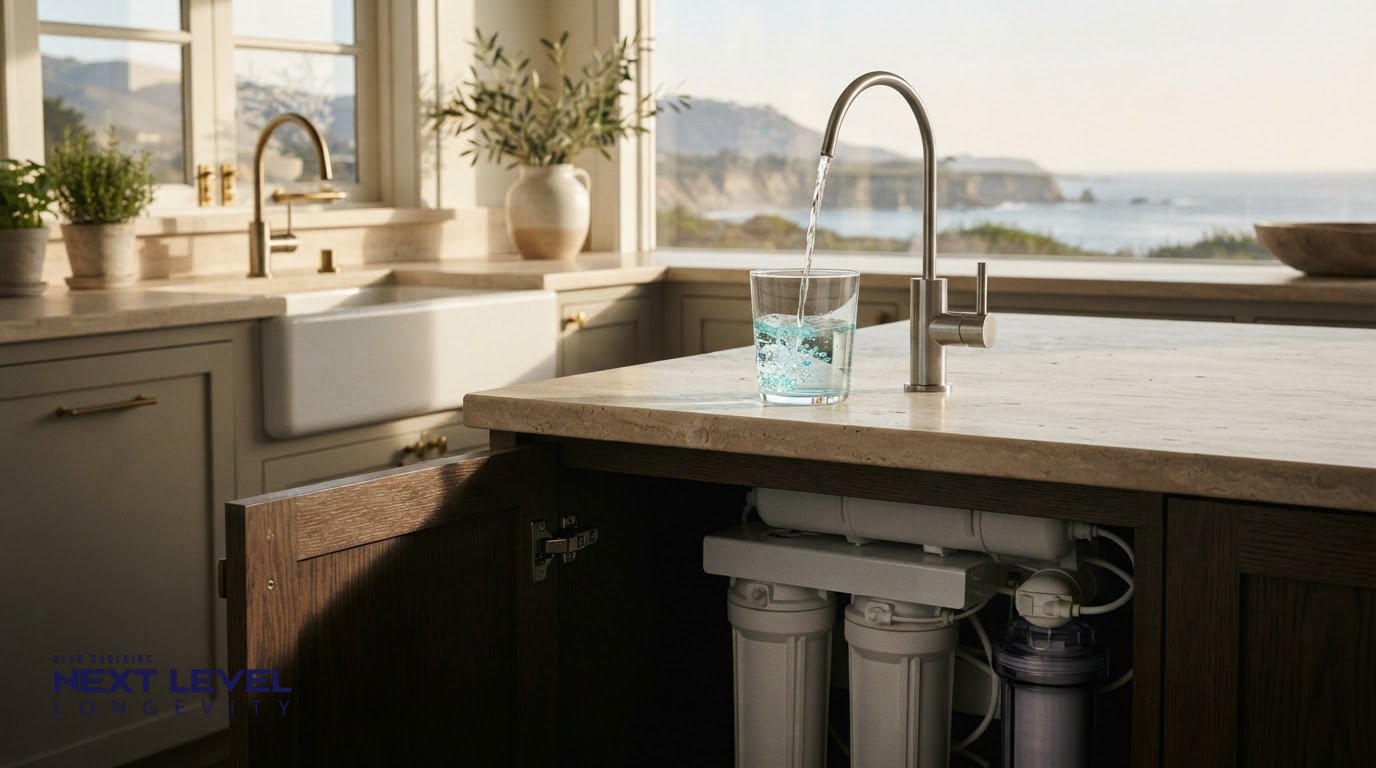
A home RO system can sit beneath a sink or on a countertop. Compare its footprint, daily use, and upkeep before choosing.
Undersink and Countertop System Options
An under-sink unit keeps its treatment components below the counter and supplies a designated drinking-water tap. It can suit a kitchen where you want treated water without equipment taking up work-surface space. Check cabinet dimensions, plumbing access, and whether the planned faucet arrangement fits the sink.
A countertop system occupies space beside the sink and may suit renters or households that prefer a less permanent setup. Connection methods vary by model, so review its instructions before purchase. A small sink area, for example, may make a countertop unit inconvenient, while a crowded cabinet may make an under-sink unit harder to maintain.
Purchase and installation costs depend on the system, included components, and work required for the existing sink and plumbing. Installation scope is a major cost factor, so the total is determined after a quote request. Compare the full setup, not just the filtration unit.
Some RO products advertise cloud-connected features. Assess those separately from water treatment. A connected display may provide system-status information if the model includes it, but connectivity alone says nothing about contaminant performance. Read the product’s stated functions and test documentation as separate parts of the decision.
Pump noise depends on system design and equipment location. If a model uses an electric pump, consider whether it will operate inside a cabinet near a living or sleeping area. Review the listed pump details and installation guidance rather than assuming all systems sound alike. The physical location can affect how noticeable operation is.
Replacement schedules differ by system and component. Follow the model’s instructions for prefilters and membranes, since parts may have different service intervals. Replacement costs depend on the specific parts and model; a quote request determines the relevant amount. Keep the model name and part details together when planning maintenance.
Alkaline and Remineralizing Systems
Some systems add a remineralizing stage after membrane treatment. This changes the finished water’s mineral composition and may affect its taste. Compare the listed minerals and the stage’s stated purpose, rather than treating “alkaline” as a complete description of the water.
A pH reading describes acidity or alkalinity; it doesn’t establish a health outcome. If mineral content matters to your choice, consider the specific added minerals and the water composition you want. The right fit depends on your treatment goals and taste preference, not an alkaline label alone.
Under-sink installation requirements
An under-sink RO system needs a suitable water connection, a drain route, and room for its components. Before installation, compare the exact model’s instructions with the plumbing and cabinet layout beneath your kitchen sink.
Start by clearing the cabinet and identifying the cold-water supply, sink drain, and available outlet. Many systems connect to the cold-water line, send wastewater to the drain, and deliver treated water through a dedicated faucet. The model’s installation guide shows which connections it uses and where each tube belongs.
Measure the cabinet space before placing a storage tank or filter assembly. Leave room to reach the shutoff valve, replace cartridges, and inspect connections. A narrow cabinet crowded with cleaning supplies may make routine filter changes awkward. Keep the system accessible rather than fitting it behind stored items.
Next, check the faucet arrangement. Some installations use a separate drinking-water faucet, which needs a suitable opening in the sink or countertop. If there’s no spare opening, account for that in the installation plan. An air-gap faucet, when specified by the system, also needs its designated drain connection.
The drain line carries concentrated wastewater away from the membrane. Follow the supplied instructions for routing and securing it to the drain assembly. Avoid sharp bends or loose connections, which can restrict flow or cause leaks. Keep the line separate from the treated-water tubing so each connection remains easy to identify.
Some RO units include an electric pump, while others operate without one. If your selected model requires power, locate an appropriate outlet and route the cord without pinching it behind the cabinet. Keep electrical components clear of drips and plumbing joints. The product instructions specify the required setup.
Use this installation sequence as a planning check:
- Identify the cold-water connection and the system’s shutoff point.
- Confirm space for the filters, storage tank, tubing, and service access.
- Plan the faucet opening and wastewater route before connecting parts.
- Follow the model’s tubing diagram and secure each connection as directed.
- Run the system as instructed, then inspect every joint for leaks.
After setup, check beneath the sink while the system is operating and again after water has collected in the tank. A dry cabinet at first use doesn’t replace a later inspection. Look for moisture around the supply adapter, filter housings, faucet tubing, and drain connection.
Keep the installation manual with the system. It identifies the correct filter arrangement, replacement steps, and any model-specific flushing instructions. If a connection differs from the diagram, pause before cutting tubing or altering plumbing. The exact system design, sink materials, and existing connections determine the installation details.
RO water health and mineral content
Reverse osmosis changes water composition as well as reducing selected contaminants. The practical questions are what remains, what the process removes, and how those changes fit your drinking-water preferences.
A membrane can reduce dissolved minerals, including calcium and magnesium. It also changes the amount of bicarbonate and other dissolved constituents in finished water. The specific composition depends on the source water and treatment stages. As a result, RO water from one system may differ from water produced by another.
Minerals in drinking water are one part of a broader picture. Foods such as leafy greens, beans, nuts, and dairy products also contain minerals. Water’s contribution varies with its original composition and treatment. This distinction matters: judging a water system only by mineral content overlooks its contaminant-reduction purpose, while judging it only by removal overlooks the finished water’s composition.
Some systems include a remineralizing stage after the membrane. It adds selected minerals to treated water and can change its taste and chemistry. Check which minerals the stage adds and how the system describes its finished water. “Alkaline” isn’t a complete description of mineral composition, and a pH reading alone doesn’t establish a health benefit.
For a clearer comparison, consider the water before and after treatment. A laboratory analysis can show the measured constituents in a sample, while a system’s performance information describes tested contaminant claims. These answer different questions. For example, a lower total dissolved solids reading doesn’t identify which individual substances account for the change.
Use these distinctions when weighing a system:
- Contaminants: Match each concern to the system’s named reduction claim.
- Minerals: Consider calcium, magnesium, and bicarbonate in the source and finished water.
- Taste: Compare plain RO water with water treated by a remineralizing stage.
- Evidence: Separate measured water chemistry from claims about health outcomes.
Properly treated RO water isn’t inherently dangerous because it contains fewer dissolved minerals. The useful takeaway is more specific: understand the water’s composition, the system’s tested purpose, and whether you prefer a remineralizing stage. These are separate decisions, not a single verdict on whether RO water is “good” or “bad.”
Glen B. Caulkins has a commercial interest in water treatment through PristineHydro. Readers can explore his research on water chemistry alongside the distinctions between contaminant reduction, mineral content, and broader health claims.
Glen B. Caulkins: Under-Counter Water Revival System
The Under-Counter Water Revival System is a practical option for households seeking a dedicated kitchen drinking-water system. Its reverse osmosis and dual deionization filtration is followed by remineralization with minerals such as magnesium and calcium bicarbonate. It’s suited to home use, rather than a travel setup.
Consider it after weighing your water goals, available cabinet space, faucet arrangement, and willingness to maintain filters. The system reflects Glen B. Caulkins’s broader interest in water chemistry and finished-water composition. Its suitability depends on how its documented features align with your household’s needs.
If portability matters more, the Travel-Portable Water Revival System serves a different use case. For a closer look at PristineHydro’s water offerings, explore the product information. You’re welcome to visit glencaulkins.com to continue exploring.
Choose the next step that fits your water routine
The most useful system fits the water you want to treat and the way you use it. Before deciding, consider which point of use matters most, how you want the finished water to taste, and what maintenance you can keep up with. That gives reverse osmosis water filtration a practical context beyond the equipment itself.
Glen B. Caulkins offers the Under-Counter Water Revival System, Travel-Portable Water Revival System, and Aqualux all-in-one filter with shower head. These options suit different settings, so start with your priorities rather than assuming one solution fits every need. Glen’s interest in water also connects treatment choices with mineral composition and the broader chemistry of daily life.
If you’re ready to explore a system or learn more about Glen’s work, contact Glen B. Caulkins. Take the next step at your own pace, guided by the questions that matter in your home.
Frequently Asked Questions
Can Bacteria Grow In RO Water?
Yes, bacteria can grow in stored RO water or system components if contamination enters after treatment. The membrane doesn’t make the faucet, storage tank, tubing, or container permanently sterile. For example, a contaminated bottle can introduce microbes to otherwise treated water. Follow the system’s sanitation and maintenance instructions, keep storage containers clean, and avoid leaving water unused for extended periods.
Does Reverse Osmosis Kill Bacteria?
No. Reverse osmosis separates water from some substances; it isn’t a disinfection process that kills bacteria. A membrane may reduce certain microorganisms, but that doesn’t establish that every system produces sterile water. Don’t treat RO filtration as a substitute for disinfection where disinfection is needed. Also consider the pathway after the membrane, including the storage tank, faucet, and container.
Does Reverse Osmosis Remove Salt?
Yes, reverse osmosis can reduce dissolved salts, which is why the process is used for treating water with elevated salinity. The amount reduced depends on the system and its operating conditions. Check performance information for the particular model rather than assuming all RO units produce the same result. If salinity is your concern, an analysis of the source and treated water can clarify the difference.
What Are The Benefits Of RO Water?
RO’s practical benefit is its potential to reduce named dissolved substances at a chosen drinking-water point. Some people also prefer treated water’s taste for drinking or cooking. Neither preference establishes a medical benefit. This guide isn’t health advice and can’t determine what’s in your water. Use your utility’s water report or a laboratory test to understand its composition.
What Makes a Good Whole House RO System?
A suitable whole-house design must match the source water, intended contaminant reductions, and simultaneous demand across household fixtures. Consider peak use, the system’s documented performance, maintenance requirements, and wastewater handling. Residents in Laguna Woods, Newport Beach, Costa Mesa, Laguna Beach, Carlsbad, and Irvine should base decisions on their own water information, rather than assume every address has identical water chemistry.
Why More And More People Are Choosing RO Water?
That trend can’t be established from the system type alone. People may consider RO for a specific water-quality concern, a preference for treated drinking water, or control over water used for cooking. Those reasons vary by household. Start with the question you want treatment to answer, then compare that goal with the system’s documented contaminant claims and practical upkeep.
How does reverse osmosis water filtration work?
Pressure pushes water toward a semipermeable membrane, which allows water molecules through while holding back some dissolved substances. The system separates the flow into treated water and a concentrated reject stream. Other stages may condition water before or after the membrane. The exact sequence varies by model, so its diagram shows how water moves through each component.
What contaminants does reverse osmosis remove, and what does it not remove?
RO systems can reduce substances such as lead, arsenic, nitrate, fluoride, and some PFAS, but performance claims apply to specific systems and tested substances. A PFAS claim may name particular compounds, not the entire group. Don’t assume a system removes every contaminant or kills bacteria. Match each concern to the model’s individual claims, and use a water analysis to identify what’s present.
Frequently Asked Questions
Can Bacteria Grow In RO Water?
Does Reverse Osmosis Kill Bacteria?
Does Reverse Osmosis Remove Salt?
What Are The Benefits Of RO Water?
What Makes a Good Whole House RO System?
Why More And More People Are Choosing RO Water?
How does reverse osmosis water filtration work?
What contaminants does reverse osmosis remove, and what does it not remove?
More articles